Loux Brand Guidelines
The Patras soft-drink maker named from a composer’s list.
Aa
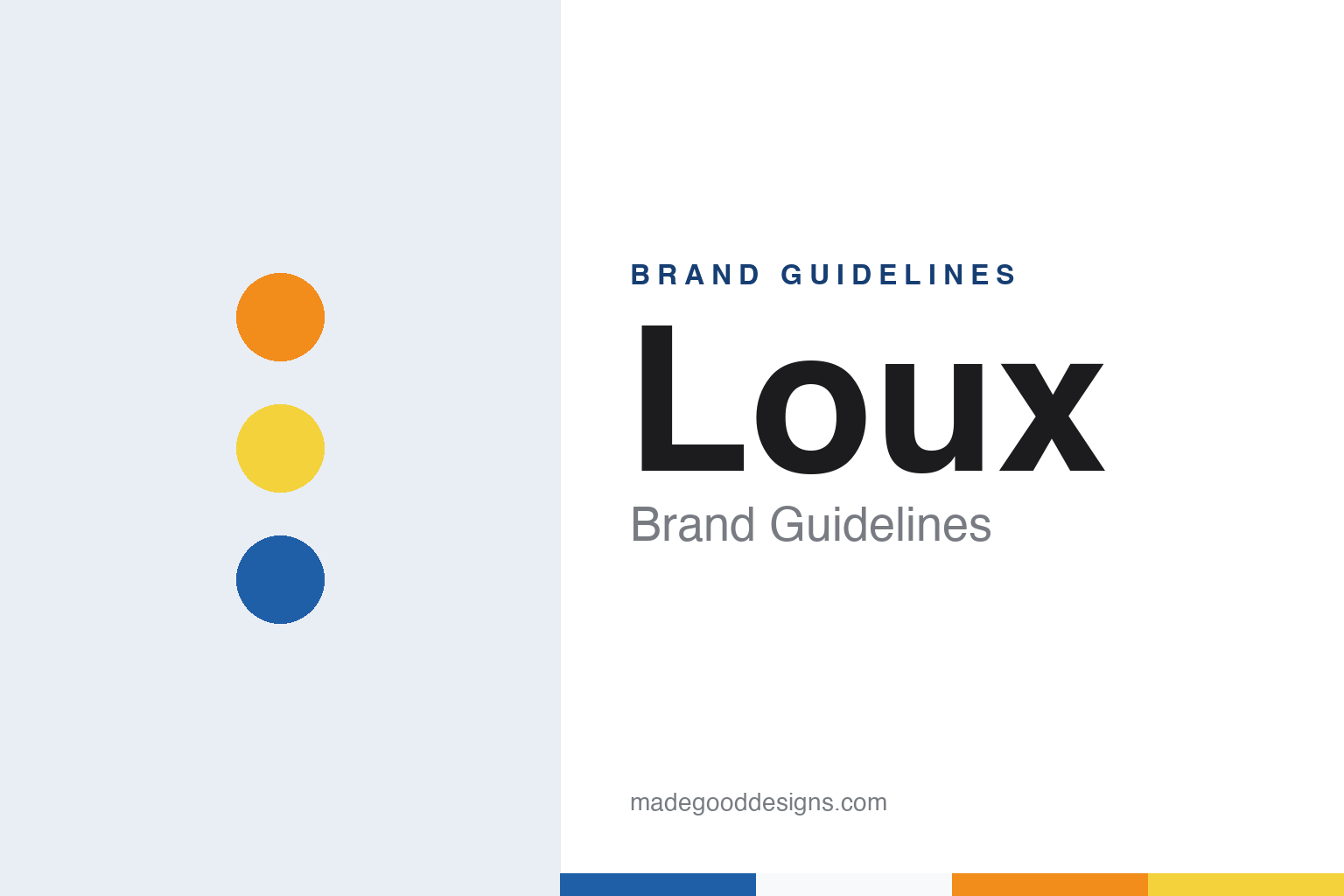
Two constants: an orangeade, lemonade yellow and spring blue palette and a rounded bold sans register. Abstract homage — not a Loux product or mark; no bottle, logo or label is reproduced.
A name from a composer
A small Patras workshop in the year 1950.
Loux — written Λουξ in Greek — comes from Patras, the port city on the northern coast of the Peloponnese. The company says it all began in 1950, when its founder, Panagiotis Marlafekas, set up a small workshop in a fairly cramped space on Pantokratoros Street, in the old town of Patras. English and Greek Wikipedia both give the same founder and year, and Greek Wikipedia lists the company’s full name as “Loux” Marlafekas, a Greek industrial and trading company of the kind known by the initials ΑΒΕΕ.
The Greek history site Mixani tou Chronou, in a 2018 article on the history of soft drinks in Greece, describes the world that Loux entered. In the 1950s, it says, Patras had eleven small soft-drink businesses, and Loux was one of them. Bottling was done by hand, and the drinks — orangeade, lemonade and the clear fizzy drink called gazoza — went out by cart to the cafés and restaurants of the area. Loux began with ten employees and sold everything in glass bottles that were cleaned and reused, eventually reaching about a hundred cases a day, the same article says.
The name did not come from the founder himself. According to Mixani tou Chronou, Marlafekas asked a Patras composer to draw up a list of possible names, and from it he chose the word “lux.” Coming soon after the Greek Civil War, the article says, the word pointed to luxury, or at least to the better life the country needed. Greek Wikipedia, citing the company’s own history page, tells the story the same way — a Patras songwriter and a list of ten candidate names — and credits the same composer as the inspiration for the company’s logo. In its own copy today the company often writes the name in lower case, as “λουξ.”
Colour
The water of Kefalovryso, a Greek cola and an old cherry drink.
The defining move came when Loux left the city. The company says the small Pantokratoros Street unit could no longer keep up with demand, and that this, together with the arrival of the multinational soft-drink companies in Greece from 1967, made it urgent to relocate to Kefalovryso, a spring area outside Patras. Greek Wikipedia and Mixani tou Chronou both date the move to 1972, and Greek Wikipedia says the company began using the local water for its drinks from then on. The start was hard, Mixani tou Chronou reports: at first the new site had no telephone lines and no electricity, and Marlafekas bought second-hand machinery from Germany.
The water became the message. Mixani tou Chronou quotes two of the company’s slogans from those years: “Our quality is the water” and “Loux with Kefalovryso water.” With campaigns of that kind and supplies from local growers, it says, Loux raised output by a thousand cases a day and spread to other Greek cities, and in 1980 it brought out its drinks in plastic bottles for the first time. Greek Wikipedia, in an uncited passage, links the company’s characteristic 330 ml plastic bottle to the same period as the move to Kefalovryso. Today the company says Kefalovryso water is still the base of its drinks.
The range grew around Greek tastes. In 1987 the company launched Loux Cola, which it calls the first Greek cola-type soft drink. In 2004 it brought back vyssinada, a traditional fizzy sour-cherry drink, and the company says it became its second most successful drink. Greek Wikipedia says Loux was the official soft drink of the Greek national football team in 2004–05, and the company says it was the official soft drink of Greece’s presidency of the Council of the European Union in 2014. The plus ’n light range followed in 2016, according to Greek Wikipedia, then a plus ’n light iced-tea line, and in 2026 the company added a range of cocktail mixers.
Typography
Design and documentation.
The seven brands in this group all make food or drink, and all of them come from Portugal or Greece: Compal, Delta Cafés, Pavlides, Misko, Loux, Fage and Kyknos. Food and drink brands in general sit at many different points in the trade, from family firms that still carry a founder’s surname to names that now belong to much larger food groups, and a single brand can be sold everywhere from a corner shop to a supermarket shelf.
A food or drink brand’s identity is usually carried less by a single product than by a pack, a name and the meal or moment it promises, because the company behind the name may have changed hands, moved its factory or grown far beyond the town where it started. That makes the questions behind each name worth asking plainly: who started it, who owns it now, and where its products are actually made and packed.
Each guide separates what independent sources record from what the company says about itself — its founding story, its owners over time, where its products are made and how its packaging has changed — and marks plainly what rests only on the company’s own word.
Aa
A rounded bold sans for a fizzy drink named after luxury. (Specimen set in Rubik, a sans STAND-IN; NOT the Loux logo.)
Loux
A family company in the Peloponnese.
Loux has stayed with the family that founded it. Mixani tou Chronou reported in 2018 that the business passed in 1989 to Panagiotis Marlafekas’s three sons, Ioannis, Konstantinos and Platon; Greek Wikipedia says the founder’s descendants took over the management in the 1990s, when the business also became a public limited company. English Wikipedia names Ioannis Marlafekas as president, and the company names Platon Marlafekas as vice-chairman and head of marketing, who in 2022 collected the “Georgios Avlonitis” marketing award for the company at the Made in Greece awards.
Production has stayed in the Peloponnese. The company says it owns three plants there, covering 33,000 square metres: two at Kefalovryso and Saravali, near Patras, for making and distributing its drinks, and one at Aigio, on the Gulf of Corinth, where it makes its own PET bottles, so that the process runs from raw material to filled bottle in-house. Greek Wikipedia, citing the company’s website as archived in 2011, dates the Aigio plant to 2009. Since 2008 the company has worked with logistics partners around Athens, and since 2016 in Thessaloniki, it says. In 2021, according to the company, it bought a 42.34% stake in Dirfys, a Greek bottled-water company.
Loux describes itself as the largest wholly Greek soft-drink and juice company, and says exports account for more than a tenth of its sales volume, across 22 countries. Its own list of awards includes the Kouros award for growth and innovation in 2009, a Superbrands Corporate Greece title for 2018–19, a “Business and Tradition” award from the Athens Chamber of Commerce and Industry in 2020 and an Export Leaders award in 2021. Greek Wikipedia notes that the company is a long-standing sponsor of the Patras Carnival and supported Patras’s year as European Capital of Culture in 2006. Its website now celebrates 75 years, and its current slogan is “Natural Greek Enjoyment.”
For a design guide, Loux shows how a regional soft drink can build a whole identity on a spring and a short, bright name. Compare Bundaberg, the family-owned Australian soft-drink maker, and Compal, the Portuguese juice brand. For this guide we use an orangeade orange, a lemonade yellow and a spring blue with a rounded sans, an unofficial interpretation; no product or logo is reproduced.
Explore & save
Keep Loux’s identity on hand — save it to a board in the Made Good inspiration library.
Loux identity set
Pin the Loux orangeade, lemonade yellow and spring blue palette and the rounded bold sans register to your own board.