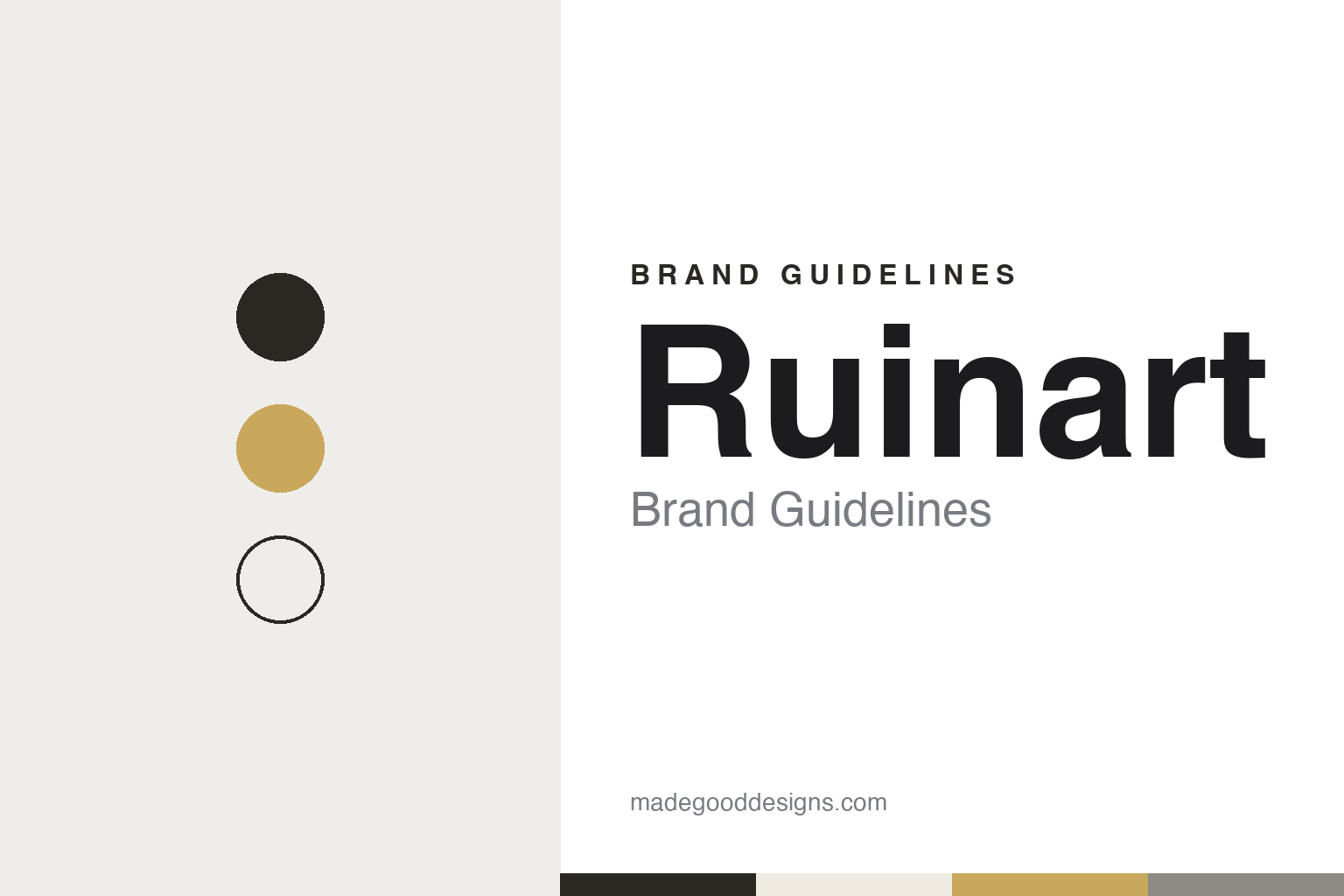
Ruinart Brand Guidelines
The Reims champagne house founded in 1729 above Gallo-Roman chalk pits.
Aa
Two constants: a chalk white, cellar dark and Chardonnay gold palette and a classical serif register. Abstract homage — not a Ruinart product or mark; no bottle, label or logo is reproduced.
A ledger opened in 1729
A cloth merchant, a Benedictine uncle and a royal decree.
Ruinart dates itself to a single day. On 1 September 1729, in Reims, Nicolas Ruinart opened the house’s first account book for wine, and that ledger is what the house and its owner, LVMH, treat as the founding of the business. The company calls Ruinart the first established champagne house, and English, French and German Wikipedia all describe it as the oldest champagne house still trading.
The family were cloth merchants in Reims. The house credits the idea to Nicolas’s uncle, Dom Thierry Ruinart, a Benedictine monk and scholar who, the company says, foresaw a future for the sparkling wine then fashionable at Europe’s courts. Timing mattered too. French and German Wikipedia, citing the oenologist Bruno Duteurtre’s 2010 book on champagne, say a royal decree of 25 May 1728 allowed wine to be transported in bottles; before it, wine could only travel in casks, which made sparkling wine all but impossible to ship.
The first bottles went to the family’s cloth customers, as what French Wikipedia calls business gifts. Sales grew quickly enough that from 1735, French and German Wikipedia say, champagne became the house’s only trade. Rosé followed. A Le Figaro article by the wine writer Bernard Burtschy in 2014, cited by French Wikipedia, says the house’s ledger records a shipment of rosé champagne to Germany on 14 March 1764; the company goes further and calls its 1764 rosé the world’s first rosé champagne.
That same year, according to the French culture ministry’s heritage inventory, Claude Ruinart, Nicolas’s son, set up the firm Ruinart Père et Fils. The company says the family was ennobled in 1817 and took the name Ruinart de Brimont, which French Wikipedia’s history of the family confirms.
Colour
Chalk pits, a rebuilt courtyard and a world heritage listing.
The house’s address is tied to the ground beneath it. The mission that manages Champagne’s world heritage listing says Ruinart settled on the Saint-Nicaise hill in Reims in 1768, after buying land and chalk pits there, and that galleries were dug both then and again between 1830 and 1860. These pits, the crayères, began as quarries; LVMH and the heritage mission both trace them to the Gallo-Roman period. The heritage mission says the tallest measures 38 metres and that the cellar network runs for more than 8 kilometres. The crayères were listed as a historic monument in 1931, according to both the heritage mission and the culture ministry’s inventory.
Above ground, the inventory says the house’s buildings were destroyed in the First World War and rebuilt to the same plan by the architect Thiérot around 1920, and that the complex keeps the classical layout given to it in the 18th century. It also records production rising from 100,000 bottles in 1849 to 350,000 in 1947, and a new building for dressing and packing bottles around 1980. On 4 July 2015 UNESCO added the “Champagne Hillsides, Houses and Cellars” to its World Heritage List, and the Saint-Nicaise hill component names the cellars of Ruinart alongside those of Pommery, Veuve Clicquot and Charles Heidsieck, French Wikipedia’s account of the listing shows.
Ruinart’s ties to art go back to the 1890s. The company says it commissioned the Czech artist Alphonse Mucha to design its first advertisement in 1896. In the early days of flight Ruinart also put its name to a prize for crossing the English Channel by air, which the aviator Jacques de Lesseps won on 21 May 1910, the French site Air Journal recalled in 2012.
Typography
Design and documentation.
The seven brands in this group are all champagne houses: Taittinger, Laurent-Perrier, Krug, Mumm, Lanson, Piper-Heidsieck and Ruinart. Champagne houses in general sit at many different points in the trade, from firms that still carry a founding family’s name to names that now belong to much larger drinks groups, and a single house can be sold everywhere from a wine merchant to a supermarket shelf.
A champagne house’s identity is usually carried less by a single wine than by a label, a name and the occasion its bottles promise, because the company behind the name may have changed hands, bought or sold vineyards or grown far beyond the cellars where it started. That makes the questions behind each name worth asking plainly: who started it, who owns it now, and where its wines are actually made and aged.
Each guide separates what independent sources record from what the house says about itself — its founding story, its owners over time, where its wines are made and how its labels and packaging have changed — and marks plainly what rests only on the house’s own word.
Aa
A classical serif for a house that dates itself to a 1729 ledger. (Specimen set in Cormorant Garamond, a serif STAND-IN; NOT the Ruinart logo.)
Ruinart
From a family house to the Moët group and LVMH.
Ruinart passed out of family hands in the 20th century. The culture ministry’s inventory, written in 1996, says the house was taken over in 1963 by the Moët group, now Moët Hennessy; Dutch Wikipedia says Moët & Chandon bought 80% of the shares that year and that Ruinart has been part of LVMH since 1987, when that group was formed. French Wikipedia says the brand is now run by MHCS, the LVMH company that also holds Moët & Chandon, Krug and Veuve Clicquot, and that the house’s head office is at 4 rue des Crayères, Reims. LVMH says its vineyards lie mainly on the Montagne de Reims and that the house chose Chardonnay as the common thread of its wines; its Blanc de Blancs is made only from that grape. English Wikipedia, citing the wine writer Chris Kissack, dates the prestige cuvée Dom Ruinart to the 1959 vintage and its rosé to 1962.
In 2020 the house introduced what it calls its “Second Skin” case, a paper sleeve moulded to the curve of the bottle that LVMH describes as recyclable. English Wikipedia says the Ruinart bottle takes its shape from the first champagne bottles of the 18th century, and the typeface question is covered separately in What Font Does Ruinart Use?.
The company still works with artists: it says it has run twelve Carte Blanche projects with artists since 2008, among them David Shrigley in 2021, Eva Jospin in 2023 and Julian Charrière in 2025. On 5 October 2024 Ruinart opened a 7,000-square-metre garden at its Reims site, with paths by the landscape designer Christophe Gautrand, a pavilion by the Japanese architect Sou Fujimoto fitted out by the designer Gwenaël Nicolas, and works by around twenty artists including Nils-Udo and Jeppe Hein, the French magazine Numéro reported. LVMH marks the house’s 300th anniversary in 2029.
For a design guide, Ruinart shows how a dated ledger, a chalk cellar and a long run of artists can carry a house from 1729 to today. Compare Krug, its LVMH stablemate, and Taittinger, another Reims house whose cellars are cut into the chalk. For this guide we use chalk white, a cellar dark and a Chardonnay gold with a classical serif, an unofficial interpretation; no product or logo is reproduced.
Explore & save
Keep Ruinart’s identity on hand — save it to a board in the Made Good inspiration library.
Ruinart identity set
Pin the Ruinart chalk white, cellar dark and Chardonnay gold palette and the classical serif register to your own board.