Old Monk Brand Guidelines
Mohan Meakin’s dark rum, launched in 1954.
Aa
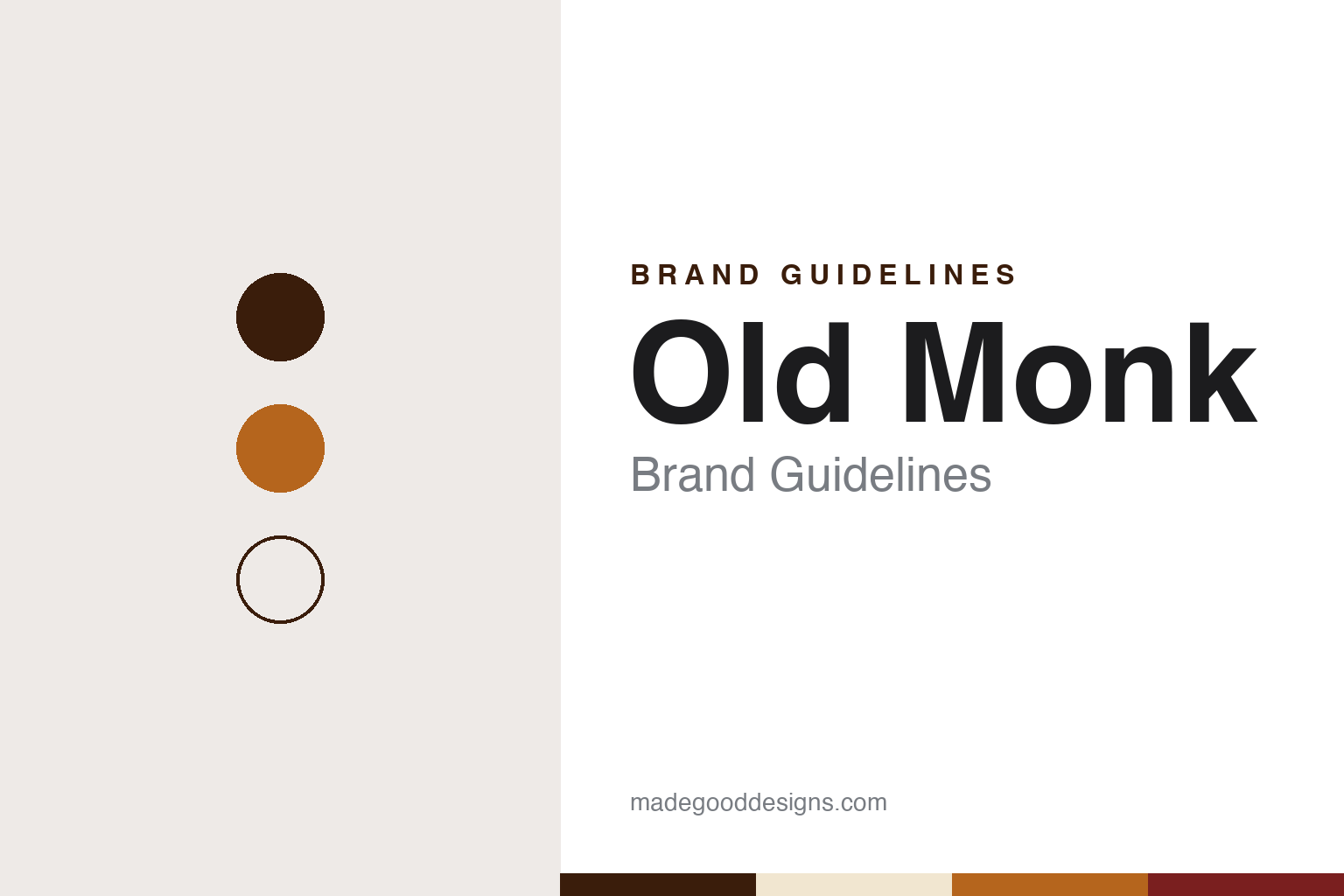
Two constants: a dark rum, cask amber and label cream palette and an old-style book serif register. Abstract homage — not an Old Monk product or mark; no label, logo or bottle is reproduced.
A brewery in the hills
From Edward Dyer’s Kasauli brewery to the Mohan family.
Old Monk is older as a company story than as a rum. Its maker, Mohan Meakin, says on its own history page that it traces itself to a brewery set up at Kasauli, in the hills of what is now Himachal Pradesh, by Edward Dyer in 1855. English Wikipedia says the business was incorporated that year as Dyer Breweries and that its first beer was Lion. Mint on Sunday told the same opening in April 2016: an entrepreneur spotted demand for cheap beer among the British and built a brewery at Kasauli that, after changing hands, became the distillery business of Mohan Meakin.
A second brewing name joined the first. The company says H. G. Meakin, from a brewing family of Burton-on-Trent where he trained, founded Meakin & Co. and bought the old Simla and Kasauli breweries; English Wikipedia, citing the historian Harish Damodaran’s India’s New Capitalists (2008), dates his purchase of the Shimla and Solan breweries to 1887. The two firms traded separately until after the First World War, when they joined as Dyer Meakin. Brewing was moved to Solan, which the company says was chosen for its spring water, while Kasauli kept its malting and became a distillery. In 1937 the Indian business was restructured as Dyer Meakin Breweries, a company listed in London, English Wikipedia says.
The Mohan family came after independence. According to English Wikipedia, citing Damodaran, Narendra Nath Mohan raised funds, travelled to London and bought a majority stake, taking over management in 1949; he built new breweries at Lucknow, Ghaziabad and Khopoli, and the company was renamed Mohan Meakin Breweries in 1967. The word “brewery” was dropped in 1982 to show the company did more than make beer — it had moved into breakfast cereals, fruit juices and mineral water under Kapil Mohan in the 1970s. The settlement that grew around the Ghaziabad works is called Mohan Nagar, and the company’s site still lists Solan, Kasauli, Mohan Gram, Mohan Nagar and Lucknow among its branches.
Colour
A rum named for monks, and a face on the bottle.
English Wikipedia describes Old Monk as a vatted Indian dark rum launched in 1954, with a vanilla note, aged in oak and bottled at 42.8 per cent alcohol. Credit for creating it has been corrected in print. Business Today, writing in January 2018, said the obituaries of chairman Brigadier Kapil Mohan had made one error: the rum was the work of his elder brother, Colonel Ved Rattan Mohan, a Rajya Sabha member, two-term mayor of Lucknow and chairman of India’s film certification board. The magazine said the Colonel launched it after a visit to Europe, where he was impressed by the Benedictine monks and the liqueurs they made, and that the name was his tribute to them; the Colonel took over the company from his father in 1969, and Kapil Mohan took charge in 1973.
The face on the bottle is not a portrait of any monk. Business Today said the jolly face of a tubby man on the label is believed to be that of H. G. Meakin, the brewer who bought into the business in 1887. The magazine said the rum is matured in oak vats for seven years and infused with spices.
The bottle has its own history. Business Today reported that Old Monk first came in long bottles, until the Colonel, impressed by the crinkled, short-necked bottle of Old Parr whisky, adopted that shape. The makers of Old Parr took Mohan Meakin to court; the magazine said the two companies agreed that Old Parr would keep its dark bottle and Old Monk would move to the clear glass still in use. Mint in 2016 called it the brand’s “trademark squat bottle.” English Wikipedia says the older Supreme expression comes in a glass bottle shaped as a monk figure, and The Legend in one shaped as a monk’s head.
Old Monk built that recognition with little advertising. English Wikipedia, citing CNN Travel in 2011, says the company does none and relies on word of mouth. A company director, Vinay Mohan, told Mint in 2016 that it does not do surrogate advertising because it does nothing not permitted by the law of the land.
Typography
Design and documentation.
The seven brands in this group are all Indian and Japanese spirits names: Old Monk, McDowell’s, Royal Stag, Officer’s Choice, Blenders Pride, Hibiki and Nikka. Spirits brands in general sit at many different points in the trade, from houses that still carry a founder’s name to labels that now belong to much larger drinks groups, and a single brand can be sold everywhere from a corner shop to a hotel bar.
A spirits brand’s identity is usually carried less by a single bottle than by a label, a name and the story it tells, because the company behind the name may have changed hands, moved its production or grown far beyond the place where it started. That makes the questions behind each name worth asking plainly: who started it, who owns it now, and where its whisky or rum is actually distilled, blended and bottled.
Each guide separates what independent sources record from what the company says about itself — its founding story, its owners over time, where its spirits are made and how its labels have changed — and marks plainly what rests only on the company’s own word.
Aa
An old-style serif for a rum that grew up in a brewery. (Specimen set in Libre Caslon Text, a serif STAND-IN; NOT the Old Monk logo.)
Old Monk
A market leader, a rival and a long family hold.
For decades Old Monk led its market. Mint on Sunday reported in April 2016, citing International Wine and Spirit Research data, that it was the single biggest brand in India’s whole branded-spirits market until 2002, ahead of whisky as well as rum, and that in the early 1990s it could be found in bars abroad. English Wikipedia, citing the Times of India in 2015, says it overtook Hercules rum in favour among the Indian armed forces.
The rivalry that ended that run came from McDowell’s. Mint said McDowell’s No.1 Celebration rum had passed Old Monk by 2005 and had pulled far ahead by 2013–14, according to Euromonitor International; it also reported that by 2008 Radico Khaitan’s Contessa had replaced Old Monk as the top seller in army canteens. The paper described how state liquor policies, distribution and a shift towards pricier whiskies had all weighed on the brand, while company director Vinay Mohan said the company was growing in several states.
The family’s hold has stayed firm. Mint reported that the company had held talks with brewers including SABMiller, which the company confirmed, without a deal. Kapil Mohan was chairman until his death, which Business Today reported in January 2018. Mohan Meakin is a listed company; its site gives its registered office at the Solan Brewery and its works at Mohan Nagar, Ghaziabad, which English Wikipedia names as where Old Monk is produced. The company now lists a dozen Old Monk rums, among them XXX, Gold Reserve, Supreme and The Legend, alongside whiskies, gins and beers such as Golden Eagle and Lion.
The name needs some care online. Old Monk is also the title of a 2022 Indian film, and some sites that use the name are distributors or price sites rather than the maker; Mohan Meakin’s own site is mohanmeakin.com.
For a design guide, Old Monk shows how a name, a borrowed bottle shape and a face on a label carried an Indian rum for seven decades with little advertising behind it. Compare McDowell’s, the United Spirits name whose Celebration rum overtook it, and Kingfisher, the Bangalore lager that English Wikipedia says took the top place in Indian beer from Mohan Meakin’s Golden Eagle in the 1980s. For this guide we use dark rum brown, cask amber and label cream with a serif, an unofficial interpretation; no product or logo is reproduced.
Explore & save
Keep Old Monk’s identity on hand — save it to a board in the Made Good inspiration library.
Old Monk identity set
Pin the Old Monk dark rum, cask amber and label cream palette and the old-style book serif register to your own board.