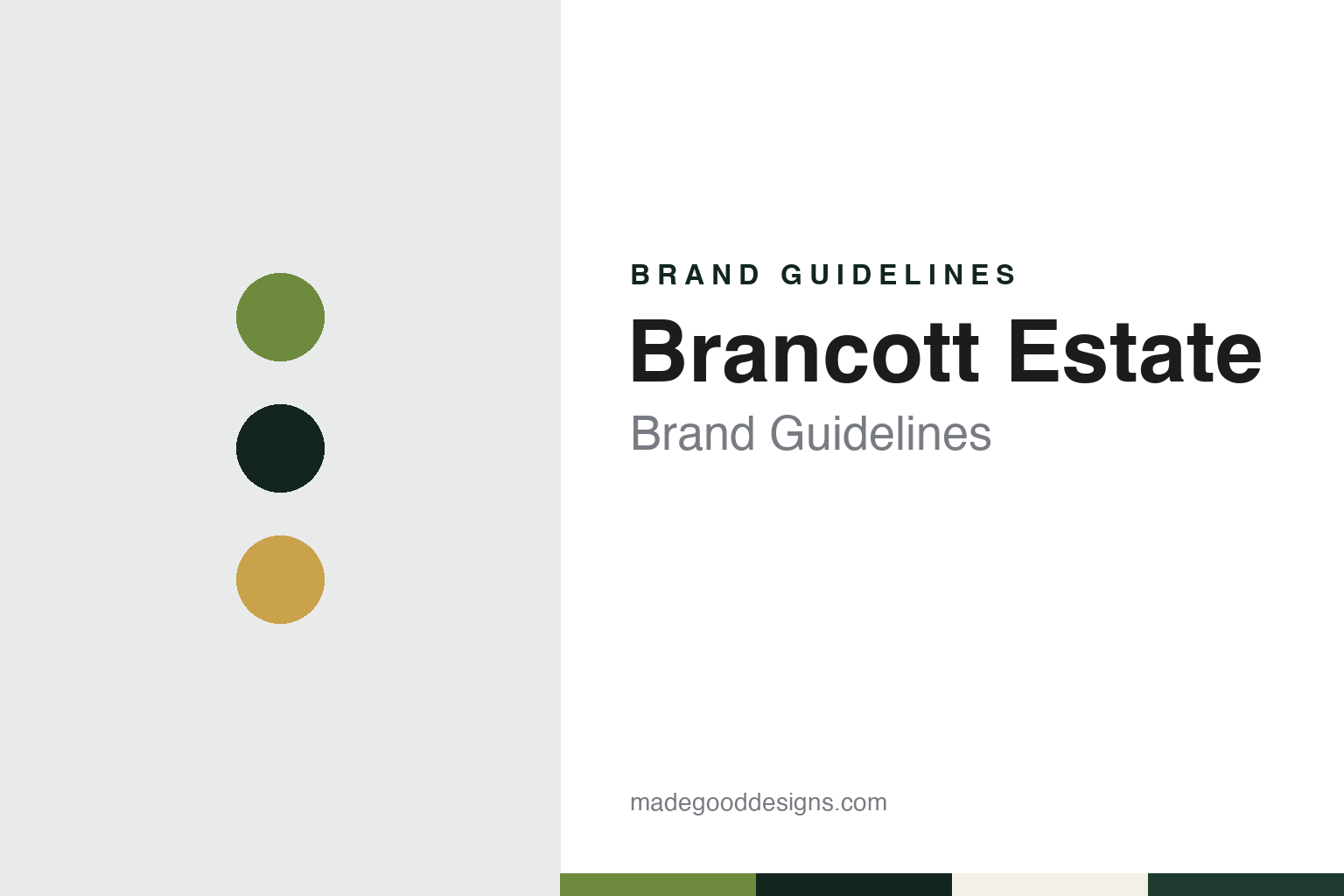
Brancott Estate Brand Guidelines
Montana’s Marlborough vineyard, planted in 1973.
Aa
Two constants: a vine green, Wairau green and mountain gold palette and a clean grotesque sans register. Abstract homage — not a Brancott Estate product or mark; no label, logo or bottle is reproduced.
From Titirangi to Marlborough
A Croatian family’s winery and a bet on the South Island.
Brancott Estate began as Montana. English Wikipedia says the business was founded by Ivan and Amanda Yukich, Croatian immigrants who planted their first vines in 1934 at Titirangi, west of Auckland, and that two of Ivan’s sons set up the company Montana Wines in 1961. English Wikipedia says its Tamaki winery in Auckland opened in 1975.
The decisive move came in the South Island. New Zealand Winegrowers, the industry body, says that on 24 August 1973 the Brancott Vineyard, near Blenheim, became the first site in Marlborough to be planted with vines, beginning the region’s wine industry. The planting was led by Frank Yukich, Ivan’s son, whose remark that “wines from here will become world-famous” the industry body quotes; the wine writer Jamie Goode reported in 2011 that Yukich had bought the land without his board’s approval, and that a monument to him now stands at the estate.
Sauvignon Blanc came slightly later. New Zealand Winegrowers says some of the original vines, unsuited to the cool nights and dry summers, were replaced with Sauvignon Blanc and Pinot Noir in 1975, and that the first Marlborough Sauvignon Blanc was released in 1979; Drinks International and the Morning Advertiser both reported in 2010 that the first Sauvignon Blanc in Marlborough was planted on the Brancott estate in 1975. English Wikipedia says the Brancott winery itself opened in 1977. The industry body also notes that Queen Elizabeth II visited the vineyard in 1989.
Colour
One name for every market.
For three decades the wine travelled under two names. English Wikipedia says the Brancott name was used in the United States to avoid confusion with the American state of Montana, while the rest of the world knew the brand as Montana.
In June 2010 the owner, Pernod Ricard, announced that the split would end. Drinks International reported on 22 June 2010 that the change from Montana to Brancott Estate would be rolled out globally from September 2010, with the 2010 vintage, quoting Fabian Partigliani, managing director of Pernod Ricard New Zealand, and linking the announcement to the brand’s sponsorship of the Rugby World Cup held in New Zealand in 2011. The company said consumer research had shaped the decision. New Zealand Winegrowers dates the completed relaunch to 2011.
The changeover was handled as a design transition. The Morning Advertiser reported in June 2010 that the first Brancott Estate bottles would keep features shoppers associated with Montana, including the gold mountain logo and the label design, and that a Montana sticker and neck collar would explain the change. It quoted Lee James of Pernod Ricard UK as saying consumers felt the Brancott Estate story “added heart and soul to the brand.”
The Montana name did not disappear entirely: English Wikipedia says a Montana range is still sold in New Zealand. Around the estate the brand has tied itself to conservation. New Zealand Winegrowers says Brancott Estate became a founding sponsor of the Marlborough Falcon Trust in 2010, which works to restore the native kārearea, and a founding member of Sustainable Winegrowing New Zealand in 1997.
Typography
Design and documentation.
The seven brands in this group are all wine and spirits names: Torres, Osborne, Fundador, Ypióca, Blandy’s, Brancott Estate and Villa Maria. Wine and spirits brands in general sit at many different points in the trade, from family houses that still carry a founder’s name to labels that now belong to much larger drinks groups, and a single brand can be sold everywhere from a corner shop to a restaurant list.
A wine or spirits brand’s identity is usually carried less by a single bottle than by a label, a name and the place it promises, because the company behind the name may have changed hands, moved its production or grown far beyond the place where it started. That makes the questions behind each name worth asking plainly: who started it, who owns it now, and where its wine or spirit is actually made and bottled.
Each guide separates what independent sources record from what the company says about itself — its founding story, its owners over time, where its wine or spirit is made and how its labels have changed — and marks plainly what rests only on the company’s own word.
Aa
A clean grotesque sans for a vineyard name. (Specimen set in Libre Franklin, a sans-serif STAND-IN; NOT the Brancott Estate logo.)
Brancott Estate
From Montana to Allied Domecq, Pernod Ricard and Vinarchy.
Ownership changed several times as the company grew. English Wikipedia says Montana bought Corbans Wines in 2000, and that in 2001 the British drinks group Allied Domecq took over Montana after outbidding Lion Nathan. When Pernod Ricard bought Allied Domecq in 2005, the New Zealand wineries passed to the French group, which in 2010 sold the Lindauer and Corbans brands to a partnership of Lion and Indevin, English Wikipedia says.
The latest handover came in 2025. Pernod Ricard announced on 29 April 2025 that it had completed the sale of its portfolio of strategic international wines to Australian Wine Holdco Limited, the owner of Accolade Wines, effective 30 April 2025; the New Zealand brands in the deal were Brancott Estate, Stoneleigh and Church Road, alongside Jacob’s Creek in Australia and Campo Viejo in Spain. The Drinks Business and Drinks International reported that the combined business was named Vinarchy, and the New Zealand trade site Drinksbiz reported that Vinarchy’s brands in the country include Stoneleigh, Brancott Estate and Mud House.
One detail of the brand’s history depends on which source is read: the 1973 date belongs to the first planting at Brancott, while the industry body and the 2010 trade reports date the first Sauvignon Blanc vines there to 1975.
For a design guide, Brancott Estate shows how a brand can trade a mountain for a vineyard name and still carry its gold emblem across the change, putting the place where Marlborough wine began at the centre of its story. Compare Villa Maria, the Auckland-founded New Zealand winery, and Jacob’s Creek, its Australian stablemate under the same owner. For this guide we use vine green, Wairau green and mountain gold with a sans, an unofficial interpretation; no product or logo is reproduced.
Explore & save
Keep Brancott Estate’s identity on hand — save it to a board in the Made Good inspiration library.
Brancott Estate identity set
Pin the Brancott Estate vine green, Wairau green and mountain gold palette and the clean grotesque sans register to your own board.