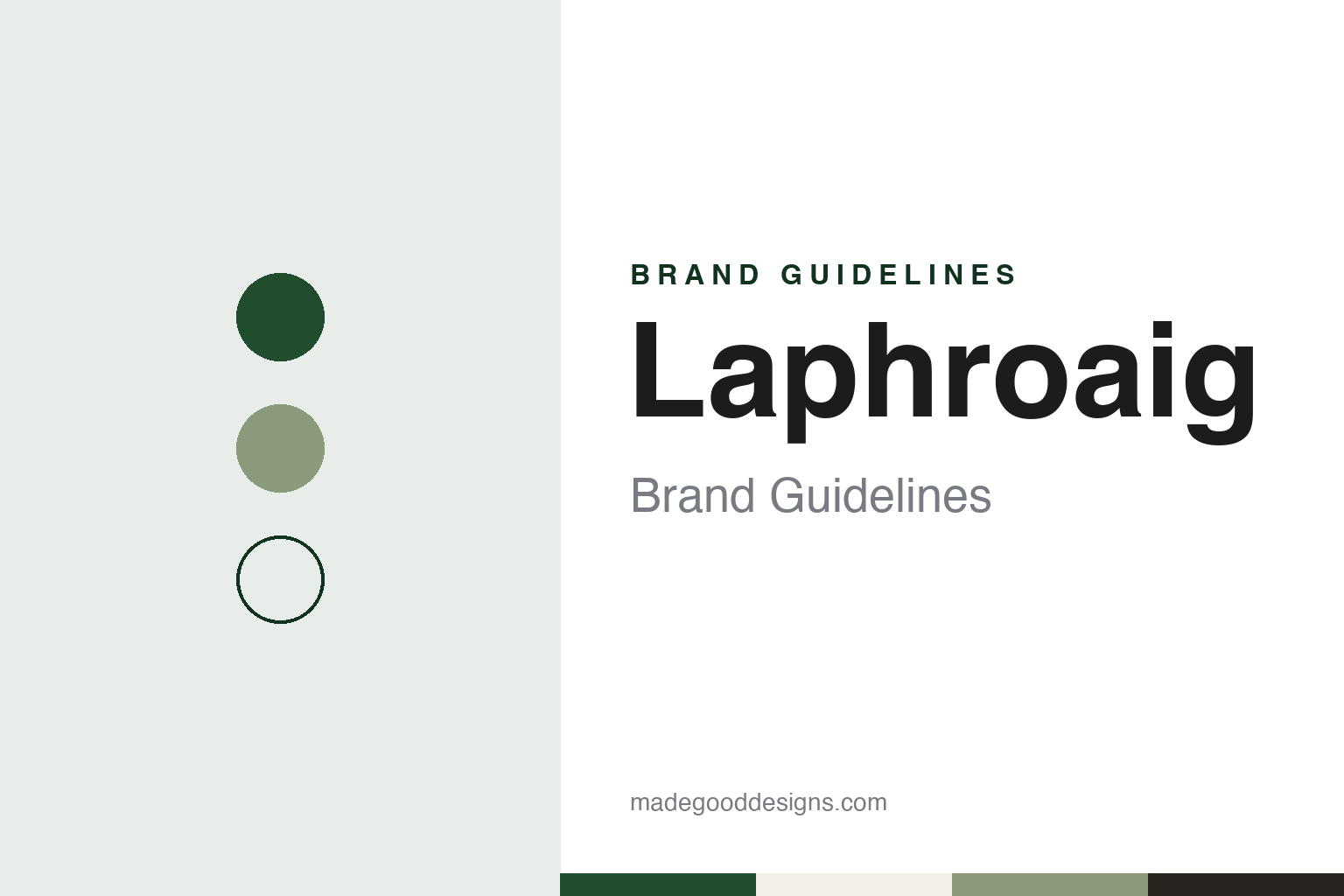
Laphroaig Brand Guidelines
The Islay malt founded by the Johnston brothers in 1815.
Aa
Two constants: an Islay green, moss and warehouse white palette and a bookish transitional serif register. Abstract homage — not a Laphroaig product or mark; no label, crest or bottle is reproduced.
The Johnstons of Laphroaig
Two brothers, a small bay and a family that ran it for more than a century.
Laphroaig is an Islay single malt Scotch whisky, pronounced “la-FROYG.” The distillery stands on the south coast of the island near Port Ellen, at the head of a small bay called Loch Laphroaig, English Wikipedia says, with the Lagavulin and Ardbeg distilleries a short way along the same shore.
It was founded in 1815 by the brothers Donald and Alexander Johnston. English Wikipedia says the Johnstons came from Clan Donald, probably from its MacIain of Ardnamurchan branch, and that the family anglicised its name to Johnston. The family’s line kept running the distillery into the twentieth century. The last of the family line to run it was Ian Hunter, a nephew of Sandy Johnston, English Wikipedia says.
Hunter’s successor is the best-known figure in the distillery’s history. Bessie Williamson, from Glasgow, took a summer job as a shorthand typist at Laphroaig in 1934, English Wikipedia says, citing the Oxford Dictionary of National Biography and Fred Minnick’s Whiskey Women (2013). She became office manager, was running the distillery by the Second World War, and in 1954 the controlling interest in Laphroaig passed from Hunter to her. She is often described as the only woman to own and manage a Scotch whisky distillery in the twentieth century; English Wikipedia’s own article on her also calls her the second woman known to have managed one. She sold a third of the business to Seager Evans in 1962 and the remainder to Long John Distilleries in 1967, and retired as managing director in 1972, English Wikipedia says.
Colour
Peat, small casks and a warrant from the Prince of Wales.
Laphroaig is known for a heavily peated, smoky character, and the company calls it “the most richly flavoured of all Scotch whiskies,” English Wikipedia reports. The distillery still malts part of its own barley: about a tenth, English Wikipedia says, dried over peat cut by hand on Islay. The flagship is the 10 Year Old, bottled at 40 or 43 per cent alcohol depending on the market, and English Wikipedia says a 15-year-old is also common.
In 2004 the distillery introduced Quarter Cask, a whisky first aged in ex-bourbon barrels and then finished in smaller casks, which give the spirit around 30 per cent more contact with the oak, English Wikipedia says. It is bottled at 48 per cent and is not chill-filtered; the company describes the small casks as creating “a soft and velvety edge.”
In 1994 Laphroaig received the Royal Warrant of the Prince of Wales, presented in person during a visit to the distillery, and English Wikipedia says it has been the only whisky to carry that warrant. The distillery refers to Charles by his Scottish title, the Duke of Rothesay. The same year it founded Friends of Laphroaig, a club whose members were granted a lifetime lease of one square foot of Laphroaig land on Islay, with an annual “rent” of a dram to be collected on a visit to the distillery. Several distillery managers are named in its history, among them John Campbell, who ran Laphroaig from 2006 to 2021, and George Campbell, manager since 2024, English Wikipedia says.
Typography
Design and documentation.
The seven brands in this group are all Scotch single malts: Glenmorangie, Laphroaig, Lagavulin, Talisker, Ardbeg, The Dalmore and Highland Park. Single malt brands in general sit at many different points in the trade, from distilleries that still carry a founder’s name to labels that now belong to much larger drinks groups, and a single brand can be sold everywhere from a corner shop to a hotel bar.
A single malt brand’s identity is usually carried less by a single bottle than by a label, a name and the place it promises, because the company behind the name may have changed hands, rebuilt its distillery or grown far beyond the place where it started. That makes the questions behind each name worth asking plainly: who started it, who owns it now, and where its whisky is actually distilled, matured and bottled.
Each guide separates what independent sources record from what the company says about itself — its founding story, its owners over time, where its whisky is made and how its labels have changed — and marks plainly what rests only on the company’s own word.
Aa
A bookish transitional serif for an Islay distillery founded in 1815. (Specimen set in Libre Baskerville, a serif STAND-IN; NOT the Laphroaig logo.)
Laphroaig
From Long John to Suntory Global Spirits.
After the Williamson years Laphroaig passed through a long line of corporate owners. English Wikipedia says the distillery went to Long John International in the 1960s, and that the brewer Whitbread acquired Long John, and with it Laphroaig, in 1973. In 1989 Whitbread sold the distillery, which became part of Allied Domecq. When Pernod Ricard took over Allied Domecq in 2005, it divested Laphroaig to Fortune Brands to win regulatory approval, English Wikipedia says. Fortune Brands split its businesses in 2011, putting its spirits into Beam Inc., and Beam was bought by Suntory Holdings of Osaka in April 2014.
The owner took its current name on 1 May 2024, when Beam Suntory became Suntory Global Spirits, The Drinks Business and The Grocer reported; the company is headquartered in New York and its portfolio also includes Jim Beam, Maker’s Mark, Bowmore and Yamazaki. In February 2025 SLTN reported that Suntory Global Spirits had launched its own UK commercial business, taking over sales and distribution of Laphroaig and Bowmore from its long-standing alliance with Edrington UK.
Laphroaig has made its hard-to-say name part of its marketing. In 2016 the poet Elvis McGonagall appeared in online advertisements reciting verse about how to pronounce it, and that October the comedian Andy Daly read Laphroaig customer reviews aloud for three and a half hours, English Wikipedia says. In 2020 the company revamped Friends of Laphroaig, replacing lifetime membership with a tiered, points-based system from 2021, a change English Wikipedia records. For more on the lettering, see our note on the Laphroaig font.
For a design guide, Laphroaig shows how a difficult name, a strong flavour and a club built on square feet of Islay land can be turned into identity rather than hidden. Compare Lagavulin, its neighbour on Islay’s south coast, and Jim Beam, the Kentucky bourbon in the same Suntory Global Spirits group. For this guide we use Islay green, moss and warehouse white with a serif, an unofficial interpretation; no product or logo is reproduced.
Explore & save
Keep Laphroaig’s identity on hand — save it to a board in the Made Good inspiration library.
Laphroaig identity set
Pin the Laphroaig Islay green, moss and warehouse white palette and the bookish transitional serif register to your own board.