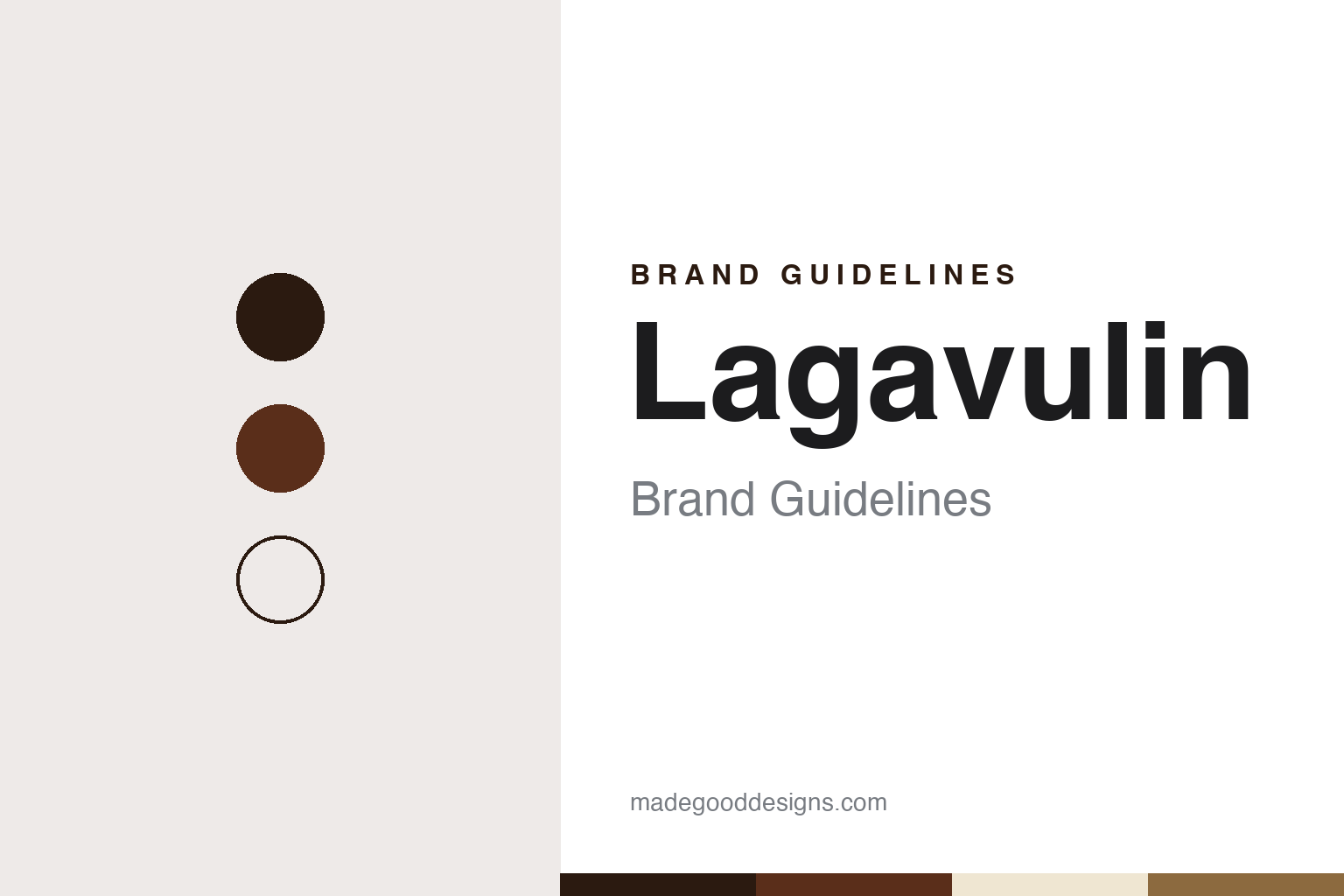
Lagavulin Brand Guidelines
The Islay single malt from the hollow of the mill, since 1816.
Aa
Two constants: a peat smoke, cask brown and Islay sand palette and an old-style serif register. Abstract homage — not a Lagavulin product or mark; no label, logo or bottle is reproduced.
The hollow of the mill
A bay on Islay’s south coast, and two centuries of distilling.
Lagavulin is a single malt Scotch whisky distillery in the village of the same name on the south coast of Islay. English Wikipedia explains the name as an anglicised form of the Scottish Gaelic Lag a’ Mhuilinn, “hollow of the mill.” The distillery is owned by Diageo, the drinks company headquartered in London.
The official story starts in 1816. English Wikipedia says that in that year John Johnston and Archibald Campbell Brooks built two distilleries on the site, and that one became Lagavulin by taking over the other, though which way round is not certain; it adds that records show illicit distilling there, in at least ten unlicensed stills, as far back as 1742. The whisky reference site Scotchwhisky.com dates the start of legal distilling under Johnston to 1816, says the Johnston family bought a second distillery on the site in 1825, and says the two were run as one Lagavulin from 1837.
Ownership then passed through several hands. Scotchwhisky.com says the Glasgow spirit merchant Alexander Graham bought the distillery in 1836, and English Wikipedia describes the Graham family running it and then entering a partnership with James Logan Mackie, who was in charge from 1856. His nephew Peter Mackie joined the firm in 1878 and took control in 1889, Scotchwhisky.com says.
Colour
White Horse, Malt Mill and a 16-year-old.
For much of its history Lagavulin was a blending whisky. Under Peter Mackie the firm, renamed Mackie & Co, built the White Horse blend around Lagavulin; Scotchwhisky.com dates the launch of White Horse in export markets to 1890, and English Wikipedia says the blend earned a Royal Warrant as supplier to King Edward VII in 1908. In 1908 Mackie also built a small replica distillery on the Lagavulin site called Malt Mill, with stills modelled on those of Laphroaig; it closed in 1962, Scotchwhisky.com says. The firm was renamed White Horse Distillers in 1924 and joined the Distillers Company in the 1920s, which became part of Guinness in 1986 and of Diageo in 1997.
The modern single malt is defined by one bottling. English Wikipedia calls the 16 Year Old, bottled at 43% ABV, the standard expression, alongside a Distillers Edition finished in Pedro Ximénez sherry casks and regular 12-year-old cask-strength releases. Lagavulin had been sold as a single malt before, but in 1988 the 16-year-old became one of the six original Classic Malts chosen by United Distillers, with Glenkinchie, Dalwhinnie, Cragganmore, Oban and Talisker. English Wikipedia credits the distillery’s character partly to slow distillation in pear-shaped pot stills, two for the wash and two for the spirit. The 16 Year Old has also done well in competition: English Wikipedia says the San Francisco World Spirits Competition gave it four consecutive double gold medals between 2005 and 2008, and gold medals in later years.
Lagavulin’s bicentenary in 2016 produced a new expression. Scotchwhisky.com reported in March 2016 that a limited 8 Year Old would be released in two waves that year, inspired by the Victorian writer Alfred Barnard, who tasted an eight-year-old Lagavulin in the late 1880s and praised it in The Whisky Distilleries of the United Kingdom; in November 2017 the same site reported that the 8 Year Old was joining the permanent range in markets including the US, Canada, Taiwan and Japan. For the lettering on the bottle, see our note on the Lagavulin font.
Typography
Design and documentation.
The seven brands in this group are all Scotch single malts: Glenmorangie, Laphroaig, Lagavulin, Talisker, Ardbeg, The Dalmore and Highland Park. Single malt brands in general sit at many different points in the trade, from distilleries that still carry a founder’s name to labels that now belong to much larger drinks groups, and a single brand can be sold everywhere from a corner shop to a hotel bar.
A single malt brand’s identity is usually carried less by a single bottle than by a label, a name and the place it promises, because the company behind the name may have changed hands, rebuilt its distillery or grown far beyond the place where it started. That makes the questions behind each name worth asking plainly: who started it, who owns it now, and where its whisky is actually distilled, matured and bottled.
Each guide separates what independent sources record from what the company says about itself — its founding story, its owners over time, where its whisky is made and how its labels have changed — and marks plainly what rests only on the company’s own word.
Aa
An old-style serif for a name with two centuries behind it. (Specimen set in Libre Caslon Text, a serif STAND-IN; NOT the Lagavulin logo.)
Lagavulin
A neighbour’s quarrel, and a television fireside.
Lagavulin sits on a short stretch of coast it shares with two other distilleries, Laphroaig and Ardbeg. Relations with Laphroaig were not always easy: English Wikipedia records several legal battles in the nineteenth century after Peter Mackie leased the Laphroaig distillery, and says he was thought to have tried to copy its style.
Popular culture has also played a part. English Wikipedia says Michael Schur, co-creator of the NBC comedy Parks and Recreation, made Lagavulin the drink of choice of Ron Swanson, played by Nick Offerman, and that the distillery appeared in the show’s sixth season. Offerman later worked with the brand directly. Scotchwhisky.com reported in December 2015 that Lagavulin had released a 45-minute parody of the American Yule Log television broadcast, in which Offerman sits by a fire sipping Lagavulin 16, and English Wikipedia notes an Offerman edition of the whisky.
The distillery also keeps traces of its working past. Scotchwhisky.com says the floor maltings were decommissioned in 1974 and now house the visitor centre and offices. The village name and the distillery name are the same, so searches for Lagavulin can return both; Diageo presents the brand through its malts.com site.
For a design guide, Lagavulin shows how a single age statement, one island and a long blending history can carry a single malt from a south-coast bay to a role in television comedy. Compare Talisker, its fellow Classic Malt from Skye, and The Glenlivet, the Speyside single malt. For this guide we use peat smoke, cask brown and Islay sand with a serif, an unofficial interpretation; no product or logo is reproduced.
Explore & save
Keep Lagavulin’s identity on hand — save it to a board in the Made Good inspiration library.
Lagavulin identity set
Pin the Lagavulin peat smoke, cask brown and Islay sand palette and the old-style serif register to your own board.