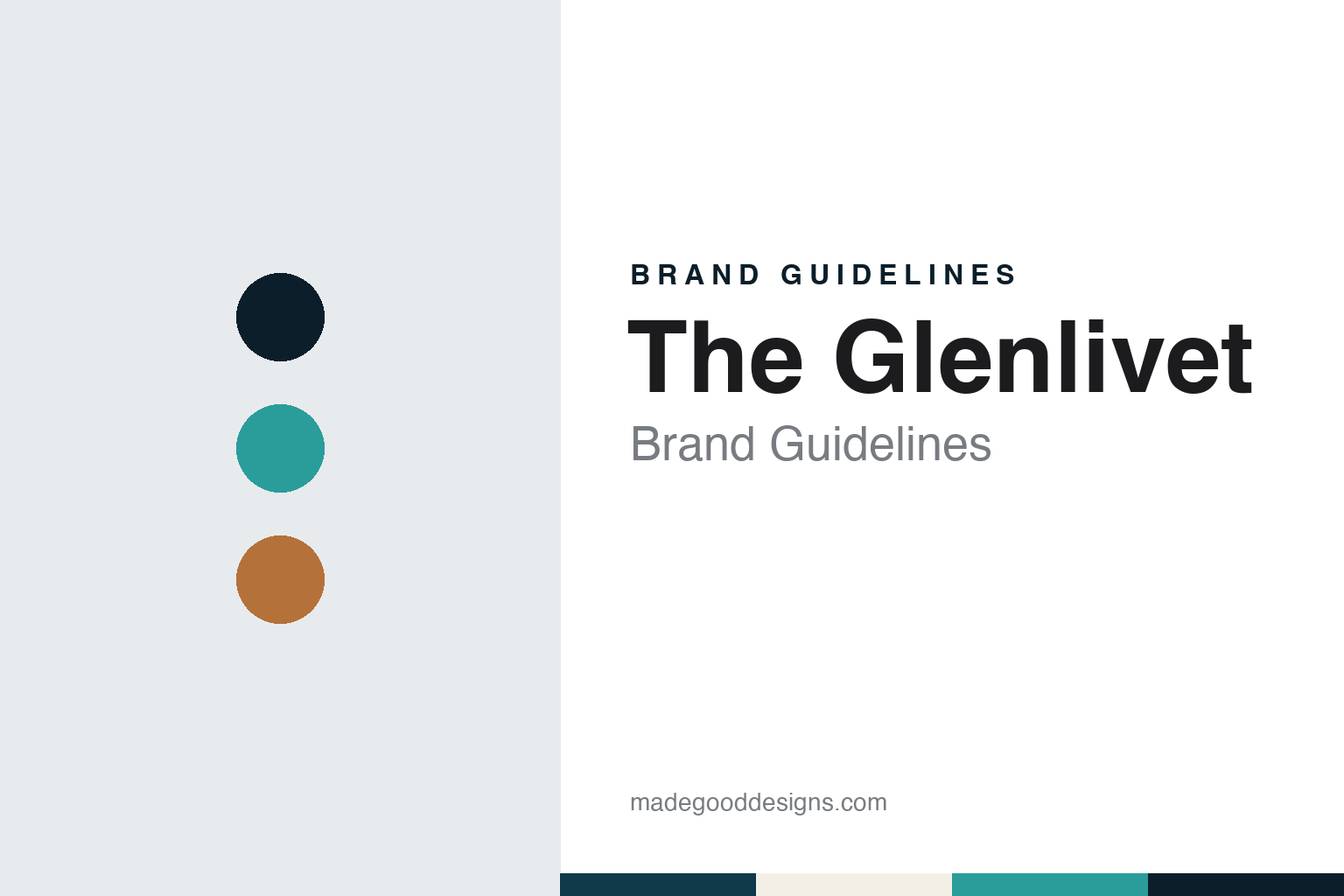
The Glenlivet Brand Guidelines
The Speyside single malt that won its own definite article.
Aa
Two constants: a turquoise, deep teal and copper palette and a high-contrast serif register. Abstract homage — not a Glenlivet product or mark; no bottle, label or logo is reproduced.
A licence in 1824
A farmer-distiller who went legal.
The Glenlivet is a Speyside single malt Scotch whisky made near Ballindalloch, in Moray. Its story begins with the Excise Act of 1823, which allowed distillers to work legally if they held a licence. George Smith, a tenant of the Duke of Gordon who was then running an illicit still on his farm at Upper Drumin, became the first person in Scotland to apply for and receive a licence under the new law, English Wikipedia says, and in 1824 he and his youngest son, John Gordon Smith, established The Glenlivet distillery at Upper Drumin, according to F. Paul Pacult’s A Double Scotch (2005) and Philip Morrice’s Schweppes Guide to Scotch (1983).
The business soon outgrew its site. Smith opened a second distillery, Cairngorm-Delnabo, in 1849, and by the mid-1850s both were running at full capacity. A new and larger distillery was already being built further down the hill at Minmore when the Upper Drumin distillery was destroyed by fire in 1858; production began at Minmore in 1859, and the company George & J.G. Smith Ltd was formed at about the same time, the same sources say. English Wikipedia calls it the oldest legal distillery in the Highlands of Scotland.
Colour
A name defended in court, and a turquoise look.
The brand’s most distinctive design element is a single word: “The.” Whisky from the Smiths’ distillery became so well regarded that other distilleries in the area began calling their products “Glenlivet.” After John Gordon Smith inherited the business in 1871 he took legal action to claim ownership of The Glenlivet name. English Wikipedia, citing Pacult and Morrice, says the verdict was a partial success: other distillers had to stop calling their whisky simply Glenlivet, and Smith and the blender Andrew Usher were given sole use of it, but neighbours were allowed to hyphenate the name onto their own, which produced labels such as Glen Moray-Glenlivet.
The modern packaging is built around colour. When the company relaunched its 21- and 25-year-old whiskies as the Sample Room Collection in 2022, The Spirits Business described the bottle and box as an evolution of the brand’s signature original look, with new tones playing on the brand’s turquoise palette, a copper finish, a deep blue gradient and embossed textures.
The 200th anniversary in 2024 was marked with new artwork. The Glenlivet chose the design for a limited-edition 12-year-old through a crowdsourcing campaign in which emerging artists interpreted the distillery’s motto of “forever moving forwards”; the winner was Studio Berdi of Colombia, The Spirits Business reported in January 2024. In December that year the brand released its own tartan, produced by the Scottish tartan maker Locharran and launched in a United States campaign with the Scottish actor Thomas Doherty, in which the pattern was wrapped around New York taxis, the same magazine reported. In 2023 it launched The Glenlivet Twist & Mix Cocktails, bottles with a Vessl cap that releases flavourings into the whisky when twisted, which The Spirits Business named its most innovative spirit launch of the year. A separate MGD guide looks at the lettering The Glenlivet uses.
Typography
Design and documentation.
The seven brands in this group are all whisky names from Ireland and Scotland: Bushmills, Tullamore D.E.W., Glenfiddich, The Glenlivet, The Macallan, Chivas Regal and The Famous Grouse. Irish and Scotch whisky brands in general sit at many different points in the trade, from names that still carry a founder’s or a place’s name to names that now belong to much larger drinks groups, and a single brand can be sold everywhere from a local bar to an airport shop.
A whisky brand’s identity is usually carried less by a single bottle than by a label, a name and the place it promises, because the company behind the name may have changed hands, moved its production or grown far beyond the place where it started. That makes the questions behind each name worth asking plainly: who started it, who owns it now, and where its whisky is actually made and bottled.
Each guide separates what independent sources record from what the company says about itself — its founding story, its owners over time, where its whisky is made and how its packaging has changed — and marks plainly what rests only on the company’s own word.
Aa
A high-contrast serif for a name that carries its own definite article. (Specimen set in Playfair Display, a serif STAND-IN; NOT The Glenlivet logo or label lettering.)
The Glenlivet
From the Smiths to Seagram to Pernod Ricard.
The Glenlivet left the Smith family through a chain of mergers. In 1953 George & J.G. Smith Ltd merged with J. & J. Grant, owner of the Glen Grant distillery, to form The Glenlivet and Glen Grant Distillers Ltd. That company merged with Hill Thomson & Co. and Longmorn-Glenlivet Distilleries in 1970 and renamed itself Glenlivet Distillers Ltd in 1972, Morrice’s guide says. The Canadian drinks group Seagram bought it in 1977. In December 2000 Pernod Ricard and Diageo agreed to buy Seagram’s drinks business, Diageo announced, and The Glenlivet passed to Pernod Ricard, whose Scotch arm Chivas Brothers it has owned since 2001, English Wikipedia says. When Glen Grant was sold to Campari in 2005, Pernod Ricard kept The Glenlivet, BBC News reported.
The whisky is still distilled at the Minmore site. English Wikipedia says the distillery draws its water from Josie’s Well and nearby springs, and that its lantern-shaped stills with long, narrow necks are part of what gives the spirit its light style, citing Wallace Milroy’s Original Malt Whisky Almanac (1998). An expansion with a new mash tun, washbacks and stills was opened by the then Prince of Wales on 5 June 2010 and raised capacity by about three-quarters. Most of the spirit is sold as The Glenlivet, and the rest goes into Pernod Ricard blends including Chivas Regal and Royal Salute. Bottling took place at the Chivas Brothers plant at Newbridge, near Edinburgh, until that plant was sold at the end of 2009, The Scotsman reported, with the work moved to other company plants.
English Wikipedia, citing a 2007 source, calls The Glenlivet the best-selling single malt in the United States and the second-best-selling in the world after Glenfiddich. The distillery is a stop on Scotland’s Malt Whisky Trail, and in May 2021 barley seeds from it were flown to the International Space Station, Whiskey Raiders reported.
For a design guide, The Glenlivet shows how a defended name and a single colour can hold a single malt together across two centuries and three owners. Compare Glenfiddich, its Speyside rival, and Chivas Regal, its sister brand at Chivas Brothers. For this guide we use turquoise, deep teal and copper with a high-contrast serif, an unofficial interpretation; no product or logo is reproduced.
Explore & save
Keep The Glenlivet’s identity on hand — save it to a board in the Made Good inspiration library.
The Glenlivet identity set
Pin The Glenlivet turquoise, deep teal and copper palette and the high-contrast serif register to your own board.