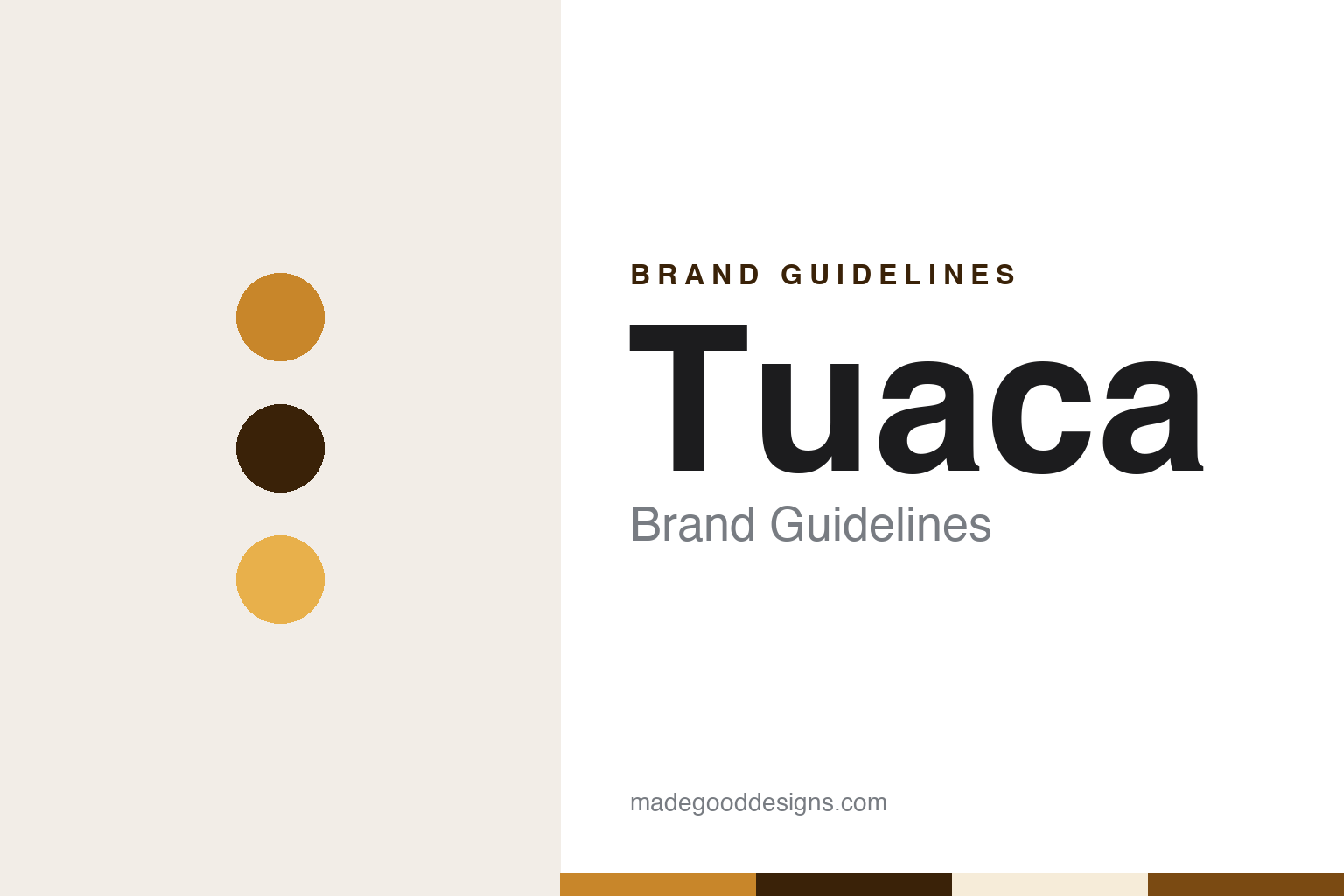
Tuaca Brand Guidelines
The vanilla-citrus brandy liqueur from Livorno.
Aa
Two constants: a brandy amber, toasted vanilla and cellar brown palette and a Renaissance serif register. Abstract homage — not a Tuaca product or mark; no label, logo or bottle is reproduced.
Tuoni and Canepa
A legend, two brothers-in-law and a distillery in Livorno.
Tuaca is a golden-brown Italian brandy liqueur flavoured with citrus and vanilla. Its story begins with a legend. The brand’s website says that, according to legend, the blend was first made to commemorate Lorenzo de’ Medici, “the Magnificent,” who ruled Florence in the 15th century; Italian Wikipedia treats the Renaissance origin as a supposition and the Lorenzo story as legend.
The documented history is Tuscan and 20th-century. Italian Wikipedia and Difford’s Guide give 1938 as the year, in the port city of Livorno, when Gaetano Tuoni and Giorgio Canepa, brothers-in-law, revived the recipe; the brand’s own site says “the 1930s.” Difford’s Guide adds that the company was founded by Alfredo Neri for his two sons-in-law. The firm traded as Tuoni e Canepa.
The name came in stages. Italian Wikipedia, citing the Livorno newspaper Il Tirreno in 2011, says the drink was first sold as “Milk Brandy,” made with milk, brandy and vanilla. When the milk was dropped, the name became Tuoca, joining the first letters of the two family names, TUOni and CAnepa. The spelling later changed to Tuaca to make it easier to pronounce in English, Il Tirreno reported in 2012.
Italian Wikipedia says the distillery stood first on Via Mastacchi in Livorno’s San Marco district and later moved to the Salviano industrial zone. The brand says the brandy at the heart of the blend comes from Anagni, a town east of Rome.
Colour
From soldiers’ kitbags to a winged lion.
Tuaca reached America through people before it reached it through trade. The brand’s site says that American servicemen stationed in Livorno during the Second World War discovered the liqueur and looked for it, without success, when they returned home; English Wikipedia says that from the mid-1940s US troops in Italy brought bottles back with them.
An importer followed. English Wikipedia names him as Mario di Grazia, an Italian who owned a chain of liquor stores in San Francisco, and dates his imports to the late 1950s, as does the brand; Italian Wikipedia, citing Il Tirreno, places the start of his US distribution in the 1960s. The drink found a second following in Britain, where English Wikipedia says the importer Danes Limited introduced it from the mid-1990s and where Time Out and The Argus have described it as a Brighton bar staple.
Under its current owner the brand was redesigned. The Spirits Business reported in May 2017 that Sazerac had given Tuaca a new recipe and a fully redesigned package: a sleeker bottle and a label carrying a winged lion, described as an Italian symbol of strength, chosen to reflect the brand’s Italian heritage. The same report said the liqueur was again made with imported Italian brandy, where the previous owner had used California brandy, infused with Mediterranean citrus and vanilla spice.
The brand’s own description lists vanilla and citrus first, with hints of butterscotch, cola and dried fig, and it presents Tuaca both as a chilled shot and as a base for cocktails. The Spirits Business said Sazerac was promoting it as an ice-cold shot and as an ingredient in hot and cold mixed drinks, and that the relaunched liqueur was on sale in the United Kingdom and Australia as well as in the United States. Its site sets the history out in a few lines: the Medici legend, the Anagni brandy, the two brothers-in-law, the wartime servicemen and the San Francisco importer.
Typography
Design and documentation.
The seven brands in this group are all liqueur and vodka names: Bols, De Kuyper, Hpnotiq, Tuaca, Goldschläger, Pinnacle and Three Olives. Liqueur and vodka brands in general sit at many different points in the trade, from old family distillers that still carry a founder’s name to labels that now belong to much larger drinks groups, and a single brand can be sold everywhere from a corner shop to a cocktail bar.
A liqueur or vodka brand’s identity is usually carried less by a single bottle than by a label, a name and the place it promises, because the company behind the name may have changed hands, moved its production or grown far beyond the place where it started. That makes the questions behind each name worth asking plainly: who started it, who owns it now, and where its liqueur or vodka is actually made and bottled.
Each guide separates what independent sources record from what the company says about itself — its founding story, its owners over time, where its liqueur or vodka is made and how its labels have changed — and marks plainly what rests only on the company’s own word.
Aa
A Renaissance serif for a brand that tells a Florentine legend. (Specimen set in Cormorant Garamond, a serif STAND-IN; NOT the Tuaca logo.)
Louisville
Two Kentucky owners and a closed Livorno plant.
Tuaca left family hands in the 2000s. Brown-Forman, the Louisville, Kentucky, company behind Jack Daniel’s, acquired the brand in 2002, English Wikipedia says. Production in Italy did not last under the new owner: the Livorno plant closed on 31 March 2010, Italian Wikipedia says, citing Qui Livorno and Il Tirreno in 2012, and the brand’s site at the time said the blend was now produced and bottled in the United States by the TUACA Liqueur Company in Louisville.
In January 2016 The Telegraph reported that Brown-Forman was selling Tuaca, together with Southern Comfort, to the American spirits group the Sazerac Company, and The Spirits Business reported that the purchase was completed in March 2016. The brand’s site now describes Tuaca as a registered trademark of the Sazerac Company and its legal line names the Sazerac Company of Louisville, Kentucky, as importer.
The recipe also changed under Brown-Forman: The Spirits Business reported in 2017 that the previous owner had made Tuaca with California brandy, and that Sazerac had returned to Italian brandy. Italian Wikipedia records that Tuoni e Canepa made the liqueur in Livorno until 2010. The official site is tuaca.com.
For a design guide, Tuaca shows how a liqueur can carry two stories at once: a Renaissance legend kept openly as legend, and a documented 20th-century history whose very name is a joined pair of family surnames. Compare Galliano, the gold liqueur also from Livorno, and Southern Comfort, which changed owners alongside it. For this guide we use brandy amber, toasted vanilla and cellar brown with a serif, an unofficial interpretation; no product or logo is reproduced.
Explore & save
Keep Tuaca’s identity on hand — save it to a board in the Made Good inspiration library.
Tuaca identity set
Pin the Tuaca brandy amber, toasted vanilla and cellar brown palette and the Renaissance serif register to your own board.