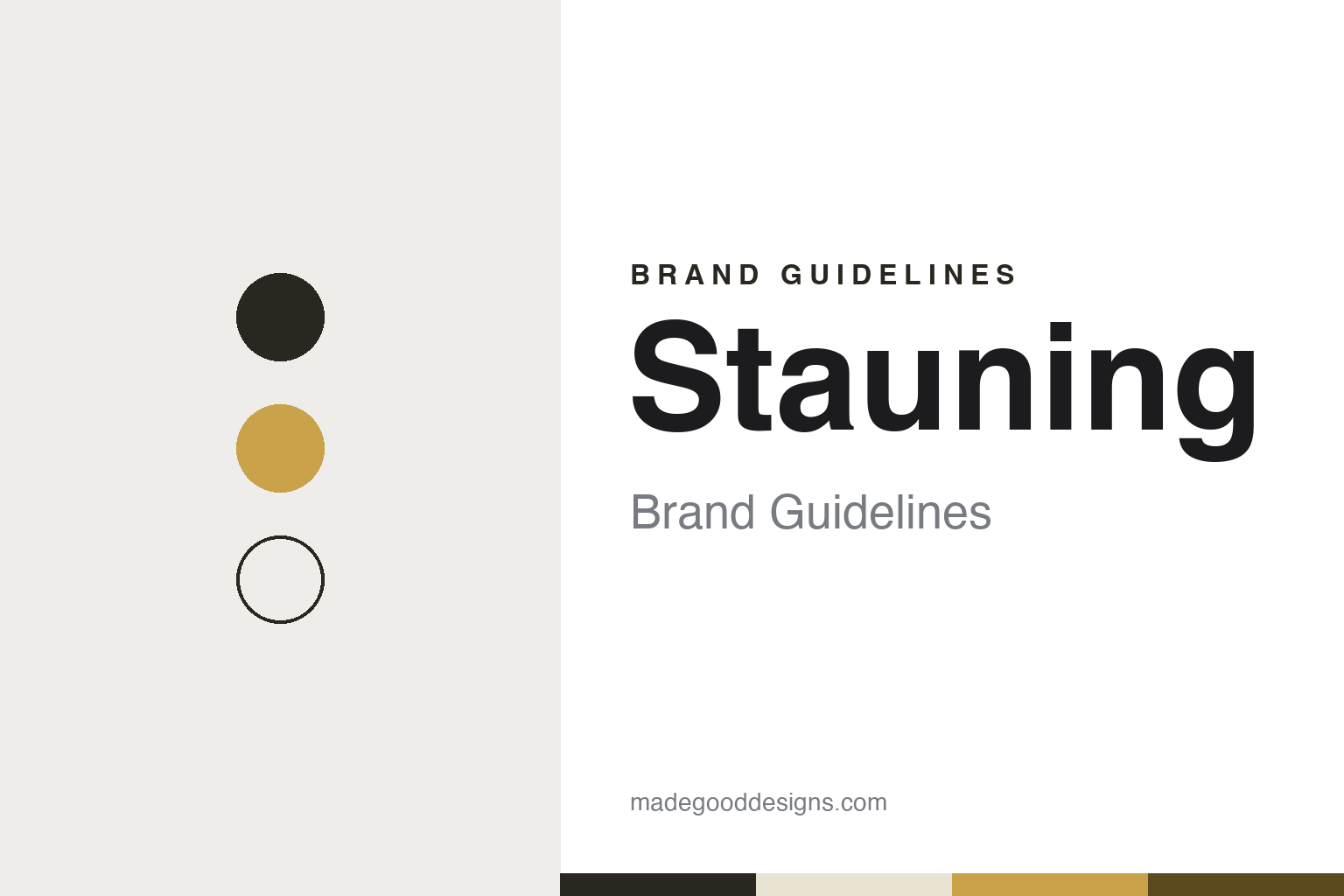
Stauning Brand Guidelines
Nine friends, an old butchery and whisky from West Jutland grain.
Aa
Two constants: a burnt timber, rye gold and dune sand palette and a contemporary serif register. Abstract homage — not a Stauning product or mark; no label, logo or bottle is reproduced.
An old butchery on the West Coast
A doctor, a chef, a butcher, a teacher, a pilot and four engineers.
Stauning Whisky was founded in May 2005 by nine Danish whisky enthusiasts, English Wikipedia says, in the village of Stauning near Skjern on the west coast of Jutland. The company describes the nine as a doctor, a chef, a butcher, a teacher, a helicopter pilot and four engineers, and says they began with two small pot stills and an old butchery. English Wikipedia says the first building belonged to one of the founders and had been a private slaughterhouse before it was renovated and licensed.
Everything was improvised. The company says the barley came from a local farmer, that malting was done on the tiled floor of the butcher’s cold room, that peat for drying and smoking the malt came from a nearby museum and that an old meat mincer served as a mill. English Wikipedia names the peat supplier as the Klosterlund Museum and dates the first distillation to August 2006. The company’s version of the story adds that a bank advised the friends to forget whisky and open a bakery instead.
In 2007 the founders bought a small farm about 1.5 kilometres south of the village, English Wikipedia says, and distilling began at the new site in April 2009. Output stayed small: about 6,000 litres of new spirit a year from 2009 to 2012, rising to 15,000 litres in 2012, by the same account. The company says its first commercial bottles were released in 2011. From the start the grain was local and the methods unusual for Scotch-style whisky: floor malting, small pot stills heated by direct fire, and both barley and rye. English Wikipedia lists early bottlings as Traditional, Peated and Young Rye, and says the whiskies were sold without chill filtration or added colour.
Colour
Burnt timber, glass and nine converging lines.
The distillery is now part of the brand’s image. The company says that in 2018 it opened a modern, purpose-built distillery near Stauning, and describes the building’s clean, sharp angles, burnt timber panelling, glass and black metal as an expression of Danish design and architecture. Inside, the company says, distillation takes place in 24 small copper stills heated by direct fire, and its whisky is made from rye and barley grown, in its phrase, “a bicycle-ride away” from the distillery. It calls the method “grain to glass.”
The core range today carries short Danish and English names. The company’s shop lists R.Y.E., HØST (Danish for harvest), the smoked RØG and KAOS, alongside limited cask finishes and a Danish dry gin.
In July 2025 Stauning marked its 20th anniversary with new packaging. Whisky Magazine and Global Drinks Intel both reported on 10 July 2025 that the new look was inspired by Scandinavian design while keeping classical whisky cues, and that its symbol is made of nine lines — one for each founder — converging on a central grain motif that stands for the distillery’s Danish grain. The redesign appeared first on Stauning Danish R.Y.E. and HØST, with the rest of the range due to move to the new bottles by the end of 2026, Global Drinks Intel reported. Co-founder Alex Højrup Munch described the new look as “thoughtful, design-led, and defiantly Danish,” Whisky Magazine reported. Neither report named a design agency.
The word rye itself became a design question. Whisky Magazine reported in the same article that, under an agreement between the European Union and Canada, European makers can no longer call their product “rye whisky”; Munch said Stauning would keep making Danish rye whisky exactly as before.
Typography
Design and documentation.
The seven brands in this group are all new-wave whisky distilleries: Sullivans Cove, Penderyn, Mackmyra, Stauning, Cotswolds Distillery, Nc’nean and Kilchoman. New-wave whisky distilleries in general sit at many different points in the trade, from family businesses that still carry a founder’s name to companies that have taken in outside investors or changed hands, and a single brand can be sold everywhere from a distillery shop to a specialist retailer abroad.
A whisky distillery’s identity is usually carried less by a single bottle than by a label, a name and the place it promises, because the company behind the name may have changed hands, moved its production or grown far beyond the place where it started. That makes the questions behind each name worth asking plainly: who started it, who owns it now, and where its whisky is actually distilled, matured and bottled.
Each guide separates what independent sources record from what the company says about itself — its founding story, its owners over time, where its whisky is made and how its labels have changed — and marks plainly what rests only on the company’s own word.
Aa
A contemporary serif for a brand that pairs classical whisky cues with Danish design. (Specimen set in Fraunces, a serif STAND-IN; NOT the Stauning logo.)
Stauning
A Diageo-backed decade, then independence again.
Growth came with an outside investor. The Spirits Business reported on 7 December 2015 that Diageo, through its accelerator Distill Ventures, would take a minority stake in Stauning, and that the money would pay for a new distillery with construction starting in summer 2016 and spirit due in 2018. Munch told the magazine that the founders were still the main shareholders. Whisky Magazine reported in January 2016 that the nine founders kept control and would continue to run Stauning as an independent Danish distillery.
That arrangement ended in 2025. Global Drinks Intel reported in July 2025 that Stauning had regained its independence after Diageo completed a strategic review of its approach to early-stage venture investments in March, and Whisky Magazine reported that Diageo’s exit from Distill Ventures led Stauning to scale back in the United States and cut about a quarter of its workforce. Stauning is distributed in about 20 markets, including the UK, the US, Germany and the Nordic countries, Global Drinks Intel reported, and it described Stauning as the largest distiller in Denmark. Whisky Magazine added that Stauning is a founding member of the Danish Whisky Manifesto, launched in 2025 with the aim of protecting Danish whisky and eventually securing a geographical indication.
The name needs care online. Stauning is first of all the name of the West Jutland village; the distillery’s sites are stauningwhisky.com and stauningwhisky.dk.
For a design guide, Stauning shows how a founding story — nine friends, an old butchery and grain from nearby fields — can be turned into a single symbol of nine lines and a grain, and carried from a farmyard to a burnt-timber distillery. Compare Mackmyra, the Swedish pioneer founded in 1999, and Talisker, one of the Diageo single malts on the Isle of Skye. For this guide we use burnt timber, rye gold and dune sand with a serif, an unofficial interpretation; no product or logo is reproduced.
Explore & save
Keep Stauning’s identity on hand — save it to a board in the Made Good inspiration library.
Stauning identity set
Pin the Stauning burnt timber, rye gold and dune sand palette and the contemporary serif register to your own board.


