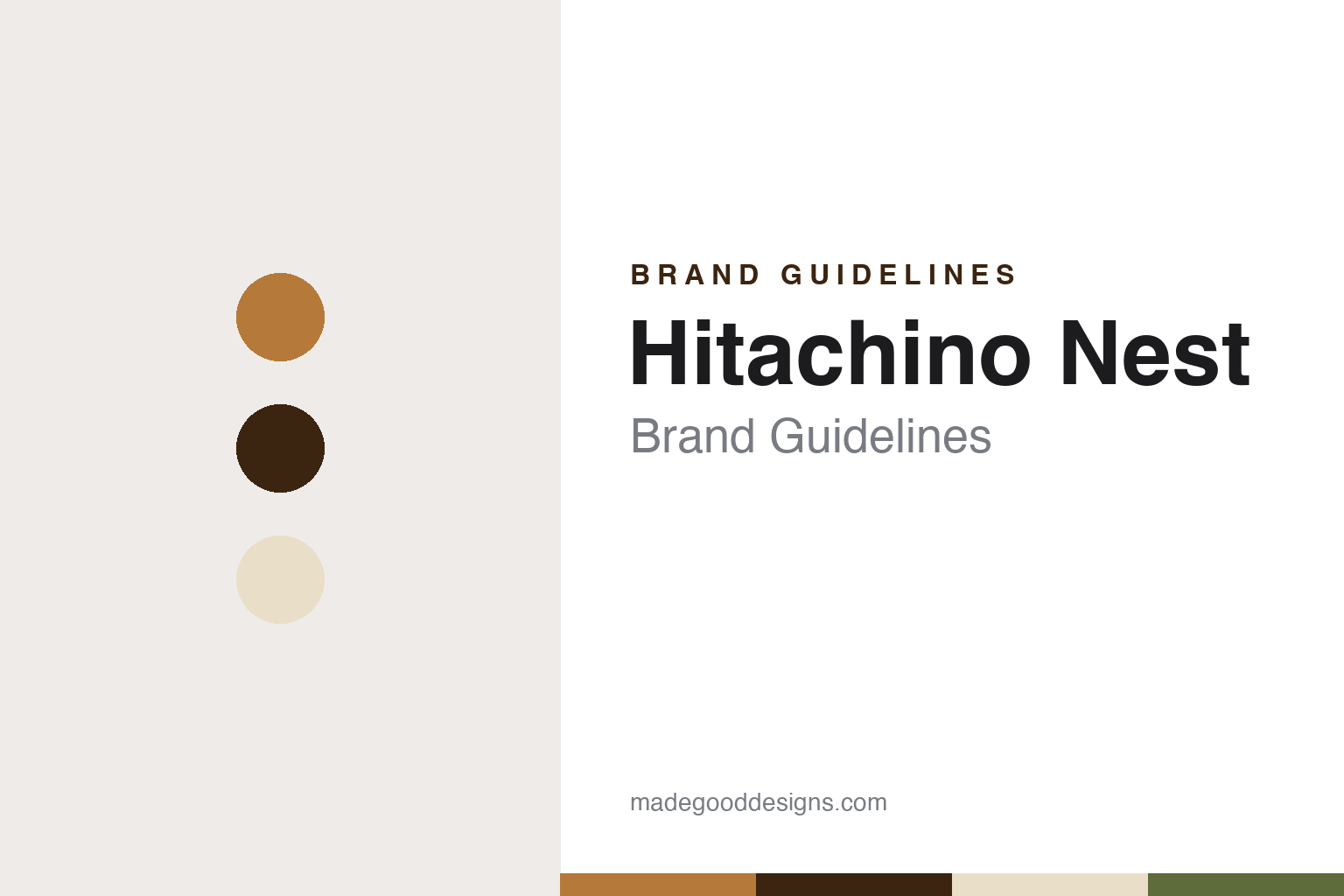
Hitachino Nest Brand Guidelines
The owl-label ale of a Kiuchi sake house dated to 1823.
Aa
Two constants: an owl brown, amber and rice-paper cream palette and a bookish serif register. Abstract homage — not a Hitachino Nest product or mark; no label, logo or bottle is reproduced.
A sake house of 1823 that turned to ale
From a village headman’s sake to a Canadian brewhouse.
Hitachino Nest is the beer brand of Kiuchi Brewery (Kiuchi Shuzō), a drinks maker in Naka, Ibaraki Prefecture, north-east of Tokyo. The company says its history begins in 1823, the sixth year of the Bunsei era, when Kiuchi Gihei, headman of the village of Kōnosu in the Naka district of Hitachi Province, began making sake; English Wikipedia, citing the Yomiuri Shimbun (2021), gives the same founder and year. According to the company, Gihei turned the rice left over from the tax rice that local farmers paid to the Mito domain into sake, buying his equipment from merchants in Aizu, and the Mito scholar Fujita Tōko, a relative of the family, named the sake Kikusakari, a name the house still uses. The company dates its Kōnosu brewery building to 1922.
Beer came almost two centuries later. Kiuchi’s own history says a 1994 revision of the Liquor Tax Act made it possible for companies other than the big brewers to make beer, and the company set out to join them. It says it began planning in 1995, found that trading houses and brewers wanted several hundred million yen for equipment and training, and instead bought a brewhouse from DME, a Canadian equipment maker it found online, for less than half the price. The containers arrived in August 1996, four employees installed the plant largely by themselves, and on 3 October 1996, the company says, the first batch of a top-fermented ale made with British malt and hops was filtered. President Online, in a December 2017 profile, gives 1995 as the year Kiuchi went into beer.
The local-beer boom of the late 1990s did not last. President Online reported that within a few years many local beer companies had gone bankrupt and that Kiuchi was hit hard too; Toshiyuki Kiuchi, then a director, told the magazine that the slump pushed the company to compete abroad instead. The company says it began exporting beer in 1999–2000.
Colour
A front-facing owl, chosen over a stork and an anglerfish.
The name is a play on place. The brand site explains that “nest” stands for su, the Japanese word for a nest, because the beer was born in Kōnosu, a place name that contains that character. The site calls the brewery a nest for people who love beer, from which its beers take flight.
The bird on the label took longer to settle. On a page about how “the familiar owl label” was decided, Kiuchi shows proposals it set aside: an anglerfish, a nod to the monkfish hotpot that is a winter speciality of Ibaraki’s coast, and a stork carrying an ear of barley, a play on the Kōnosu place name and the stork as a bearer of new life. The company says the owl was finally chosen as the brand’s image character and was worked through a long series of sketches into its present front-facing pose; the page does not name the designer. The bird has become shorthand for the beer: the Yomiuri Shimbun headlined a March 2021 feature on the brewery with the phrase “owl beer,” and the company says the owl-label beer now goes to about forty countries, naming the United States, Britain, Thailand and Australia among them.
The range follows European and American styles with Japanese ingredients. English Wikipedia lists among its beers a White Ale, an Amber Ale, a Red Rice Ale and a Real Ginger Ale, and notes that its XH strong ale is matured in shōchū casks. The company’s philosophy page says that although its raw materials come from Europe and America, it is not making copies of Western beer. It also says it revived Kaneko Golden, an old Japanese malting barley no longer grown after the 1950s and early 1960s, with local farmers, which made possible its Nipponia ale brewed with Ibaraki barley and hops of Japanese origin.
Typography
Design and documentation.
The seven brands in this group are all Japanese craft beers: Hitachino Nest, Yo-Ho, Coedo, Echigo, Minoh, Baird and Shiga Kogen. Most of them trace back to a single change in the law. Japanese Wikipedia records that a 1994 revision of the liquor tax law cut the minimum annual output needed for a beer licence from 2,000 kilolitres to 60, and that the small regional breweries that followed, known as “ji-bīru,” at one point numbered more than 300.
Several of the seven grew out of older drinks businesses. English Wikipedia says Kiuchi Brewery, the maker of Hitachino Nest in Naka, Ibaraki, was founded in 1823 as a sake producer and began brewing beer in 1996; Shiga Kogen Beer belongs to Tamamura Honten, a Nagano sake house that dates itself to 1805 and began brewing beer in 2004. Others sit inside larger companies: Japanese Wikipedia says Yo-Ho Brewing of Karuizawa was founded in 1996 by Yoshiharu Hoshino of Hoshino Resorts and entered a business and capital alliance with Kirin Beer in 2014, that Coedo is the beer division of Kyodo Shoji of Kawagoe, and that the confectioner Bourbon has owned all of Echigo Beer of Niigata since 2010. Minoh Beer is a family brewery in Minoh, Osaka, and Zoom Japan reported in 2020 that Baird Beer was founded in Numazu in 2000 by Bryan and Sayuri Baird and moved its headquarters to Shuzenji in 2014.
Each guide separates what independent sources record from what the company says about itself — its founding story, its owners over time, where its beer is brewed and how its labels and cans have changed — and marks plainly what rests only on the company’s own word.
Aa
A bookish serif for a two-hundred-year-old sake house. (Specimen set in Noto Serif, a serif STAND-IN; NOT the Hitachino Nest logo.)
Hitachino Nest
From the old sake house to Nukada, whisky and forty countries.
Growth moved the brewing out of the old sake house. The company’s history says it built the Nukada brewery, also in Naka, in 2007 to make beer in volume (its beer pages date the move to 2008), and that the site now brews more than fifteen Hitachino Nest beers at any time. President Online reported in December 2017 that the company had opened its own shop and restaurant in San Francisco that March. The original Kōnosu brewery still hosts a small brewhouse where visitors can make their own beer, the company says.
Kiuchi has kept widening its range of drinks. The company says it launched Kiuchi umeshu in 2008, began making whisky at Nukada in 2016, opened the Yasato distillery in Ishioka in 2020, released its first Hinomaru Whisky in 2022 and opened a malting plant in Ishioka in 2023. During the pandemic, CNN reported in December 2020, the company ran a “Save Beer Spirits” scheme at its Tokyo distillery, distilling bars’ and brewers’ unsold beer into gin and sending it back. Japanese Wikipedia, citing a company notice of March 2022, records a reorganisation of the group’s companies that year, and in October 2026 the company announced that it is taking part in a new whisky distillery at Ōarai, due to start in spring 2027.
For a design guide, Hitachino Nest shows how a sake house founded two centuries ago can carry one small, front-facing owl from a village in Ibaraki onto beer shelves in some forty countries. Compare Kirin, the Japanese brewer whose label carries the mythical qilin, and Gekkeikan, the Fushimi sake house founded in 1637. For this guide we use owl brown, amber and rice-paper cream with a serif, an unofficial interpretation; no product or logo is reproduced.
Explore & save
Keep Hitachino Nest’s identity on hand — save it to a board in the Made Good inspiration library.
Hitachino Nest identity set
Pin the Hitachino Nest owl brown, amber and rice-paper cream palette and the bookish serif register to your own board.


