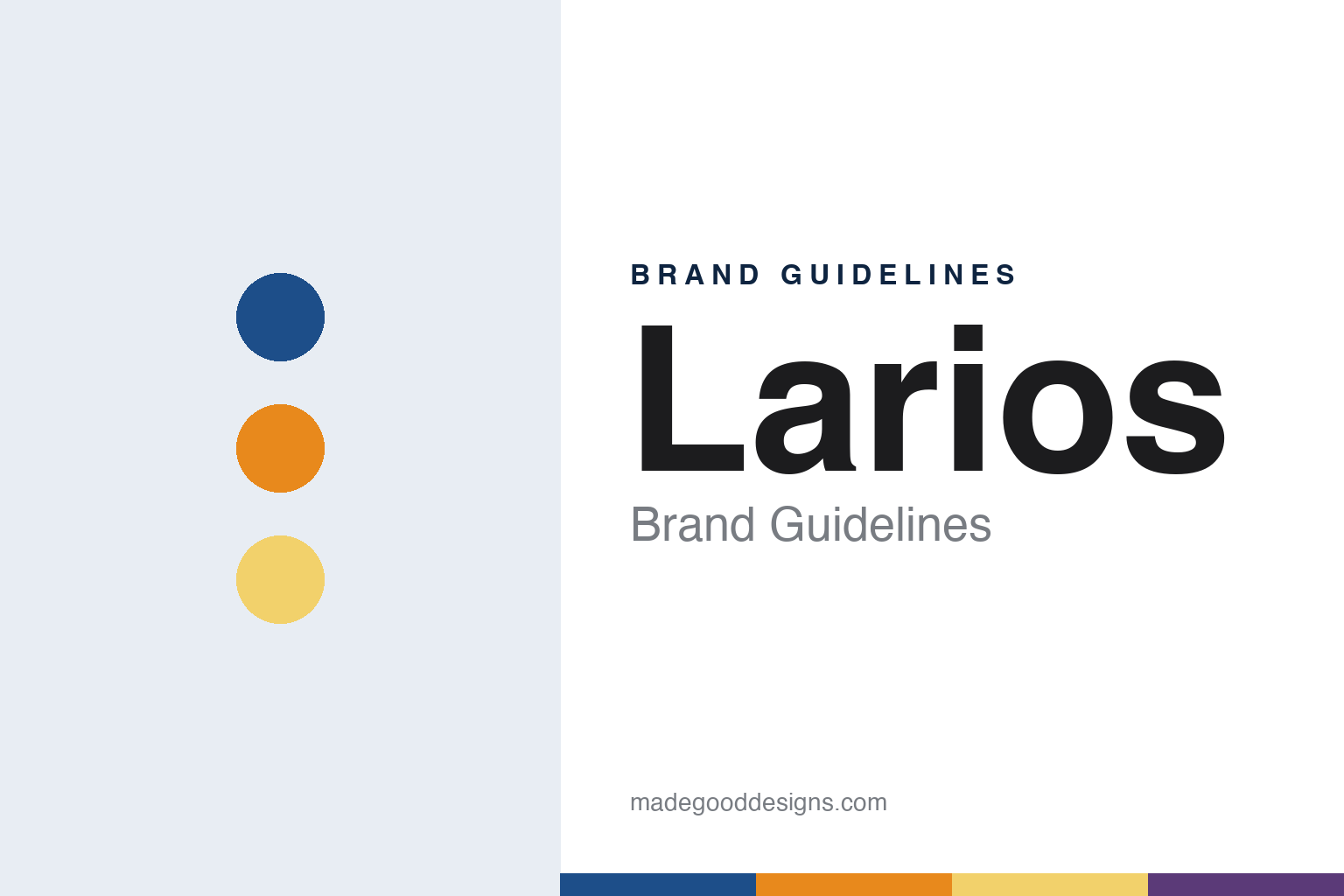
Larios Brand Guidelines
The Málaga gin rebuilt around the Mediterranean.
Aa
Two constants: a Larios Mediterranean blue, orange and lemon palette and a Geometric sans register. Abstract homage — not a Larios product or mark; no bottle, logo or label is reproduced.
Jiménez y Lamothe
A Málaga wine house and a family name.
Larios dates itself to 1866 and to Málaga. Its website says the company has been making Mediterranean gin among Málaga’s citrus groves “since 1866,” and names its founder as Pablo Larios, writing that he and the Larios family set out to capture the spirit of Málaga two centuries ago. In 2016 the brand marked its 150th anniversary, Alimarket reported, with a Larios 150 Aniversario edition whose design was inspired by the original of 1866.
The documented history runs through an older Málaga wine house. Spanish Wikipedia, citing two 2010 articles by Manuel Martínez Molina in the Málaga journal El Avisador, says Jiménez y Lamothe grew out of Carlos Lamothe y Cía., a wine company established in Málaga in 1852, when the partner Fernando Jiménez joined it. The firm built a distillery in Málaga’s La Aurora district and exported to England, France, Germany, Cuba, Russia, Australia, Mexico, Argentina and the United States. It also set up a winery at Manzanares, in La Mancha, to supply the distillery with wine that was turned into brandy, anís, aguardiente and triple sec. It was named a supplier to the Spanish royal household.
In 1918, Spanish Wikipedia says, the business was acquired by the Larios house, giving rise to the later Bodegas Larios. Other accounts date the company differently: a 2021 article on the Spanish business site Merca2 credited the third Marqués de Larios with founding it in 1933, and noted that Málaga’s Calle Larios, named after the marqués, is the street many young Spaniards connect with the drink. The same article described how, for many Spaniards, Larios had been the gin of the village bar, served long with a slice of lemon.
Colour
From Pernod Ricard to Suntory.
Larios has belonged to international drinks groups for almost three decades. Pernod Ricard’s annual report for 2006, filed with the US Securities and Exchange Commission, records that in 1997 it acquired Larios, “a Spanish producer of gin and the owner of the Larios brand.” The brand moved again as part of Pernod Ricard’s takeover of Allied Domecq. When that deal was agreed in April 2005, The Moodie Davitt Report reported that certain brands, among them “Pernod Ricard’s Larios brand,” would be sold on to Fortune Brands, the owner of Jim Beam, and Pernod Ricard’s filing says it sold the Larios brand and related assets to Fortune Brands in September 2005.
The owner’s name has changed since. Fortune Brands separated its spirits business as Beam Inc. in October 2011; Suntory of Japan bought Beam in 2014, creating Beam Suntory, which renamed itself Suntory Global Spirits in May 2024, English Wikipedia records. Suntory has owned Larios since 2014, through Beam. In Spain, Alimarket reported in 2016 that the brand belonged to Beam Suntory Spain and was distributed by Maxxium España.
Larios carries Málaga’s name, but Alimarket reported in June 2016 that the gins were made and bottled at two plants in the province of Segovia, at Valverde de Majano and Palazuelos de Eresma. In March 2019 the trade journal reported that Larios was bottled at Valverde de Majano, alongside DYC whisky, Anís Castellana and Jim Beam, and that about 15% of the gin’s production was then exported, to markets including the United Kingdom, Germany and Australia.
The range has widened from one bottle. Alongside Larios Dry Gin, the premium Larios 12 arrived in 2009, Merca2 reported; Alimarket said in 2015 that it used twelve botanicals and five distillations. A Larios Rosé followed, and in June 2018 Alimarket reported the launch of Larios Citrus, made with Mediterranean oranges, other citrus fruit and juniper, for the aperitif hour. The current English-language website describes Larios Gin as distilled four times, with orange blossom added in a fifth distillation, and Larios Rosé as juniper and Mediterranean citrus with a strawberry twist.
Typography
Design and documentation.
The seven brands in this group are all Spanish gins: Nordés, Xoriguer, Puerto de Indias, Larios, Gin Raw, Le Tribute and Santamanía. They come from different corners of the country, from Galicia and the Balearic Islands to Andalusia, Catalonia and Madrid, and they sit at different points in the trade, from family distilleries and small independent producers to names that now belong to much larger drinks groups.
A gin brand’s identity is usually carried less by the liquid than by a bottle, a label and the place it names, because the company behind the name may have changed hands, moved its distilling or grown far beyond the town where it began. That makes the questions behind each name worth asking plainly: who started it, who owns it now, and where its gin is actually distilled and bottled.
Each guide separates what independent sources record from what the company says about itself — its founding story, its owners over time, its recipe and botanicals, where its gin is made and how its bottles and labels have changed — and marks plainly what rests only on the company’s own word.
Aa
A geometric sans for a Mediterranean repositioning. (Specimen set in Outfit, a sans STAND-IN; NOT the Larios logo.)
Larios
“Ginebra Mediterránea.”
The brand’s design has been rebuilt around the Mediterranean. In June 2015 Alimarket reported a new design for Larios Dry Gin and Larios 12 under the concept “Espíritu Mediterráneo,” with a modern, clean, crystal-clear look: the Dry Gin strengthened the orange and lemon of its citrus notes, while Larios 12 took a more intense blue, evoking the Mediterranean night. Both bottles and labels carried colourful patterns, icons for origin, tradition and serving moments, and a shield recalling the first distillery in Málaga. A 2018 design-effectiveness case study published on WARC, credited to Maxxium España, describes a new bottle drawing on the patterns, colours and textures of the Mediterranean coast, with the label wording changed from “London Dry Gin” to “Ginebra Mediterránea.”
The core bottle was restyled again in 2021. The Spanish packaging site NewsPackaging reported in March 2021 that the creative agency Pelonio had restyled Larios Dry Gin, keeping its visual identity while stressing origin and Mediterranean botanicals: purple for juniper, orange for orange and yellow for lemon, with the label printed on metallic paper and arabesque patterns around the ingredients.
Not every campaign landed. Merca2 reported in 2021 that a 2013 campaign presenting Larios as “just a gin” revived the old image after the brand had modernised, that consumers reacted badly, and that the company apologised and tried to withdraw it. An advertising lecturer at Madrid’s Universidad CEU San Pablo told the site that the company had changed its packaging more than its advertising, and that for some years it had been selling a feeling rather than the product. The brand has also used its bottles for special editions: in June 2016 Alimarket reported a Larios 12 edition for Madrid’s Pride week, with the rainbow flag on the neck and Madrid symbols such as the Puerta de Alcalá and the Puerta del Sol.
For a design guide, Larios shows how a long-established gin can reposition itself through its packaging, by turning its Mediterranean origin into a colour scheme. Compare Roku Gin, its Japanese stablemate under Suntory, and Gin Mare, another Spanish gin that sells the Mediterranean. For this guide we use Mediterranean blue, night blue, orange, lemon and juniper purple with a sans, an unofficial interpretation; no product or logo is reproduced.
Explore & save
Keep Larios’s identity on hand — save it to a board in the Made Good inspiration library.
Larios identity set
Pin the Larios Mediterranean blue, orange and lemon palette and the Geometric sans register to your own board.