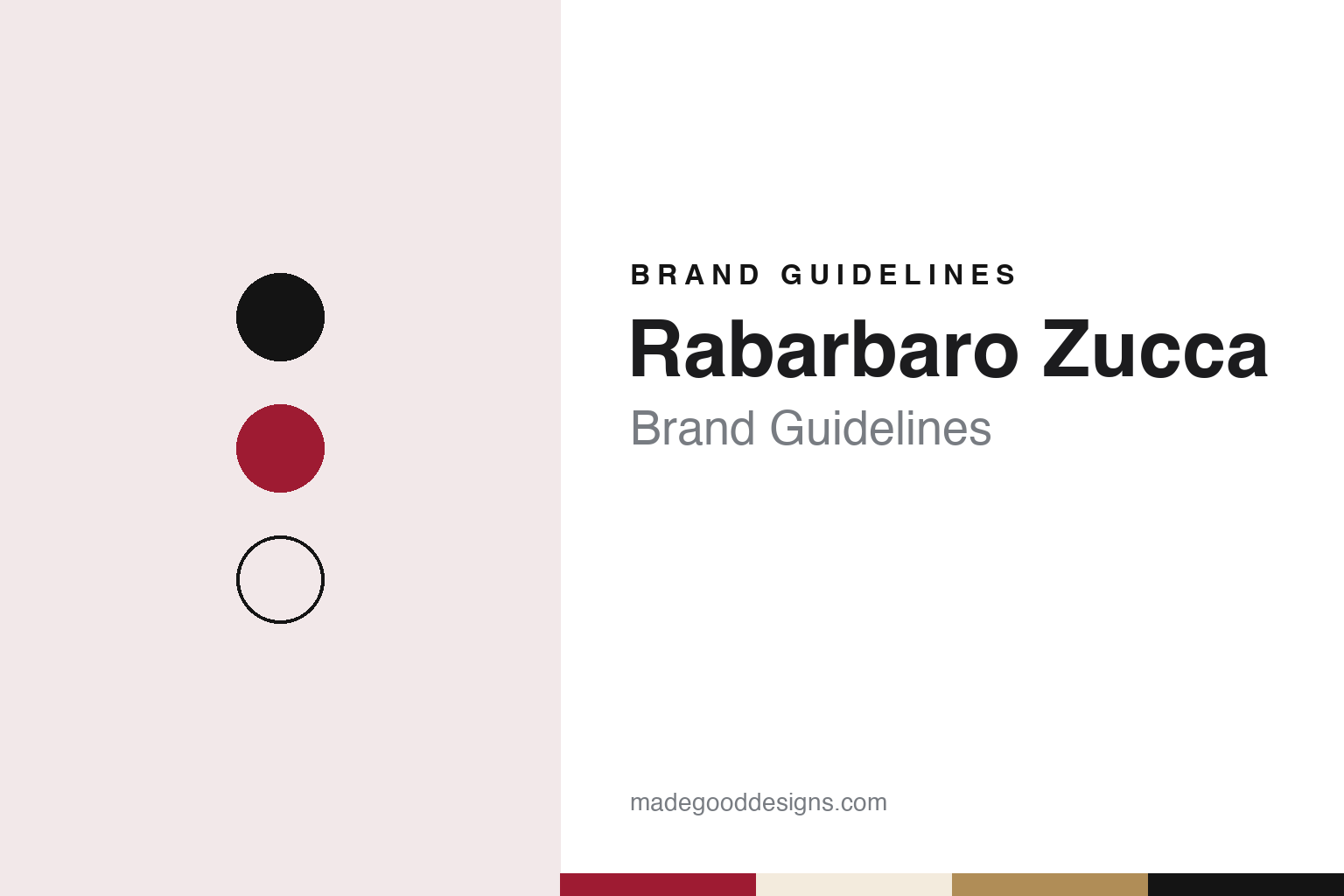
Rabarbaro Zucca Brand Guidelines
The Milan rhubarb amaro of 1845 and its Galleria bar.
Aa
Two constants: a Zucca rhubarb red and gold palette and a Milanese serif register. Abstract homage — not a Zucca product or mark; no bottle, label, advertisement or logo is reproduced.
Ettore and Tilde
A Milan workshop and a family name.
Rabarbaro Zucca was created in Milan in 1845, in the artisan workshop of Ettore and Tilde Zucca, according to a 2022 history of the Italian aperitivo published by Salone Milano, the furniture fair’s editorial site; Italian Wikipedia gives the same year and credits Ettore Zucca. The name causes a small confusion for Italian speakers, since zucca means pumpkin: Italian Wikipedia points out that it comes from the family’s surname, not the vegetable. The first word, rabarbaro, is simply Italian for rhubarb.
The business grew through the family. Salone Milano says Ettore and Tilde’s son Carlo turned his parents’ early venture into an industrial business, and that later Zucca generations, Emilio and Gerolamo, took it beyond the city of Milan. The same article illustrates the brand with a photograph of a Zucca stand at the Milan Trade Fair in 1963, part of its argument that many Italian aperitivo brands were launched or popularised at the city’s fair.
Zucca belongs to a crowded Milanese family of bitters. The same Salone Milano article, by Elisa Carassai, dates Fratelli Branca, the maker of Fernet-Branca, to 1845 in Milan — the same year as Zucca — and Gaspare Campari’s Milan distillery to 1860, and says the pharmacist Ausano Ramazzotti produced his amaro in the city from 1815. Its photographs of the fair show the Zucca stand of 1963 next to kiosks and stands for Branca, Cinzano, Campari and Averna, a reminder of how these brands competed for the same visitors.
Colour
Rhubarb, and a bar in the Galleria.
The recipe centres on rhubarb. Italian Wikipedia describes it as made by infusing rhubarb rhizomes in alcohol, with bitter orange peel, cardamom, cinchona and other aromatic herbs; the full recipe is not published. The same article says it is usually drunk as an aperitif, neat or with sparkling water and ice, and also used in cocktails, and places it in the same family as Italian bitters and aperitifs such as Cynar, Punt e Mes and Campari.
Its most visible chapter played out in the Galleria Vittorio Emanuele II, the glass-roofed arcade beside Milan Cathedral. The historic café at the Galleria’s entrance, known as the Camparino, carried the Zucca name on its signs from 1996 until January 2012, Italian Wikipedia says, citing a La Repubblica report by Laura Fugnoli of 29 September 2011 headlined, in translation, “The bitter has beaten the rhubarb: Bar Zucca becomes Campari again.” Salone Milano likewise says the bar was owned by the Rabarbaro Zucca brand from 1996 until 2012. For sixteen years, the café known as the Camparino carried the name of a rival Milan amaro.
The brand’s advertising leaned on its initial. From the 1960s, Italian Wikipedia says, Zucca’s advertisements and promotional objects showed a kneeling girl dressed in red whose outstretched arms formed the letter Z, an image meant to allude to rhubarb’s Chinese origins. Its slogan was a pun on the word itself — “Il Rabarbaro Zucca si trova nel bar come il bar si trova nel RaBARbaro”, roughly “Rabarbaro Zucca is found in the bar, just as the bar is found in RaBARbaro” — playing on the letters b-a-r hidden inside the Italian word for rhubarb. The slogan has been discussed by the linguist Giuseppe Aldo Rossi in a 1993 book on Italian words, Italian Wikipedia notes, with Rossi giving the wording as “nei bar”, in the plural.
Typography
Design and documentation.
The six brands in this group are amaro and anise spirits: Vecchio Amaro del Capo, Rabarbaro Zucca, Amaro Sibilla, Henri Bardouin, Pastis 51 and Arak Brun. They come from two old families of drinks. Amaro, English Wikipedia says, is a descriptor for an Italian, or Italian-style, herbal liqueur, usually bittersweet and usually served after a meal. Pastis and arak belong to the anise family: English Wikipedia says pastis was first sold commercially by Paul Ricard in 1932, and describes arak, often called the national drink of Lebanon, as a spirit traditionally made from grapes and aniseed.
The anise spirits share one visual effect. Add water and the clear spirit turns a cloudy, milky white — the effect English Wikipedia calls the louche, or the ouzo effect.
The owners behind these names range widely. English Wikipedia lists Pastis 51 as made by Pernod Ricard, the French drinks group, and Henri Bardouin as made by Distilleries et Domaines de Provence, while Arak Brun belongs to a Lebanese wine estate that changed hands in 2000.
A drinks brand’s identity is usually carried less by a single bottle than by a label, a name and the place it promises, because the company behind the name may have changed hands or grown far beyond where it started. Each guide separates what independent sources record from what the company says about itself — its founding story, its owners over time, where its spirit is made and how its labels have changed — and marks plainly what rests only on the company’s own word.
Aa
A Milanese serif — an amaro that spelled its own name in an advertisement. (Specimen set in Bodoni Moda, a serif STAND-IN; NOT the Zucca logo.)
Zucca
A family name inside a Saronno group.
The Zucca name no longer belongs to the Zucca family. The brand is owned by ILLVA Saronno, the company best known for Disaronno amaretto, according to Italian Wikipedia; a 2020 profile of Augusto Reina in the local paper Saronnonews listed Zucca among the brands “acquired over time” that the Reina family holding controls, alongside Artic vodka, Amaro 18 Isolabella, Mandarinetto and Barceló rum. Saronnonews dated ILLVA Saronno’s founding to 23 July 1947, and said the group grew on the Italian market in the 1960s and later took in the Sicilian wine houses Duca di Salaparuta and Cantine Florio.
The group has since added another amaro. On 18 December 2025 the news agency AGI reported that Campari had agreed to sell Averna, the Sicilian amaro, and the Sardinian myrtle liqueur Zedda Piras to Illva Saronno Holding, with completion expected in the first half of 2026. That would put a Milan rhubarb amaro and a Caltanissetta amaro under the same Saronno owner.
The brand also has a literary sideline. Since 2011, Italian Wikipedia says, it has sponsored the Premio Zucca – Spirito Noir, a prize for crime fiction whose first edition was held at the Courmayeur Noir in Festival.
For a design guide, Zucca shows how a brand can be carried by a single letter, a pun and a place on the map. Compare Disaronno, the amaretto from the same Saronno owner, and Ramazzotti, another nineteenth-century Milan amaro. For this guide we use a rhubarb red, a gold and a cream with a serif, an unofficial interpretation; no product or logo is reproduced.
Explore & save
Keep Rabarbaro Zucca’s identity on hand — save it to a board in the Made Good inspiration library.
Rabarbaro Zucca identity set
Pin the Zucca rhubarb red and gold palette and the Milanese serif register to your own board.