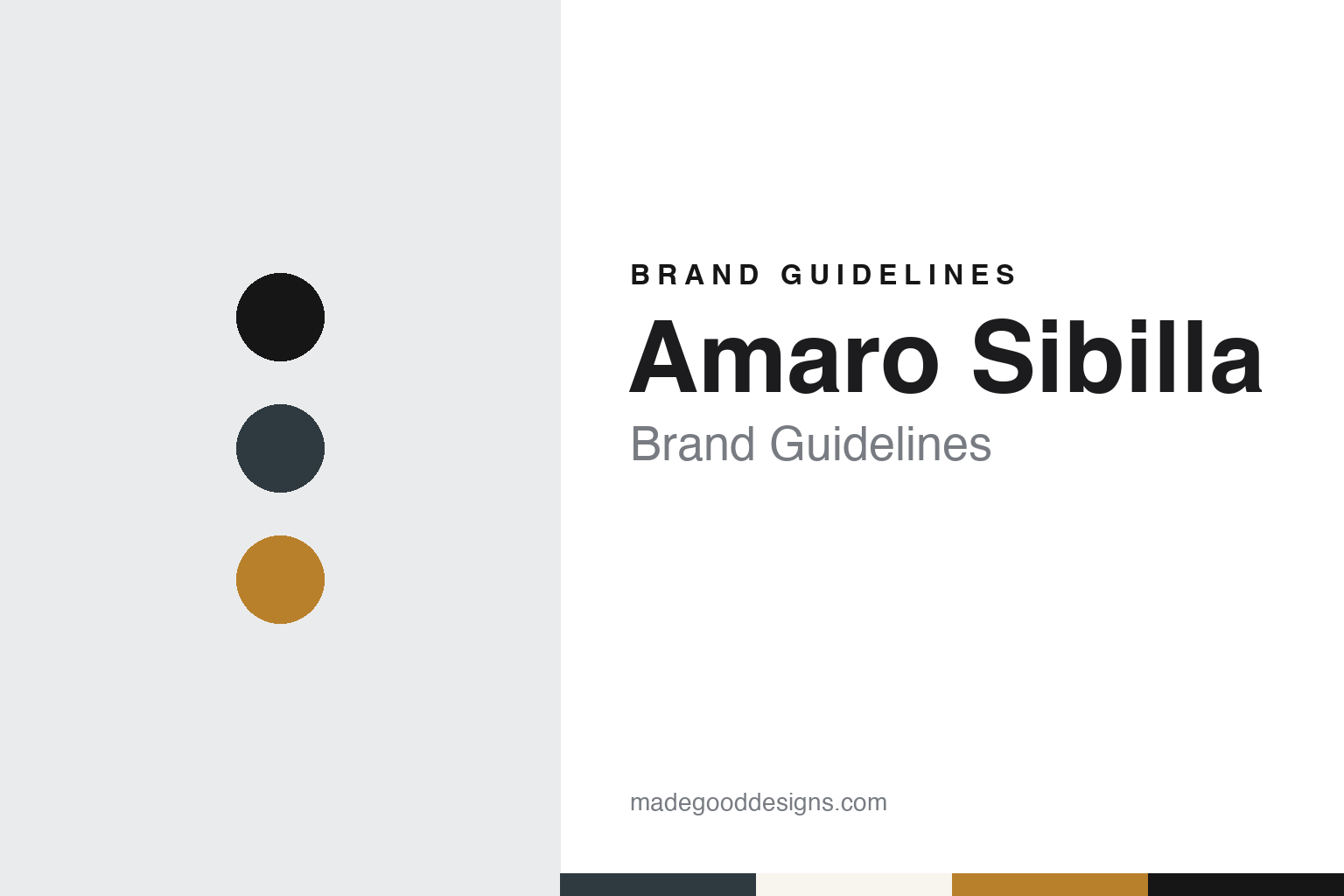
Amaro Sibilla Brand Guidelines
Varnelli’s honey-sweetened amaro of the Monti Sibillini.
Aa
Two constants: an Amaro Sibilla slate and honey palette and a Mountain serif register. Abstract homage — not a Varnelli product or mark; no bottle, label or logo is reproduced.
Distilleria Varnelli
A herbalist’s firm in the Sibillini foothills.
Amaro Sibilla is the herbal amaro of Distilleria Varnelli, a family distillery in the province of Macerata, in the Marche. The company says it was founded in 1868 by Girolamo Varnelli, drawing on his knowledge of herbs, and the same date is given by the food guide Gambero Rosso in its producer profile and by a 2014 article on the Varnelli trademark published by the intellectual-property firm Protectia. The company also says it was the first distillery in the Marche to obtain a licence for working alcohol, licence number 1 of the old U.T.I.F. excise office.
The firm is spread over two places in the upper Chienti valley. Its registered seat is at Pievebovigliana, which since 1 January 2017 has been part of the merged municipality of Valfornace, according to Italian Wikipedia; its production plant is at Muccia, on a street named Via Girolamo Varnelli, the company says. Gambero Rosso also places today’s production at Muccia.
The house’s other pillar came with the second generation. Italian Wikipedia, citing the company’s own history and a 2007 book on the firm by Pia Passalacqua and Carlo Vischi, says Girolamo’s son Antonio joined the business in 1906 and created the dry anise spirit that carries the family name, a version of the Marche’s traditional mistrà; Protectia called it the family’s “biggest invention.” Antonio’s son, another Girolamo, gave it the slogan “Sovrano correttivo del caffè” — the sovereign corrector of coffee — Italian Wikipedia says.
The anise is a dry spirit bottled at 46 per cent, made from grain alcohol and an anise distillate, according to Italian Wikipedia, which also cites a 2017 article in the trade site Bar.it on a cocktail, “Lu Carzolà,” pairing it with Caffè Borghetti, an espresso liqueur from Ancona. The family’s story was told at book length in Varnelli, anice da gustare, by Pia Passalacqua and Carlo Vischi, published by Gribaudo in 2007.
Colour
Gentian, cinchona and mountain honey.
The company says Girolamo Varnelli invented Amaro Sibilla in 1868, the year it gives for the firm itself, so the amaro is presented as the distillery’s founding product. Gambero Rosso describes it as based on yellow gentian, cinchona and other plants, and the company’s own page lists the same two botanicals alongside unnamed “officinal” herbs.
Its method, as the company describes it, is old-fashioned: a decoction of the herbs over a wood fire, a long period of settling, and a final filtering through cloth before bottling. The company says the amaro is sweetened exclusively with honey from the Monti Sibillini, rather than with sugar, and bottles it at 34 per cent alcohol in sizes from a 10-centilitre miniature to a full litre. It suggests serving it neat, over ice, with soda or orange juice, or in a spritz.
The name points to the landscape. Amaro Sibilla is named after the Monti Sibillini, the mountains on whose slopes, the company says, Varnelli has worked since its founding. The company says the mountains became a national park in 1993, and that Varnelli was one of twenty businesses profiled in a report on companies inside Italy’s national parks, commissioned by the environment ministry with Unioncamere and presented in Rome on 16 September 2014.
For the distillery’s 150th anniversary in 2018, Italian Wikipedia records, the company created a cocktail called “Centocinquanta” — Italian for “a hundred and fifty” — that combines Amaro Sibilla with the Varnelli anise, bringing the founder’s amaro and his son’s spirit into one glass.
Typography
Design and documentation.
The six brands in this group are amaro and anise spirits: Vecchio Amaro del Capo, Rabarbaro Zucca, Amaro Sibilla, Henri Bardouin, Pastis 51 and Arak Brun. They come from two old families of drinks. Amaro, English Wikipedia says, is a descriptor for an Italian, or Italian-style, herbal liqueur, usually bittersweet and usually served after a meal. Pastis and arak belong to the anise family: English Wikipedia says pastis was first sold commercially by Paul Ricard in 1932, and describes arak, often called the national drink of Lebanon, as a spirit traditionally made from grapes and aniseed.
The anise spirits share one visual effect. Add water and the clear spirit turns a cloudy, milky white — the effect English Wikipedia calls the louche, or the ouzo effect.
The owners behind these names range widely. English Wikipedia lists Pastis 51 as made by Pernod Ricard, the French drinks group, and Henri Bardouin as made by Distilleries et Domaines de Provence, while Arak Brun belongs to a Lebanese wine estate that changed hands in 2000.
A drinks brand’s identity is usually carried less by a single bottle than by a label, a name and the place it promises, because the company behind the name may have changed hands or grown far beyond where it started. Each guide separates what independent sources record from what the company says about itself — its founding story, its owners over time, where its spirit is made and how its labels have changed — and marks plainly what rests only on the company’s own word.
Aa
A mountain serif — a herbalist’s amaro named after the Sibillini. (Specimen set in Fraunces, a serif STAND-IN; NOT the Varnelli or Amaro Sibilla logo.)
Amaro Sibilla
A family name and a mountain name.
Varnelli has stayed in the family. The company says the business has passed through four generations of herbalists, and Protectia described it in 2014 as managed by the fourth generation. In 1988 it became a joint-stock company, an S.p.A., whose capital, the company says, “appartiene interamente alla famiglia Varnelli” — belongs entirely to the Varnelli family.
The brand rests on two names that do different jobs. The Varnelli name, on the anise spirit, is a family signature; Protectia described the registered trademark in 2014 as the “heritage of the entire community” and argued that protecting it kept the product tied to its region. The Sibilla name, on the amaro, is a place name, borrowing the mountains and their legend rather than a person. Italian Wikipedia adds that a Varnelli radio advertisement had run on the national broadcaster RAI for more than twenty years.
The company tells its story through its territory as much as through its products, with pages on the Monti Sibillini, the national park and local traditions. Its website also gathers stories from the distillery, local events in the Sibillini villages and cocktails built on its two signature bottles, the anise and the amaro.
For a design guide, Amaro Sibilla shows how a small family house can build a brand on a landscape and a founder’s date. Compare Meletti, the anisetta house of Ascoli Piceno, also in the Marche, and Braulio, the Alpine amaro named after a mountain. For this guide we use a mountain slate and a honey amber with a serif, an unofficial interpretation; no product or logo is reproduced.
Explore & save
Keep Amaro Sibilla’s identity on hand — save it to a board in the Made Good inspiration library.
Amaro Sibilla identity set
Pin the Amaro Sibilla slate and honey palette and the Mountain serif register to your own board.


