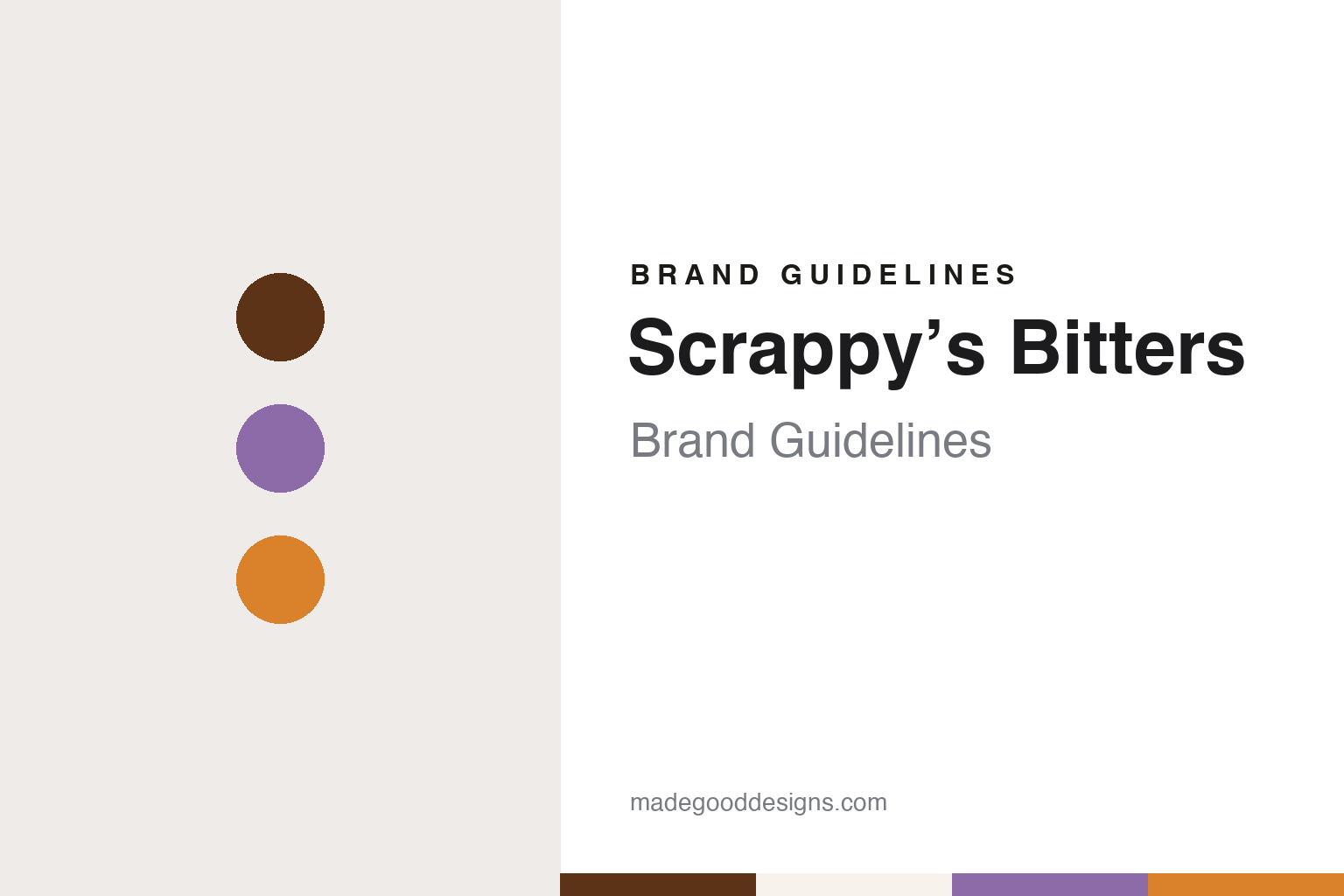
Scrappy’s Bitters Brand Guidelines
The Seattle bartender’s bitters, named after his nickname.
Aa
Two constants: a Scrappy’s amber, lavender and orange palette and a Sturdy sans register. Abstract homage — not a Scrappy’s product or mark; no bottle, label or logo is reproduced.
Scrappy
A bartender’s nickname on a bottle.
Scrappy’s Bitters is a Seattle company built around one bartender. Its founder, Miles Thomas, worked behind the bar in the city for about a decade — at Serafina, Branzino and the Hideout, according to a 2013 profile in the Seattle weekly The Stranger — and began making his own bitters while he was there. A.J. Rathbun, writing in Seattle magazine in April 2018, placed the start at Serafina in the early 2000s, during the revival of classic cocktails, when Thomas wanted something of his own to offer from behind the bar and judged his bitters at least as good as the commercial ones.
The name is his own. The Stranger reported that “Scrappy” was a nickname Thomas had picked up for a youthful tendency to get into fistfights, a habit the paper said he had long outgrown.
The company dates its first commercial release to 2008. In August 2009 Seattle Met wrote that Thomas had been making bitters for about five years and selling them commercially for about six months, and that they were already behind the bar at about 40 Seattle bars, as well as at cocktail bars in Portland, Boston and Vancouver. They were not yet sold in shops; the magazine said he was in talks with DeLaurenti and hoped to open a distillery in Seattle. In April 2018 Seattle magazine said the line would turn ten that November. The company’s own account of those years stresses method: it says Thomas spent many years and countless test batches experimenting with herbs and spices, comparing extraction methods and studying flavour pairing before the first release.
Colour
From a closet in Belltown to Fremont.
Production began small. The Stranger said demand grew so quickly that Thomas needed a storage closet under a restaurant in Belltown to keep up, and that the business later moved into a building in Fremont, where access was restricted to protect its recipes. In 2025 the Washington magazine 1889 described his first base as a commissary kitchen rented in the basement of an Italian restaurant, and said Thomas eventually left his bartending job to run the company full-time.
The early flavours, as Seattle Met listed them in 2009, included orange, grapefruit, lavender and chocolate, and Thomas was then experimenting with a cola bitters. By 2018 Seattle magazine counted eleven products, among them aromatic, black lemon, lime and Orleans bitters, plus Firewater Tincture, made with habanero peppers, which the magazine called the company’s first product that was not a bitters. The 2025 1889 article added Northwest Alpine and a Seville orange to the line-up. The company’s website now features its Aromatic, Orange and Lavender bitters and Firewater, with Northwest Alpine and Spice Plantation alongside.
Seattle bars stayed close to the brand. When Thomas joined Tavern Law in 2009, Seattle Met noted that his bitters were likely already behind the bar at the city’s cocktail spots; by 2013 The Stranger reported that Tavern Law and Canon both stocked the full line, cardamom and chocolate included. In 2018 Seattle magazine said a tenth-anniversary bitters and seasonal flavours were in development, and that Thomas was by then making bitters full-time.
The company presents itself as a hand operation. “A small, dedicated team still produces every bottle by hand in Seattle, Washington,” its website says, and its footer describes the bitters as “handcrafted in small batches.” Brand copy published on the World’s 50 Best Bars website in 2021 added, in the company’s words, that Scrappy’s zests its fresh citrus by hand rather than using oils or extracts, uses organic ingredients with no artificial flavours or dyes, processes and bottles everything in one location, and numbers every batch by hand.
Typography
Bitters and the bar trade.
The seven brands in this group are all cocktail-bitters names: Peychaud’s, Fee Brothers, Regans’, Bittermens, Scrappy’s, The Bitter Truth and Bob’s Bitters. Cocktail bitters are concentrated flavourings, usually made by steeping herbs, spices, roots, peels or other ingredients in alcohol, and they are used a few dashes or drops at a time to season a drink rather than as a drink in their own right.
That small dose shapes how a bitters brand looks. The product is sold in a small bottle, often fitted with a dasher top or a dropper, so the label has to carry a name, a flavour and a maker in very little space, and the same bottle may sit on a bar back, a shop shelf or a kitchen counter. The brands here range from names with long histories to small makers started in this century, and some now belong to much larger drinks companies while others are still run by the people who founded them.
Each guide separates what independent sources record from what the company says about itself — who founded the brand and when, who owns it now, where its bitters are made and how its labels and packaging have changed — and marks plainly what rests only on the company’s own word.
Aa
A sturdy sans — a bartender’s nickname. (Specimen set in Archivo, a sans STAND-IN; NOT the Scrappy’s logo.)
Scrappy’s
A bartenders’ brand, made in Seattle.
The brand grew through the bar trade rather than through shops. The World’s 50 Best Bars, the annual ranking of cocktail bars, listed Scrappy’s on its website as its “Official Cocktail Bitters Partner” in archived copies of the page from July 2021 and October 2023. 1889 described Ben Sheffield, Thomas’s best friend, as the company’s global brand ambassador, and reported in 2025 that Scrappy’s exports its bitters around the world. The packaging-design website The Dieline featured Scrappy’s bottles in February 2013.
The company’s own account has stayed consistent. The Stranger named Thomas as the owner in 2013, and the company’s website, in 2026, still tells its story through him, from the early test batches to a range sold to bars abroad. When he started, Thomas told Seattle magazine in 2018, there were four bitters brands in the country; 1889 named Angostura and Peychaud’s as the bitters bartenders could find in 2008. By 2025, the same magazine reported, North America had more than 100 bitters makers.
For a design guide, Scrappy’s shows how a bartender’s nickname and a hand-made story can carry a small brand from one city’s bars to an international partner list. Compare Angostura, the 1824 bitters with the oversized label, and Peychaud’s, the New Orleans bitters of the Sazerac. For this guide we use an amber, a lavender and an orange with a sans, an unofficial interpretation; no product or logo is reproduced.
Explore & save
Keep Scrappy’s Bitters’s identity on hand — save it to a board in the Made Good inspiration library.
Scrappy’s identity set
Pin the Scrappy’s amber, lavender and orange palette and the Sturdy sans register to your own board.