Dooley’s Brand Guidelines
Waldemar Behn’s toffee cream liqueur from Eckernförde.
Aa
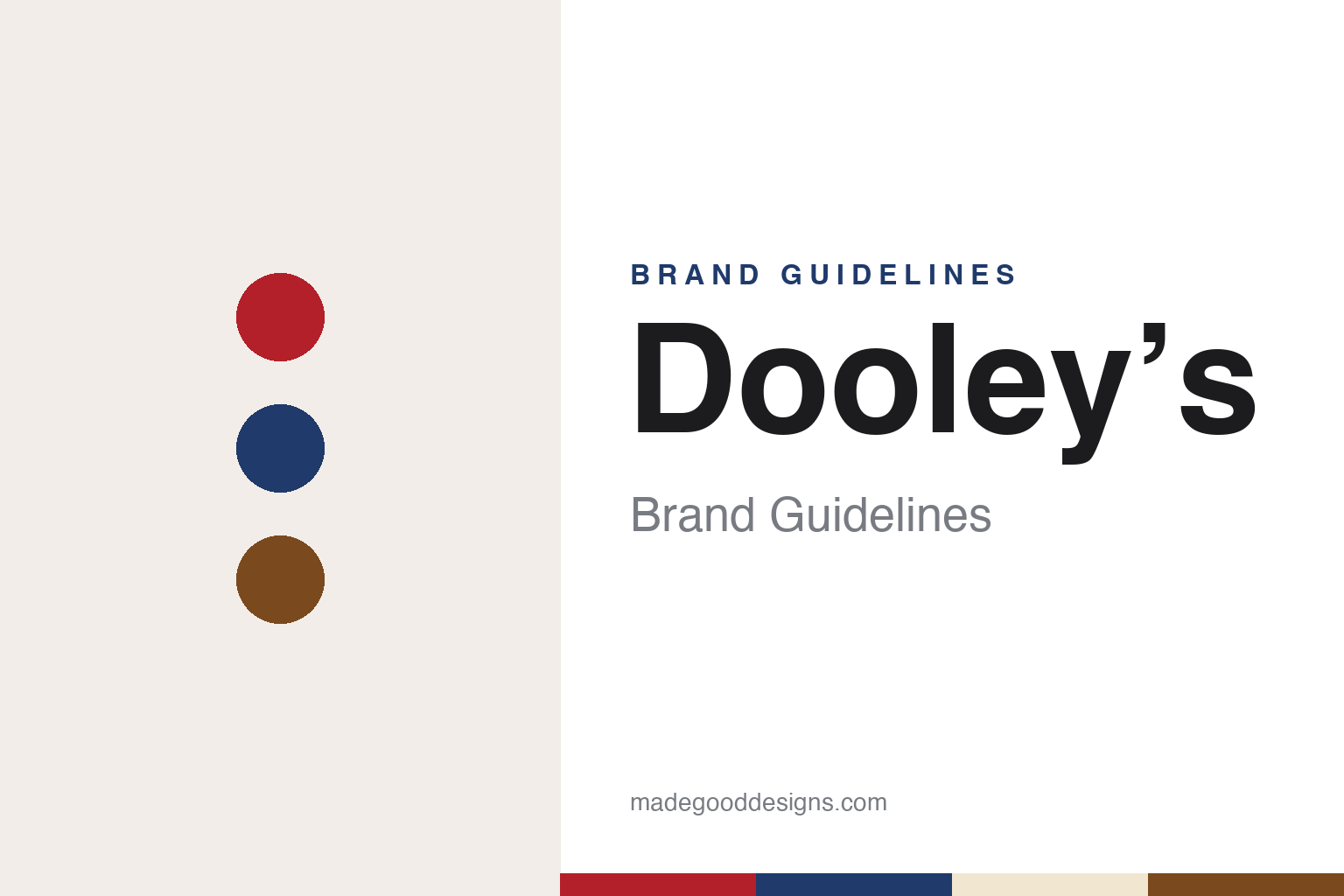
Two constants: a bottle red, bottle blue and toffee brown palette and a bold grotesque sans register. Abstract homage — not a Dooley’s product or mark; no label, logo or bottle is reproduced.
A cream liqueur from the Baltic coast
A toffee liqueur from a family spirits company founded in 1892.
Dooley’s is a cream liqueur from northern Germany. It is made by Waldemar Behn, a family-owned spirits company in Eckernförde, on the Baltic coast of Schleswig-Holstein, and its original flavour is toffee. English Wikipedia describes it as a German cream liqueur combining toffee and vodka, sold in a red and blue opaque bottle, with a strength of 17 per cent alcohol.
The brand dates from the end of the 1990s. The drinks trade site Just Drinks reported in September 2024 that Dooley’s was first launched in 1999; English Wikipedia’s article on Waldemar Behn dates the brand to 2000. Waldemar Behn has owned Dooley’s since its launch.
The company behind it is much older. Waldemar Behn says it was founded in 1892, and the German trade site about-drinks reported in August 2026 that the business has been family-owned throughout and is run in its fifth generation by Lisa Behn and Asmus Behn, with more than 170 employees. English Wikipedia says the company introduced its first liqueur brands in the 1950s, established Küstennebel in 1985 and launched the party drink Kleiner Feigling in 1992, its first brand known across Germany. In 2013, English Wikipedia says, it bought the Danish vodka brand Danzka from Marie Brizard Wine & Spirits, then called Belvedere. The Moodie Davitt Report wrote in October 2013 that Behn hoped the Danzka purchase would bring more interest in its brands, Dooley’s among them, from duty-free and travel-retail buyers.
Colour
A red and blue bottle, redrawn three times.
The bottle has long been the brand’s most recognisable feature. English Wikipedia describes it as opaque, in red and blue, holding a cream-coloured liqueur. In October 2013 the Moodie Davitt Report reported that Waldemar Behn had given the Dooley’s range a fresh look, upgrading the bottle design, the logo and the overall appearance of the range with what it called a “conceptual approach”; no agency was named.
The range has grown around the toffee original. In March 2017 about-drinks reported the launch of Dooley’s Original Egg Cream Liqueur, a vodka-based variant with the character of an egg liqueur, at 15 per cent in a 0.7-litre bottle. It called it the fourth Dooley’s variant on the German market and quoted the managing director, Rüdiger Behn.
The biggest change came in 2024. Just Drinks reported on 23 September 2024 that Waldemar Behn had changed the recipe of its vodka-based cream liqueur to make it entirely plant-based, using soy and coconut in place of cow’s milk, and that the brand would be relaunched as Dooley’s Creamy Liqueur at the end of October in 700 ml bottles, in three flavours — Toffee, White Choc Berry and The Yellow One — each at 15 per cent, and lactose-free. Fellmann called the change “a bold step” that “adapts to current consumer trends and continues Dooley’s success story.” The company cited “global trends towards more sustainable and plant-based diets,” and Fellmann said the plant-based version had exceeded the company’s expectations on taste. The same report noted that Waldemar Behn had recently redesigned other bottles in its portfolio, including Danzka and Andalö.
Another redesign followed two years later. about-drinks reported on 26 August 2026 that from 1 October 2026 three Dooley’s liqueurs — Toffee, White Chocolate with red wild berries, and a limited Salted Peanut edition — would appear in a revised look, in 0.7-litre bottles with a matt sleeve and the line “The Taste Experience.” That report said the recipe of the existing varieties was unchanged, described the base as a mild vodka with cream, and quoted Lisa Behn on pairing a familiar taste with a refined design. The toffee original, it added, would also come in a pack of 24 two-centilitre PET miniatures, and a gift pack for all three flavours, each with two of the brand’s Original Tipper glasses, was planned for November 2026.
Typography
Design and documentation.
The seven brands in this group are all coffee or cream liqueurs: Mr Black, Carolans, Saint Brendan’s, Kamora, Caffè Borghetti, Dooley’s and Coole Swan. Some are sweetened spirits flavoured with coffee; others blend dairy cream with a spirit such as Irish whiskey. Brands like these sit at many different points in the trade, from small independent companies to labels that now belong to much larger drinks groups, and the same bottle can turn up on a supermarket shelf, in an airport shop or behind a cocktail bar.
A liqueur brand’s identity is usually carried less by the liquid than by a bottle, a label and the story it tells, because the company behind the name may have changed hands, moved its production or licensed its name to others. That makes the questions behind each name worth asking plainly: who created it, who owns it now, and where it is actually made and bottled.
Each guide separates what independent sources record from what the company says about itself — its founding story, its owners over time, where its liqueur is made and how its bottles and labels have changed — and marks plainly what rests only on the company’s own word.
Aa
A bold grotesque sans for a brand built on its bottle. (Specimen set in Archivo, a sans-serif STAND-IN; NOT the Dooley’s logo.)
Dooley’s
A German cream liqueur that travels.
Dooley’s sells well beyond Eckernförde. The Moodie Davitt Report described it in 2013 as mainly a European-selling brand in duty-free and travel retail, and Just Drinks listed Germany and the United Kingdom among its markets in 2024. At home, Waldemar Behn also runs a drinks wholesaler, Behn Getränke, which Just Drinks reported supplies restaurants, food retailers, petrol stations, clinics and hospitals in the region. The company’s other brands include Kleiner Feigling, Danzka and the aperitif Andalö, and in 2024 Just Drinks named Philipp Fellmann as managing director; the 2026 about-drinks report named Lisa Behn as managing partner.
The name needs a little care online. dooleys.com belongs to an unrelated social and entertainment club in Lidcombe, Sydney; the liqueur’s maker publishes its corporate site at behn.de.
For a design guide, Dooley’s shows how a red and blue bottle and a cream-coloured toffee liqueur can stay recognisable through three redesigns, in 2013, 2024 and 2026, while the recipe and the range around it change. Compare Baileys, the Irish cream first devised in 1973, and Sheridan’s, the twin-chambered Irish coffee-and-cream liqueur. For this guide we use bottle red, bottle blue and toffee brown with a sans, an unofficial interpretation; no product or logo is reproduced.
Explore & save
Keep Dooley’s’s identity on hand — save it to a board in the Made Good inspiration library.
Dooley’s identity set
Pin the Dooley’s bottle red, bottle blue and toffee brown palette and the bold grotesque sans register to your own board.