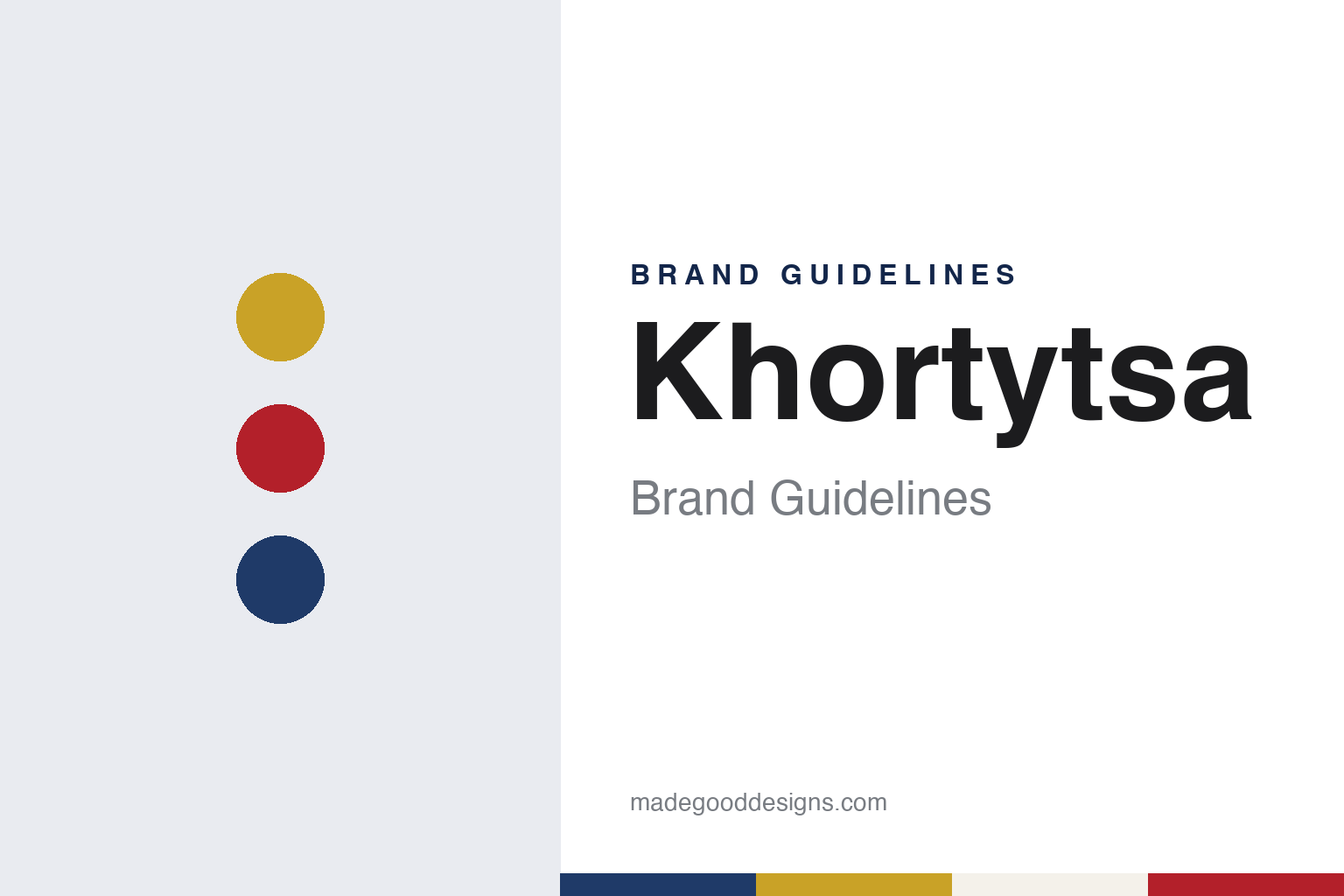
Khortytsa Brand Guidelines
The Zaporizhzhia vodka named after a Dnipro island.
Aa
Two constants: a Dnipro blue, cap gold and ring red palette and a high-contrast serif register. Abstract homage — not a Khortytsa product or mark; no label, logo or bottle is reproduced.
An island in the Dnipro
A distributor, a new distillery and a famous island’s name.
Khortytsa is a Ukrainian vodka named after Khortytsia, the island in the Dnipro River that lies within the city limits of Zaporizhzhia, in south-eastern Ukraine. Ukrainian Wikipedia says the company and its vodka were named in honour of the island. English Wikipedia gives the island as about 12.5 kilometres long and describes it as having played an important role in the history of Ukraine, especially in the history of the Zaporozhian Cossacks. On the neighbouring island of Little Khortytsia, it says, Dmytro Vyshnevetsky built a castle in the 1550s that is the earliest record of a stronghold later called a sich, although whether the castle counts as one is disputed; the Dnieper Rapids historical and cultural reserve set up there in 1974 was given national status in 1993. The brand writes its name “Khortytsa” in English, while English-language news reports usually spell the plant and the island “Khortytsia.”
The business began with distribution rather than distilling. Ukrainian Wikipedia says the entrepreneur Yevhen Chernyak founded a distribution company in Ukraine in 1998, and the brand’s own website today says Khortytsa was “launched in 1998.” The distillery came later. According to Ukrainian Wikipedia, its first bottles came off the line in December 2003, exactly a year after construction of the plant began, and the Kyiv Independent, writing in August 2026, likewise dated the launch of the Khortytsia distillery to 2003.
The plant became the base of a wider group. Global Spirits, the holding that owns the brand, was founded in 2008, Ukrainian Wikipedia says. In March 2025 Interfax-Ukraine described Global Spirits as headquartered in New York and as bringing together the Khortytsa plant in Zaporizhzhia, the Odesa Cognac Plant and a distribution company, with more than fifteen brands including Khortytsa, Pervak, Shustov and Morosha. The same report described Chernyak as the founder of the Khortytsa brand and said open sources name him as chair of the holding’s supervisory board. Ukrainian Wikipedia traces the Odesa plant to the Shustov family in 1863. It says the holding owns businesses producing vodka, infused spirits, brandy, wine and sparkling wine, and lists its own brands as including Khortytsa, Morosha, Shustoff and Blagoff.
Exports followed the domestic launch. Ukrainian Wikipedia says the Zaporizhzhia plant began distributing to CIS markets in 2006 and that the group’s representative office in the United States opened in 2011; English Wikipedia says the vodka is sold there under the shorter name Khor. On 24 February 2022, following Russia’s full-scale invasion of Ukraine, Global Spirits withdrew its licence to produce and distribute its products in the Russian market, Interfax-Ukraine reported in 2025.
Colour
A gold cap, a red ring and a bottle that turns blue.
Khortytsa’s identity is carried as much by the closure as by the label. The brand’s website describes a golden cap stamped with a raised logo and sealed with a red protection ring, which it says is there to guard against counterfeits. It presents three vodkas in its current range: Platinum, which it calls the flagship and says is known worldwide; De Luxe, which it describes as an elite, VIP-class vodka; and Premium. Ukrainian Wikipedia lists a longer family of earlier and parallel variants, including a Classic, a Silver Cool and an Ice.
The Ice is the most visual of them. Ukrainian Wikipedia says its bottle changes colour from white to blue to signal the ideal serving temperature, so that the pack itself tells the drinker when the vodka is cold enough.
The company describes its recipe in the same confident terms it uses for its packaging. Its website says Khortytsa is made from grain — selected wheat with the addition of rye and barley — and passed through seven levels of filtration, among them a filter containing the mineral shungite, quartz sand and charcoal made from birch and alder; these are the company’s own descriptions.
The name does the rest of the work. In Ukraine the vodka carries the island’s name in full; in the United States, English Wikipedia says, it is sold as Khor. The brand website’s copyright line names GSH Trademarks Limited, and the site credits its web design and marketing to Alcohol Marketing Agency.
Khortytsa shares its home market with another Ukrainian vodka covered in this series, Nemiroff, from Nemyriv, and with its own sister brands inside Global Spirits, such as Morosha and Pervak, which the holding lists alongside it.
Typography
Vodka, aquavit and bitters from the north and east.
The six brands in this group are spirits from northern and eastern Europe: Gammel Dansk, Malteserkreuz, Explorer, Purity, Luksusowa and Khortytsa. They span three kinds of drink — aquavit, a bitter and vodka — and spirits brands of this kind sit at many different points in the trade, from names that still carry a founder’s signature to labels that now belong to much larger drinks groups, and a single brand can be sold everywhere from a state-run shop to a duty-free shelf.
A spirits brand’s identity is usually carried less by the liquid than by a bottle, a label and the place or story it promises, because the company behind the name may have changed hands, moved its production or grown far beyond the town where it started. That makes the questions behind each name worth asking plainly: who started it, who owns it now, and where its spirit is actually distilled and bottled.
Each guide separates what independent sources record from what the company says about itself — its founding story, its owners over time, where its spirit is made and how its labels have changed — and marks plainly what rests only on the company’s own word.
Aa
A high-contrast serif for a vodka named after a historic island. (Specimen set in Playfair Display, a serif STAND-IN; NOT the Khortytsa logo.)
Khortytsa
From Zaporizhzhia to Rivne, 2022–2026.
The war changed where Khortytsa is made. In 2022, the Kyiv Independent reported, citing Bloomberg, the company agreed to move about half of Khortytsia’s production to Rivne, in western Ukraine, because of the Zaporizhzhia plant’s proximity to the front line.
In 2026 the plant itself was hit. On 19 July, Global Spirits’ main warehouse was badly damaged in a Russian attack, and on 27 August 2026 the Khortytsia distillery was hit four times during a Russian attack on Zaporizhzhia Oblast, sparking a fire that lasted about three hours, the Kyiv Independent reported on 28 August, citing the company’s press service speaking to the Ukrainian outlet NV. The company said the plant had been destroyed beyond repair; some of its finished products burned completely and others partially melted. Ukrainian Wikipedia now records the Zaporizhzhia plant as fully destroyed. In October 2026 the brand’s website continued to present Platinum, De Luxe and Premium. Beyond Zaporizhzhia and Rivne, Global Spirits also owns a cognac plant in Odesa, the Kyiv Independent noted in the same report.
For a design guide, Khortytsa shows how a vodka can take its identity from a place — an island in the Dnipro — and carry it through a name, a gold cap with a red ring and a bottle that changes colour when cold. Compare Nemiroff, another Ukrainian vodka, and Luksusowa, from neighbouring Poland. For this guide we use Dnipro blue, cap gold and ring red with a serif, an unofficial interpretation; no product or logo is reproduced.
Explore & save
Keep Khortytsa’s identity on hand — save it to a board in the Made Good inspiration library.
Khortytsa identity set
Pin the Khortytsa Dnipro blue, cap gold and ring red palette and the high-contrast serif register to your own board.


