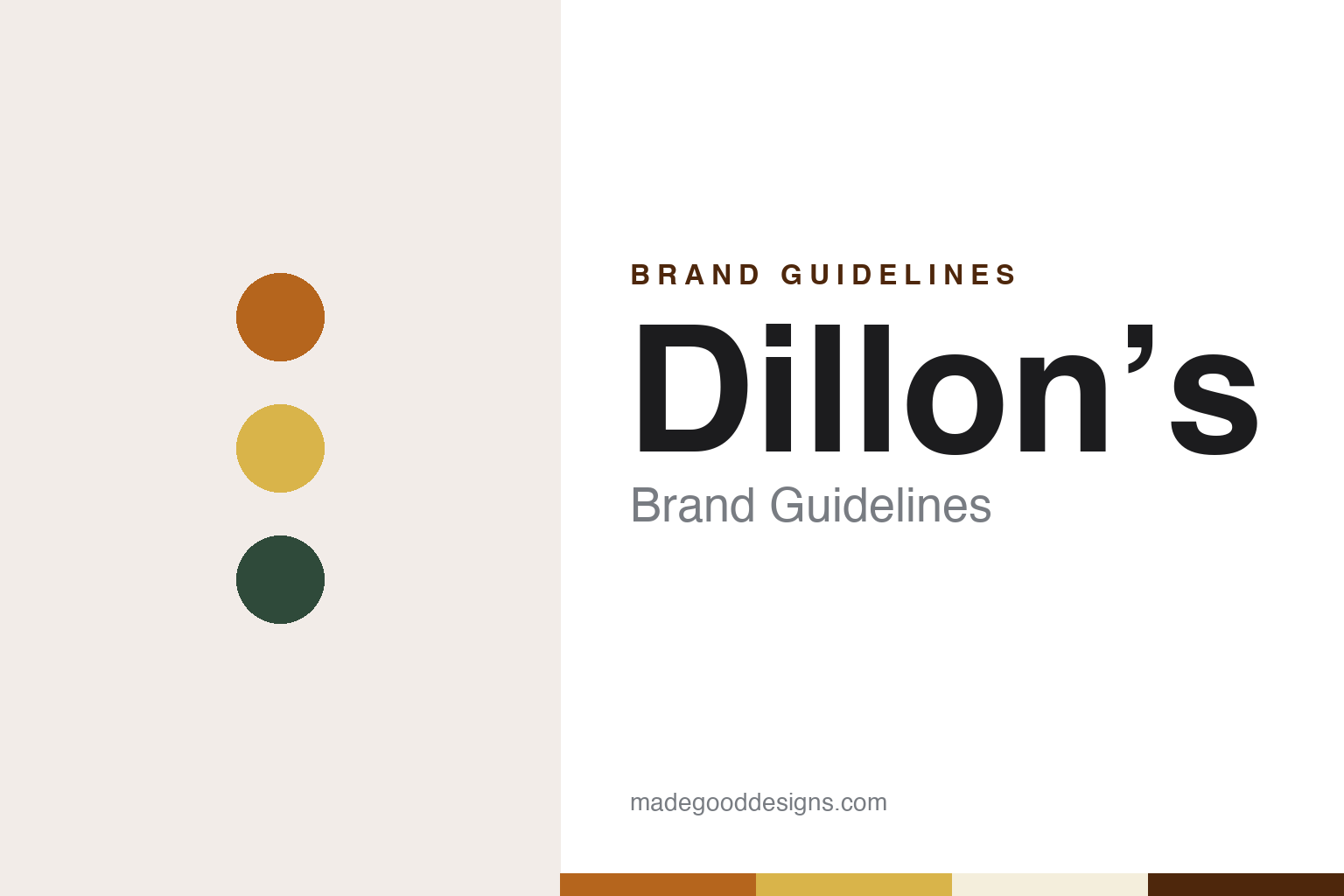
Dillon’s Brand Guidelines
Geoff Dillon’s Beamsville rye distillery, founded 2012.
Aa
Two constants: a pot-still copper, rye straw and vine green palette and a bookish transitional serif register. Abstract homage — not a Dillon’s product or mark; no label, logo or bottle is reproduced.
A biochemist’s distillery in wine country
Copper pots, Niagara fruit and a rye made only from rye.
Dillon’s Small Batch Distillers is a craft distillery in Beamsville, Ontario, on the Niagara Peninsula. It was founded in 2012 by Geoff Dillon, whom the Niagara wine writer Rick VanSickle described in Wines In Niagara in April 2021 as a master distiller with degrees in biochemistry and economics. The company itself dates its start to 2012, writing on its website that it “began this journey back in 2012.”
It began as a father-and-son venture. Writing in eatdrink magazine soon after the distillery opened, VanSickle named Geoff’s father, Dr. Peter Dillon, a Trent University professor specialising in biogeochemistry, as his partner, and reported that the young distillery shared a production facility with Angels Gate Winery. Even in that first profile, the method was the message: Dillon told the magazine that most Canadian whisky is made in continuous columns, “while we are returning to copper pot stills,” and the distillery had built its own mashing-stripping still.
The raw materials were local from the start. eatdrink reported a base spirit made from Niagara grapes that would otherwise have been discarded during the annual thinning of the vines, seasonal spirits from Niagara peaches, pears and cherries, and a whisky made from 100% Ontario-grown rye. The same article described an absinthe made with wormwood from Peter Dillon’s garden and a rye whisky resting in barrels of Ontario-grown oak. Dillon pointed out to the magazine that Canadian rye whisky can be made with as little as zero per cent rye grain.
Colour
An ingredient list on every label, and a rye named for its grain.
The clearest statement of the brand is printed on the bottle. Dillon told eatdrink that the company aimed to be “honest and open,” saying, “We not only list all the ingredients used, but where they come from, on every label.” The company’s website repeats the idea in a quote attributed to its founder: “We won’t put something in a bottle without telling you what it is.” The site also names the growers and places behind its ingredients, from berry farms in Jordan, Ontario, to rye grain from Brant County.
The gin made the name first. NOW Toronto reviewed Dillon’s Unfiltered Gin 22 in April 2014, describing a gin distilled from 100 per cent Ontario grape spirit, infused with 22 botanicals, many grown by Niagara farmers, and left unfiltered so that it turns cloudy when ice or water is added, which the writer told readers not to be alarmed by.
The whisky took longer, because it had to age. Wines In Niagara reported that the distillery’s flagship rye was first sold as The White Rye, with Dillon’s Rye Whisky following in 2016. A decade on, the whisky reached a wider stage: The Tasting Alliance, which runs the San Francisco World Spirits Competition, announced in June 2026 that Dillon’s Rye 1 Whisky had won the competition’s Best New Rye Whiskey award for 2026, describing a whisky made entirely on site from a mash of 100% Ontario-grown rye and aged in local oak.
The brand also lives in print and in cans. Geoff Dillon and Whitney Rorison, whom the company’s website names as its brand steward, wrote Craft Cocktails: Seasonally Inspired Drinks and Snacks from Our Sipping Room, published by Penguin Random House in 2019, according to its Open Library catalogue record. The company says it launched ready-to-drink Gin Cocktails in 2022, followed by Vodka Cocktails. Its current website carries a credit to the agency Major Tom.
Typography
Design and documentation.
The six brands in this group are all Canadian whisky names: Pike Creek, Shelter Point, Still Waters, Dillon’s, Okanagan Spirits and Canadian Mist. They range from labels that belong to large international drinks groups to independent distilleries in Ontario and British Columbia, and a single bottle can be sold everywhere from a provincial liquor store to a bar rail on the other side of the border.
A whisky brand’s identity is usually carried less by the spirit itself than by a label, a name and the place it promises, because the company behind the name may have changed hands, the distillery may have changed owners, and the bottling may happen somewhere other than where the whisky was made. That makes the questions behind each name worth asking plainly: who started it, who owns it now, and where its whisky is actually distilled, aged and bottled.
Each guide separates what independent sources record from what the company says about itself — its founding story, its owners over time, where its whisky is made and how its labels have changed — and marks plainly what rests only on the company’s own word.
Aa
A bookish transitional serif for a name that reads like a family firm. (Specimen set in Libre Baskerville, a serif STAND-IN; NOT the Dillon’s logo.)
Dillon’s
A Niagara craft distillery inside a national drinks group.
In 2021 the distillery changed hands. The Vancouver law firm Farris announced on 1 February 2021 that it had represented Mark Anthony Group in completing the acquisition of substantially all of the assets of Pure Spirits Distilling Corporation, which traded as Dillon’s Small Batch Distillers; the firm’s announcement pointed to the distillery’s Niagara Peninsula location and its access to local ingredients. The deal became public in late April, when Wines In Niagara reported it and noted that Mark Anthony Group, founded in 1972 by Anthony von Mandl, also owns Mission Hill and several other British Columbia wineries, White Claw and Bearface Canadian Whisky. Mark Anthony Group has owned Dillon’s since 2021; von Mandl’s earlier hit was Mike’s Hard Lemonade.
The new owner kept the founder and the name. Wines In Niagara reported that Geoff Dillon agreed to stay on as general manager of the distillery he founded, that it would remain in Beamsville, and that the team would keep making small-batch releases under the Dillon’s name with fresh local ingredients. Dillon told the publication, “I could not be happier to be part of the Mark Anthony family.” Today the company describes a range that runs across gin, rye whisky, vodka, fruit spirits, bitters and canned cocktails, with tours and tastings at the distillery.
For a design guide, Dillon’s shows how a small distillery can make its recipe the brand: a family name, an all-rye whisky and an ingredient list printed on every label, carried intact into a national drinks group. Compare Forty Creek, John Hall’s whisky from nearby Grimsby, and Mission Hill, the British Columbia winery in the same group. For this guide we use pot-still copper, rye straw and vine green with a serif, an unofficial interpretation; no product or logo is reproduced.
Explore & save
Keep Dillon’s’s identity on hand — save it to a board in the Made Good inspiration library.
Dillon’s identity set
Pin the Dillon’s pot-still copper, rye straw and vine green palette and the bookish transitional serif register to your own board.


