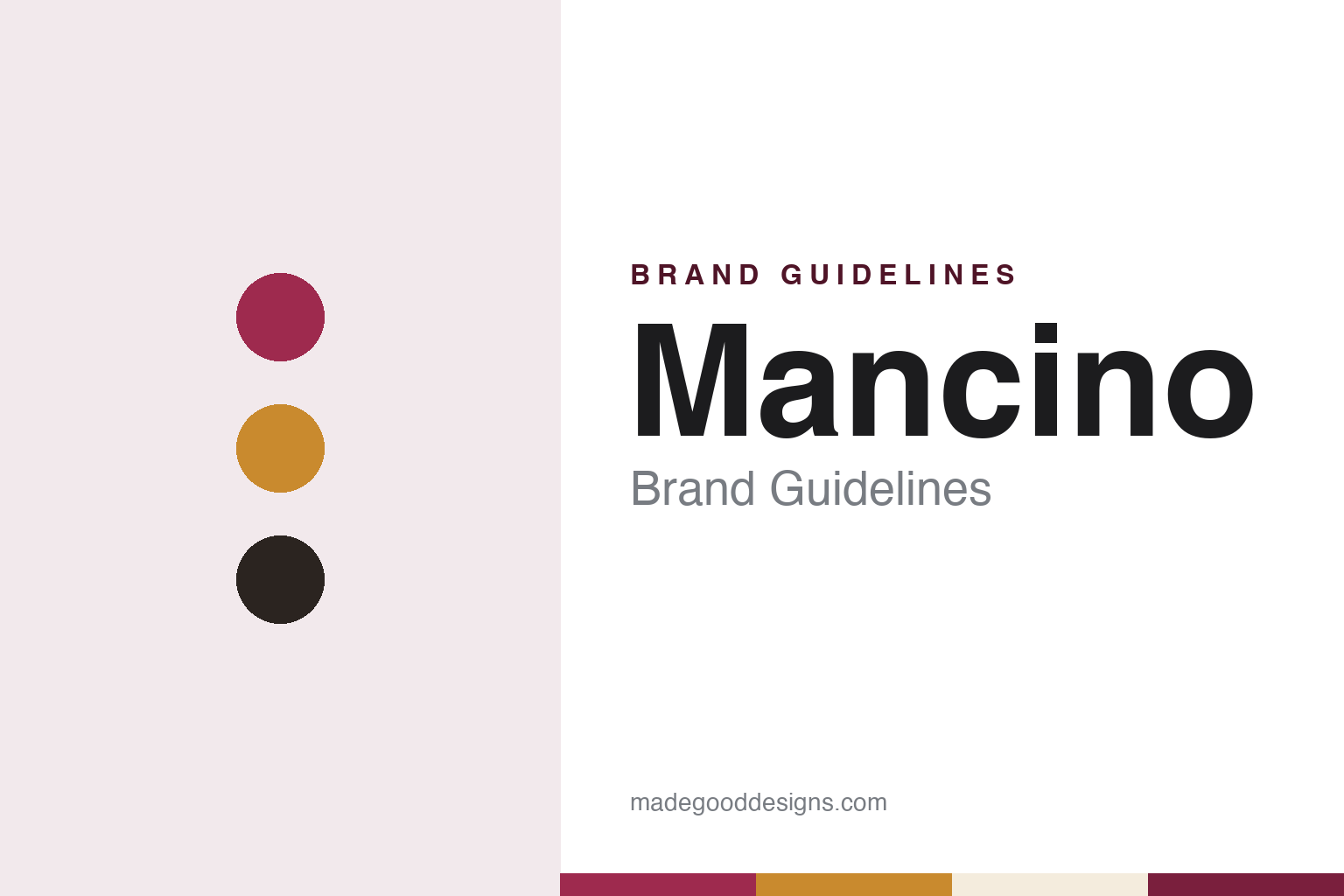
Mancino Brand Guidelines
A bartender’s vermouth from Asti, Lucano-owned since 2021.
Aa
Two constants: an amaranth red, amber and label cream palette and a high-contrast display serif register. Abstract homage — not a Mancino product or mark; no label, logo or bottle is reproduced.
A bartender’s own vermouth
From the back bar in London to a distillery in Asti.
Mancino is a vermouth brand named after the man who created it. Giancarlo Mancino is a bartender and entrepreneur; the company says he comes from Pignola, a small hill town in Basilicata, and in an interview with Australian Bartender published in January 2023 he said he started out very young as a bartender in London. The Spirits Business reported in March 2017 that he headed the bar team at The Athenaeum, a five-star hotel in London, and had been instrumental in developing its bar concept and cocktail programme. He also ran a consultancy, Giancarlo Bar, according to the 2023 interview.
The vermouth came out of that work behind the bar. The brand’s partner page on The World’s 50 Best Bars site says Mancino Vermouth was born in 2011 in a small family-run distillery in Asti, Piedmont, a distillery established in 1957, and that Mancino set out to bring back vermouth in the classic style of the early 1900s. The company’s own biography of Mancino tells the same story of a family-run Asti distillery founded in 1957. The Spirits Business also gave 2011 as the year the line launched.
The public debut came a year later. The company says the range was presented at Bar Convent Berlin in 2012, the trade fair for the bar industry, and Mancino himself told Australian Bartender in 2023 that he “finally launched” his own vermouth in 2012 at the BCB in Berlin. Both dates therefore appear in the record: 2011 for the creation of the vermouth, 2012 for its presentation to the trade.
Colour
Forty botanicals, an old mill and names taken from colour.
Mancino describes its method in some detail, and all of it is the company’s own account. It says about 40 hand-selected herbs from Italy, England, Vietnam and India are used; that each herb is crushed in an old mill dating from 1930; that extraction takes up to 30 days for each herb; and that the herbs are blended with a Trebbiano di Romagna IGP wine, sugar and a neutral alcohol made from sugar beet. The company says the vermouth is then filtered through linen fibres for about a week and rests in stainless-steel tanks for another six months before bottling, at its plant in Piedmont.
The names of the core range do the descriptive work. Alongside the Secco sit the Bianco Ambrato and the Rosso Amaranto, names that take the Italian words for amber and amaranth. According to the brand’s partner page on The World’s 50 Best Bars site, the Secco, Bianco and Rosso use Trebbiano di Romagna, the Vecchio is aged in barrel for twelve months, and the Chinato is built on Barbera d’Asti. The same page speaks of the “classic look and feel” of the bottle, which is brand copy rather than an independent description.
Limited editions stretched the line. The Spirits Business reported in March 2017 that Mancino had launched Sakura, a vermouth made with violet petals and cherry blossom, at first only for the Mandarin Oriental Tokyo; it was the sixth release, joining the Secco, the Bianco Ambrato, the Rosso Amaranto, the Vecchio and the Chinato. A coffee vermouth, Kopi, has since joined the range, and the company lists a Mancino Highball, which it dates to 2019.
The brand also uses art and bar culture as part of its identity. The company says it has commissioned made-to-measure posters from an artist, offered as free downloads, and that its sponsorship of The World’s 50 Best Bars began in 2018; the awards’ site lists Mancino as its Official Vermouth Partner.
Typography
Design and documentation.
The seven brands in this group are sherry and vermouth names: Valdespino, Williams & Humbert, Barbadillo and Emilio Hidalgo on the sherry side, and Dolin, Belsazar and Mancino on the vermouth side. Sherry is a fortified wine from the far south of Spain, made by bodegas in towns such as Jerez de la Frontera and Sanlúcar de Barrameda; vermouth is a wine flavoured with herbs and spices, made here in France, Germany and Italy. Both trades sit at many different points in the drinks business, from family houses that still carry a founder’s name to labels that now belong to larger groups.
A sherry or vermouth brand’s identity is usually carried less by a single bottle than by a label, a name and the place it promises, because the company behind the name may have changed hands, moved its production or grown far beyond the place where it started. That makes the questions behind each name worth asking plainly: who started it, who owns it now, and where its wine is actually made and bottled.
Each guide separates what independent sources record from what the company says about itself — its founding story, its owners over time, where its sherry or vermouth is made and how its labels have changed — and marks plainly what rests only on the company’s own word.
Aa
A high-contrast display serif for a vermouth that looks back to the early 1900s. (Specimen set in Playfair Display, a serif STAND-IN; NOT the Mancino logo.)
Mancino
From a founder’s brand to a family-owned group.
In December 2021 the brand changed hands. The Italian food site Dissapore reported on 7 December 2021 that Amaro Lucano, the family company behind the amaro from Pisticci in Basilicata, had acquired the majority of Mancino Vermouth and its seven labels, and that Giancarlo Mancino would stay in the company as a director responsible for business development. No percentage was given. Drinks International reported the deal on 20 December 2021 and noted that the owners of the two companies had first met in Chicago in 2013; Dissapore named that first meeting as one between Giancarlo Mancino and Leonardo Vena of the Lucano family. Mancino told Australian Bartender in 2023 that part of the company had been bought by the Amaro Lucano family.
The deal joined a vermouth made in Piedmont, created by a bartender the company says comes from Pignola in Basilicata, to the group behind Amaro Lucano, whose home is in the same southern region. The company, Mancino Vermouth S.r.l., gives an address in Milan, and the brand’s site links to Amaro Lucano’s online shop.
The name needs a little care. Mancino is also an Italian surname, and the vermouth brand’s own site is mancinovermouth.com.
For a design guide, Mancino shows how a founder’s name, colour words built into product names and a steady presence in the bar trade can carry a young vermouth brand alongside houses that are far older. Compare Cocchi, the Asti house of Americano and vermouth, and Carpano, the Turin vermouth of 1786. For this guide we use amaranth red, amber and label cream with a display serif, an unofficial interpretation; no product or logo is reproduced.
Explore & save
Keep Mancino’s identity on hand — save it to a board in the Made Good inspiration library.
Mancino identity set
Pin the Mancino amaranth red, amber and label cream palette and the high-contrast display serif register to your own board.


