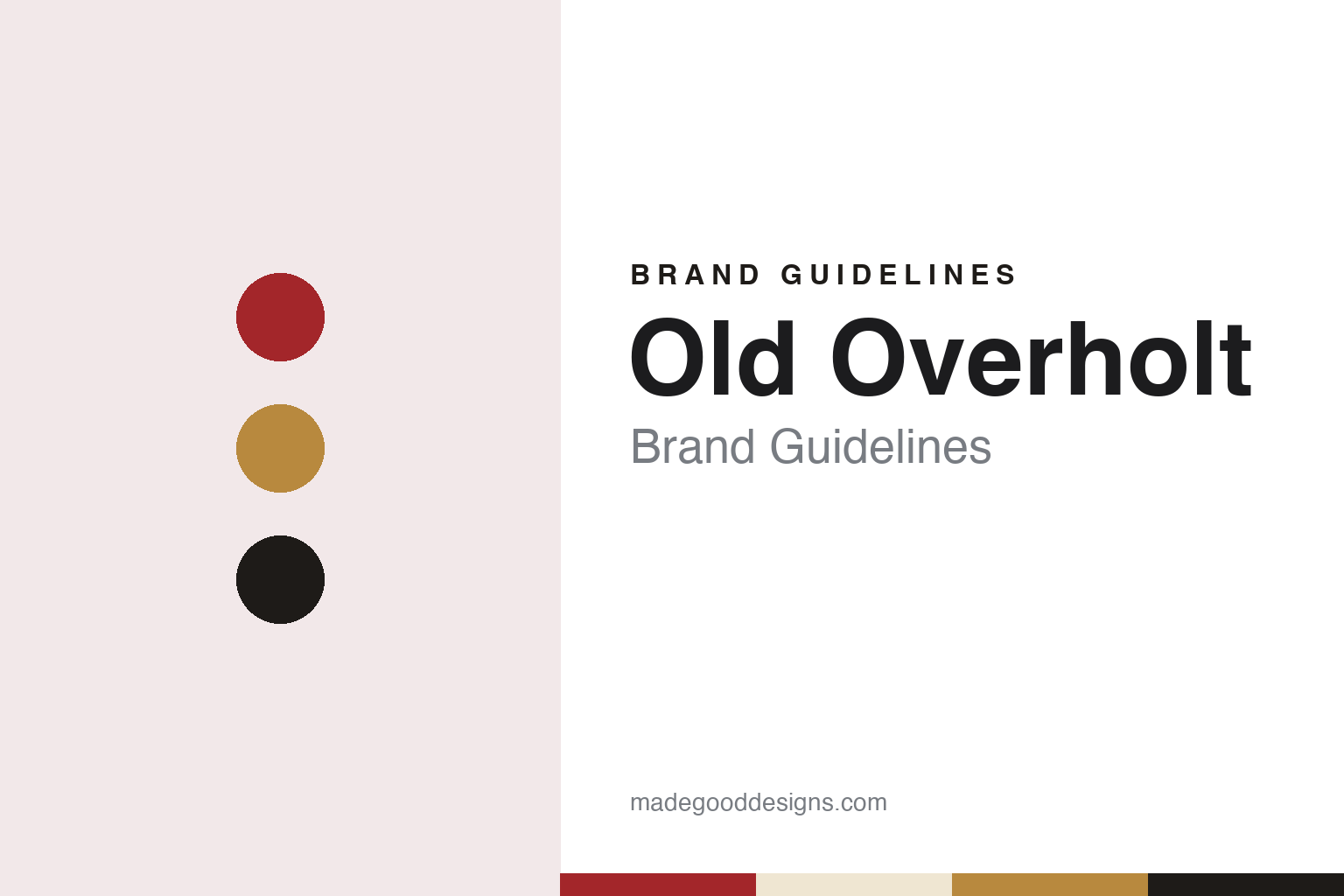
Old Overholt Brand Guidelines
The Pennsylvania rye with a founder’s frown on the label.
Aa
Two constants: a railroad red, rye gold and engraving black palette and a Victorian modern serif register. Abstract homage — not an Old Overholt product or mark; no label, logo or bottle is reproduced.
A Mennonite farm on Jacobs Creek
Henry and Abraham Overholt, West Overton and Broad Ford.
Old Overholt began on a farm in south-western Pennsylvania. The Pittsburgh Tribune-Review reported in December 2020 that Henry Overholt, a Mennonite farmer, led a family of 13 across the Allegheny Mountains from Bucks County in 1800 and settled by Jacobs Creek in Westmoreland County, at the place now called West Overton. The Tribune-Review says the family distilled surplus grain into whiskey. English Wikipedia’s article on the village says his son Abraham Overholt started a distillery there in 1803; the brand dates itself to 1810, the year, the Tribune-Review says, that Abraham turned his father’s distilling into a commercial business.
The business grew through the first half of the century. English Wikipedia’s article on the brand, drawing on the drinks historian David Wondrich’s 2016 history in The Daily Beast, says Baltimore newspapers were advertising Overholt’s “Old Rye” by 1843, and that a second distillery opened at Broad Ford, in neighbouring Fayette County, in 1853. The firm became A. & H.S. Overholt in 1854 and later A. Overholt & Co., according to the 1985 National Register of Historic Places nomination cited there. The Tribune-Review says one early name for the whiskey was Old Farm Pure Rye Whiskey.
The next chapter stayed in the family. Abraham’s grandson was Henry Clay Frick, the coke and steel magnate, who was born at West Overton in 1849, English Wikipedia says. In 1881 Frick took over the business, bringing in the banker Andrew Mellon and Charles W. Mauck as partners with a third each.
Colour
A founder’s portrait in 1888, a grin, and a frown restored in 2020.
The name and the face arrived together. According to English Wikipedia, citing Wondrich, it was Mauck who adopted the name Old Overholt in 1888, used Abraham Overholt’s portrait as the logo, and moved the company from selling whiskey by the barrel to selling it in bottles. The Tribune-Review describes the portrait as scowling, “grumpy or stoic”, and taken from photographs of him. The portrait has stayed on the label ever since.
Over time the face softened. In March 2020 Beam Suntory announced a package update, and The Whiskey Wash quoted the company as saying that Abraham, “most recently depicted with a gentle grin,” would now show a distinct frown, matching his historical portraits and labels going back to 1888. Whisky Advocate called the new face “slightly grumpier.” The Tribune-Review reported that the new portrait was drawn by the illustrator Steven Noble, the artist behind the American Express Centurion logo.
The same update changed other parts of the bottle. The label gained the words “Born in PA” and “Made in KY,” a short summary of the brand’s two homes, and the black closure gave way to a red cap, which the company said was closer to the original bottles. The Tribune-Review added that the company described the red caps as a tribute to the Overholt family’s links with the Pennsylvania Railroad. The whiskey inside changed too: from March 2020 the standard rye moved from 80 to 86 proof and stopped being chill-filtered, and the bottled-in-bond version received the same label and filtration changes.
Typography
Design and documentation.
The seven brands in this group are all American whiskey names known for rye, often alongside bourbon: Sagamore Spirit, Old Overholt, Templeton, Pikesville, James E. Pepper, Willett and Catoctin Creek. They sit at very different points in the trade, from family-run distilleries to labels that belong to much larger drinks groups, and a single name can stand for a working distillery, a revived old brand or a whiskey made somewhere else and bottled under the label.
In the United States the word on the label has a legal meaning. Federal rules on spirits labelling (27 CFR 5.143) define rye whisky as whisky made from a fermented mash of at least 51 per cent rye, distilled at 160 proof or less and stored in charred new oak barrels at 125 proof or less; a whisky called “straight” must spend at least two years in those barrels. The same rules set out bourbon on the same pattern, with corn in place of rye. What the rules fix is the recipe and the barrel, not the look of the bottle, so the identity of each brand is carried by its name, its label and the place it claims.
That makes the questions behind each name worth asking plainly: who started it, who owns it now, and where its whiskey is actually distilled, aged and bottled. Each guide separates what independent sources record from what the company says about itself — its founding story, its owners over time, where its whiskey is made and how its labels have changed — and marks plainly what rests only on the company’s own word.
Aa
A Victorian modern serif for a label built around an 1888 portrait. (Specimen set in Old Standard TT, a serif STAND-IN; NOT the Old Overholt logo.)
Old Overholt
From Frick and Mellon to National Distillers, Beam and Suntory.
The Frick era ended after his death in December 1919, when his share passed to Mellon, English Wikipedia says, citing Wondrich. National Prohibition began in 1920, and the company obtained a permit to sell its existing stock to druggists as medicinal whiskey. Mellon sold his share in 1925, and in 1932 the brand went to National Distillers Products. After repeal the Broad Ford plant restarted, but West Overton never reopened, Whisky Advocate reported in 2018. National Distillers stopped distilling at Broad Ford in 1951, and a lighter 86-proof version followed in 1962.
In 1987 the brand was sold to the James B. Beam Distilling Company, then part of American Brands, and production moved from Pennsylvania to Kentucky. The Japanese drinks group Suntory completed its takeover of Beam Inc. in April 2014, creating Beam Suntory, which was renamed Suntory Global Spirits in May 2024, English Wikipedia says. Suntory has owned Old Overholt since 2014, and English Wikipedia gives the Jim Beam distillery at Clermont, Kentucky, as where it is made today.
The range has widened since the 2010s. A four-year-old, 100-proof bottled-in-bond rye was released late in 2017, and in 2020 the company sent two limited releases, a 114-proof rye and an 11-year-old, to Pennsylvania and Ohio, the Tribune-Review reported. In 2024 A. Overholt appeared, a rye made from what the company calls a “Monongahela mash” of rye and malted barley, Whisky Advocate reported. The brand’s home village has its own story now: West Overton is a museum complex covering distilling, milling and the coal and coke industry, and English Wikipedia says Monongahela rye has been made again at its educational distillery since October 2020.
For a design guide, Old Overholt shows how a single portrait can hold a brand together through more than a century of changing owners and a move between two states, and how small changes to a face, a cap and two short place names can shift a label’s mood. Compare Rittenhouse, the bonded rye named for a Philadelphia square, and Jim Beam, its stablemate at Clermont. For this guide we use railroad red, rye gold and engraving black with a Victorian serif, an unofficial interpretation; no product or logo is reproduced.
Explore & save
Keep Old Overholt’s identity on hand — save it to a board in the Made Good inspiration library.
Old Overholt identity set
Pin the Old Overholt railroad red, rye gold and engraving black palette and the Victorian modern serif register to your own board.


