Silentnight Brand Guidelines
The Barnoldswick bed maker of the Hippo and the Duck.
Aa
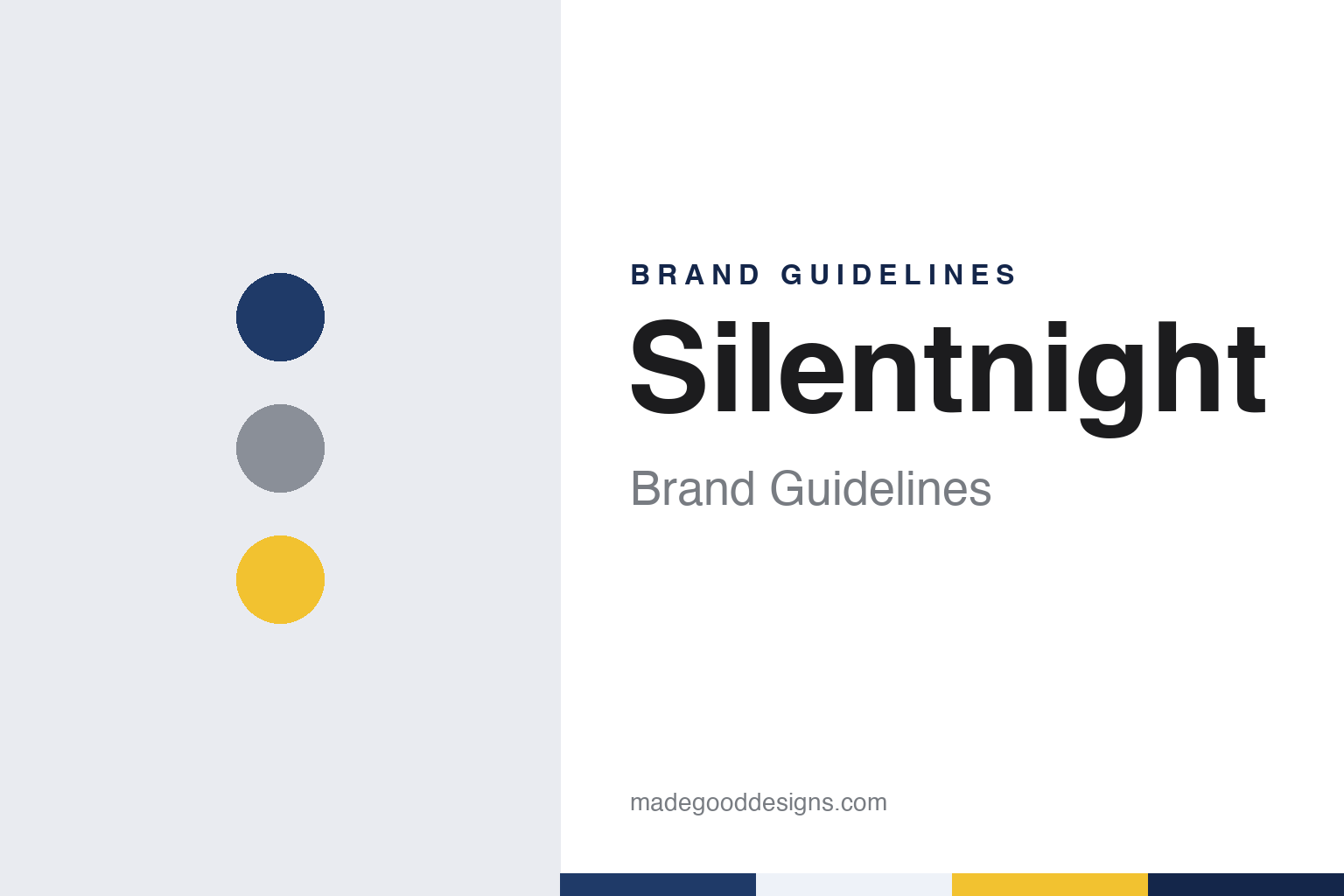
Two constants: a Silentnight navy, grey and yellow palette and a friendly rounded sans register. Abstract homage — not a Silentnight product or mark; no mattress, mascot or logo is reproduced.
Clarke’s Mattresses
A naval gratuity, a Yorkshire town and a new name in 1951.
Silentnight began on 11 July 1946 in Skipton, North Yorkshire, when Tom Clarke set up Clarke’s Mattresses Limited, English Wikipedia says, citing the Keighley News and the company’s own history; it adds that the business was funded by the gratuity Clarke received on leaving the Royal Navy. The company itself calls 1946 its “official birth” and says it was “born as Clarkes Mattresses before changing its name to Silentnight in 1951.” English Wikipedia credits the new name to a suggestion by Clarke’s wife, Joan.
The firm soon moved a few miles west. English Wikipedia, citing the Lancashire Telegraph, says it has been based in Barnoldswick since 1949 and in its present premises there since 1961. The town was then in the West Riding of Yorkshire; the 1974 boundary changes moved it into Lancashire, which is why a company founded in Yorkshire is now described as Lancashire-based.
Silentnight grew into a listed company. It floated on the stock market in 1973, the BBC reported in 2003, and that year the Clarke family took it private again, according to the Yorkshire Post. Along the way it ran other factories, at Sutton-in-Craven, Keighley and Batley among others; English Wikipedia, citing local papers, records the Keighley plant closing in 2002 and Batley in 2012. Its history also includes a long industrial dispute at Barnoldswick and Sutton-in-Craven between 1985 and 1987, which English Wikipedia, citing The Independent, says lasted 616 days.
Colour
Two cartoon animals and a spring unit.
Silentnight’s best-known piece of identity is not a logo but a double act. The company dates its Hippo & Duck mascots to 1986. The Institute of Practitioners in Advertising, which gave the campaign a third prize in its 1990 Effectiveness Awards, credits the agency TBWA’s Manchester office and describes a television test in three areas followed by a national roll-out in 1987; the IPA case study says the characters used in the advertising “were deemed effective.”
The pair came back more than once. Marketing Week reported in November 2000 that the “Lancashire-based bed manufacturer” would return to television in January 2001 with a campaign by Mortimer Whittaker O’Sullivan that would bring back the hippo and duck, “absent from the small screen for ten years.” In March 2002 The Drum reported that Silentnight was again using its “trusty ‘duck and hippo’ partnership” to sell its Miracoil mattresses.
The company’s own timeline marks later turns in its presentation: a rebrand in 2012 “to reflect a focus on quality and new products,” and in 2020 a benefit-led positioning it summarises as “sleepers before springs.” Today its website calls Silentnight “the UK’s most trusted sleep brand” and says it has been “helping the nation sleep better for over 80 years”; both are the company’s own descriptions.
Its range is broad. English Wikipedia, citing Furniture Production in 2017, lists the group’s brands as Layezee, Perfecta, Rest Assured, Silentnight, Studio and The Pocket Spring Bed Company, so the Silentnight name sits above a family of beds and mattresses at different levels of the market.
Typography
Design and documentation.
The seven brands in this group are all mattress names: Silentnight, Relyon, Eve, Layla, Helix, Leesa and Dunlopillo. Mattress brands in general sit at many different points in the trade, from long-established factory names sold through bed shops and department stores to younger companies that began by selling online and delivering a mattress rolled up in a box, and a single name can change hands more than once while the product on the shop floor looks much the same.
A mattress brand’s identity is usually carried less by the product itself, which is mostly hidden under a sheet, than by a name, a label stitched to the side, the box it arrives in and the advertising around it. The company behind that name may have been sold, gone through administration, seen its name pass to different owners in different countries or moved its making elsewhere. That makes the questions behind each name worth asking plainly: who started it, who owns it now, and where its mattresses are actually made.
Each guide separates what independent sources record from what the company says about itself — its founding story, its owners over time, where its mattresses are made and how its look has changed — and marks plainly what rests only on the company’s own word.
Aa
A friendly rounded sans for a mass-market sleep brand. (Specimen set in DM Sans, a sans STAND-IN; NOT the Silentnight logo.)
Silentnight
From family firm to private-equity group.
The family era ended in 2011. In May that year the private-equity firm HIG Europe bought Silentnight out of administration, the BBC reported on 9 May 2011, and HIG has owned it since; English Wikipedia, citing the same report, says the Clarke family was largely replaced in the management and that the business then employed about 1,250 people in the UK. The deal left a long pensions dispute: the Pensions Regulator announced legal action in 2013, Sky News reported, and in March 2021 the regulator announced a settlement with HIG over the Silentnight pension scheme.
Silentnight is now part of a larger bed group. In May 2024 Furniture News reported that The Sleep Group, owned by HIG Capital and the parent of Silentnight, had bought Sleepeezee, the bed maker of Rochester, Kent, from the French private-equity firm Perceva, with both brands keeping their own sites and management. In October 2024 the same magazine said Silentnight had made its products in Lancashire for more than 75 years, with research and development at its manufacturing hub in Barnoldswick, and quoted its chief executive, Tracey Bamber. Alongside the Barnoldswick works, English Wikipedia records a digital office on Quay Street in Manchester.
The company’s own claims about making are direct: “Our products are handmade in our factory, here in the UK,” its website says, and it describes beds “manufactured here in the UK.” It also says it became Premier Inn’s official bed supplier for the UK and Europe in 2023, became a certified B Corporation in 2025, after an assessment by B Lab, and in 2026 became Manchester City’s official sleep partner. It says it repurposes manufacturing waste so that none goes to landfill.
For a design guide, Silentnight shows how a pair of cartoon animals can carry a functional promise for decades. Compare Relyon, a West Country bed maker with a longer history and a different ownership story, and Vispring, the Plymouth pocket-spring maker. For this guide we use navy, a hippo grey and a duck yellow with a sans, an unofficial interpretation; no product or logo is reproduced.
Explore & save
Keep Silentnight’s identity on hand — save it to a board in the Made Good inspiration library.
Silentnight identity set
Pin the Silentnight navy, grey and yellow palette and the friendly rounded sans register to your own board.


