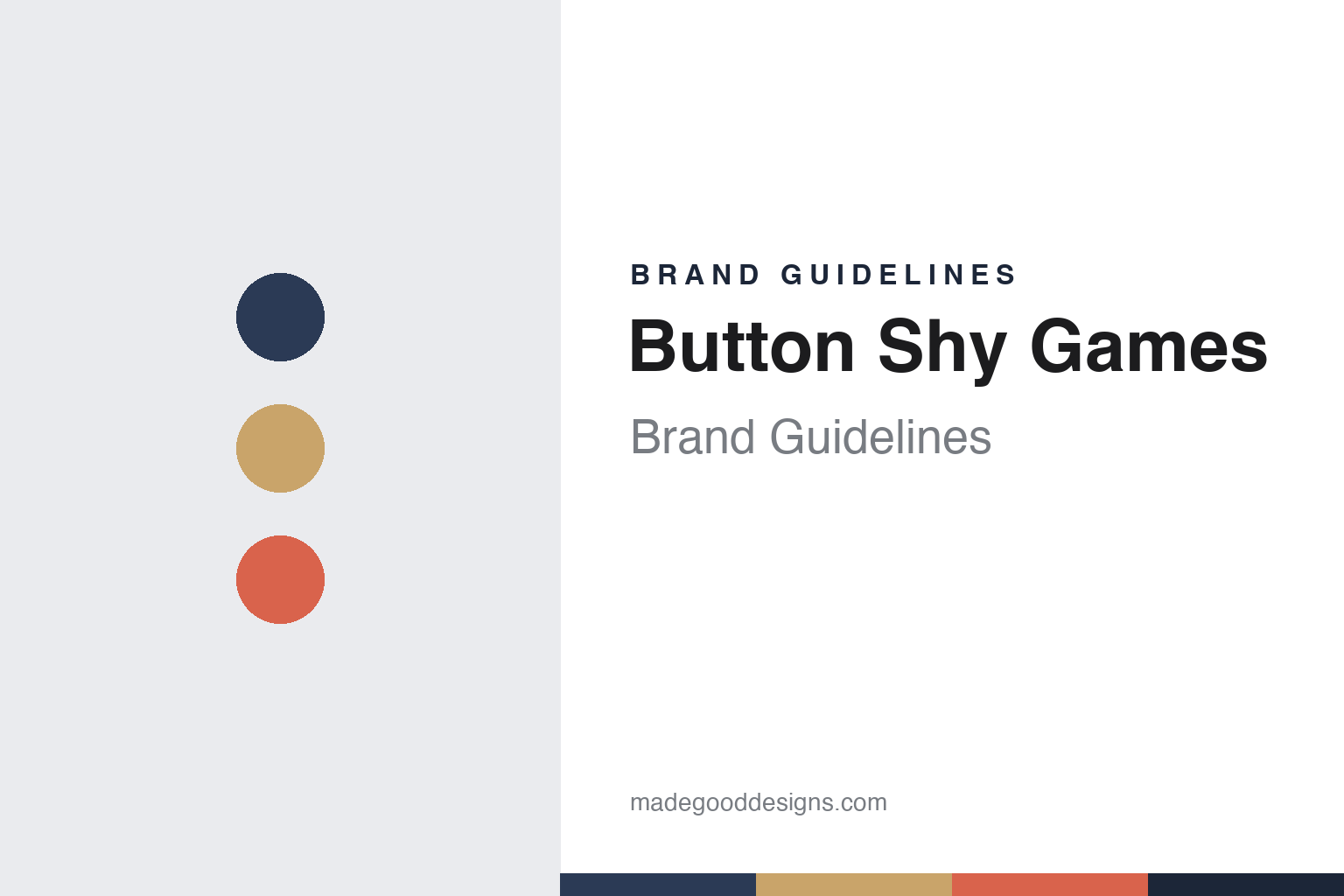
Button Shy Games Brand Guidelines
Tiny wallets, eighteen cards, one game a month.
Aa
Two constants: a Button Shy navy, kraft and red palette and a slab serif register. Abstract homage — not a Button Shy product or mark; no game, wallet, card or logo is reproduced.
A one-person label
Pocket-sized games from a New Jersey home.
Button Shy Games is the label of the game designer Jason Tagmire. The local news site NJ Pen reported in July 2023 that he established Button Shy Games in 2015 from his home in Haddon Township, in Camden County, New Jersey; an earlier NJ Pen profile, from 2015, already described a Kickstarter campaign for a third series of its wallet games. That profile said Tagmire had briefly owned a comic book and trading card store and had worked as a consultant for other game companies before publishing under his own name, using the on-demand printer The Game Crafter, and that he built, play-tested and shipped games from an arts building in the township. The titles it named then included Cunning Folk, a bluffing game set during the Salem witch trials; Smoke and Mirrors, about feuding magicians; and Wild Cats, about three cats scuffling in the back of a police car. Tagmire also told the site that community mattered more than anything else: “It’s the community you need to make a board game.”
The company describes itself as “the cardboard world of Jason Tagmire and friends,” and names him as the designer of Pixel Lincoln and Maximum Throwdown. It sells mainly direct to players rather than through a distributor, which it calls “a very DIY / indie approach.” In 2018 the review site Sprites and Dice described the business as “literally one dude, Jason Tagmire, along with a handful of friends and family,” and reported that the games were printed elsewhere, shipped to Tagmire and assembled by hand.
Tagmire explained the appeal to NJ Pen in 2015: “Our little games are cheap, and they’re small.”
Colour
Eighteen cards in a wallet.
A Button Shy game usually has 18 cards and comes not in a box but in a small bi-fold wallet that fits in a pocket. NJ Pen described them in 2023 as hand-packaged in a screen-printed wallet; Meeple Mountain noted in December 2022 that expansion packs usually add six cards each. The company releases about one new game a month, and subscribers to its Patreon club, which the company calls the Board Game of the Month Club, receive each one by post. By May 2018, Sprites and Dice counted nearly two dozen titles, and Button Shy was crowdfunding another, Arcane Bakery Clash, a game about wizards baking confectionery monsters. Tagmire told NJ Pen: “The size of the game is not defined by the size of the product.”
Many of its designs come from outside designers, and some from its own contests. Meeple Mountain reported that Button Shy runs regular design competitions, called 18 Card Challenges, and that several titles came from them. Sprawlopolis, a cooperative city-building game from 2018 credited to Steven Aramini, Danny Devine and Paul Kluka, was crowdfunded on Kickstarter by Tagmire from Collingswood, New Jersey, and later gained a farming companion, Agropolis, in 2021; in Germany, Frosted Games published it in a small box rather than a wallet. English Wikipedia says Tussie Mussie, a flower-drafting game by Elizabeth Hargrave, the designer of Wingspan, was written for the 2018 Gen Can’t design contest and published by Button Shy in 2019.
Other titles include Circle the Wagons and Avignon: A Clash of Popes, both reviewed by Sprites and Dice in 2018, and Hugo Kawamata’s two-player Hierarchy, a 14-card game featuring characters from Japanese folklore, the tableau-builder Skulls of Sedlec and the solo puzzle ROVE, all covered by Meeple Mountain.
Typography
Design and documentation.
The seven brands in this group are all board-game publishers: Allplay, Button Shy, Flatout Games, Keymaster Games, Mindclash Games, Red Raven Games and Grail Games. A publisher’s name sits on the box beside the names of the designers who invented the game and the artists who illustrated it, and a single title can pass from one publisher to another as rights are licensed, new editions are made and older editions go out of print.
A board-game publisher’s identity is therefore carried less by one product than by a logo on the box, a run of illustrators and a promise about the kind of games it makes, because the company behind the name may change its partners, its owners or the places where its games are printed. That makes the plain questions behind each name worth asking: who started it, who runs or owns it now, and where its games are made.
Each guide separates what independent sources record from what the company says about itself — its founding story, its owners and partners over time, where its games are manufactured and how its look has changed — and marks plainly what rests only on the company’s own word.
Aa
A sturdy slab serif for a hand-packed, small-batch register. (Specimen set in Bitter, a serif STAND-IN; NOT the Button Shy logo.)
Button Shy Games
From wallets to “the Board Game Backyard.”
For most of its life Button Shy met its customers online and at conventions. That changed in 2023. In July that year NJ Pen reported that Tagmire had opened the Button Shy Company Store on Haddon Avenue in Haddon Township, in a former gaming storefront he had spent about five months refurbishing from February. He called it “the Board Game Backyard”: a café, shop and play area with pergolas, pendant lights and synthetic grass, where customers could buy Button Shy titles, play games from the store library or bring their own. The space also hosts play-testing nights, an idea Tagmire explained to the site: “If you’re designing in a vacuum, getting no opinions, your game’s not getting any better.”
The range has also widened beyond the wallet. The company’s website now lists new boxed games alongside its classic wallet games and expansions, and it has crowdfunded on Gamefound as well as Kickstarter: its River Wild: Ancient Realm campaign paired two solo games by Steven Aramini, whom the company credits with work on Sprawlopolis and Circle the Wagons. The website also says its hand-assembled games are now labelled for ages 14 and up, in line with customer demand and changing US and international market standards.
For a design guide, Button Shy Games shows how a fixed format — eighteen cards in a printed wallet, one release a month — can work as an identity in its own right. Compare Allplay, another American publisher that sells direct, and Stonemaier Games, publisher of Elizabeth Hargrave’s Wingspan. For this guide we use a wallet navy, a kraft brown and a print red with a serif, an unofficial interpretation; no product or logo is reproduced.
Explore & save
Keep Button Shy Games’s identity on hand — save it to a board in the Made Good inspiration library.
Button Shy Games identity set
Pin the Button Shy navy, kraft and red palette and the slab serif register to your own board.


