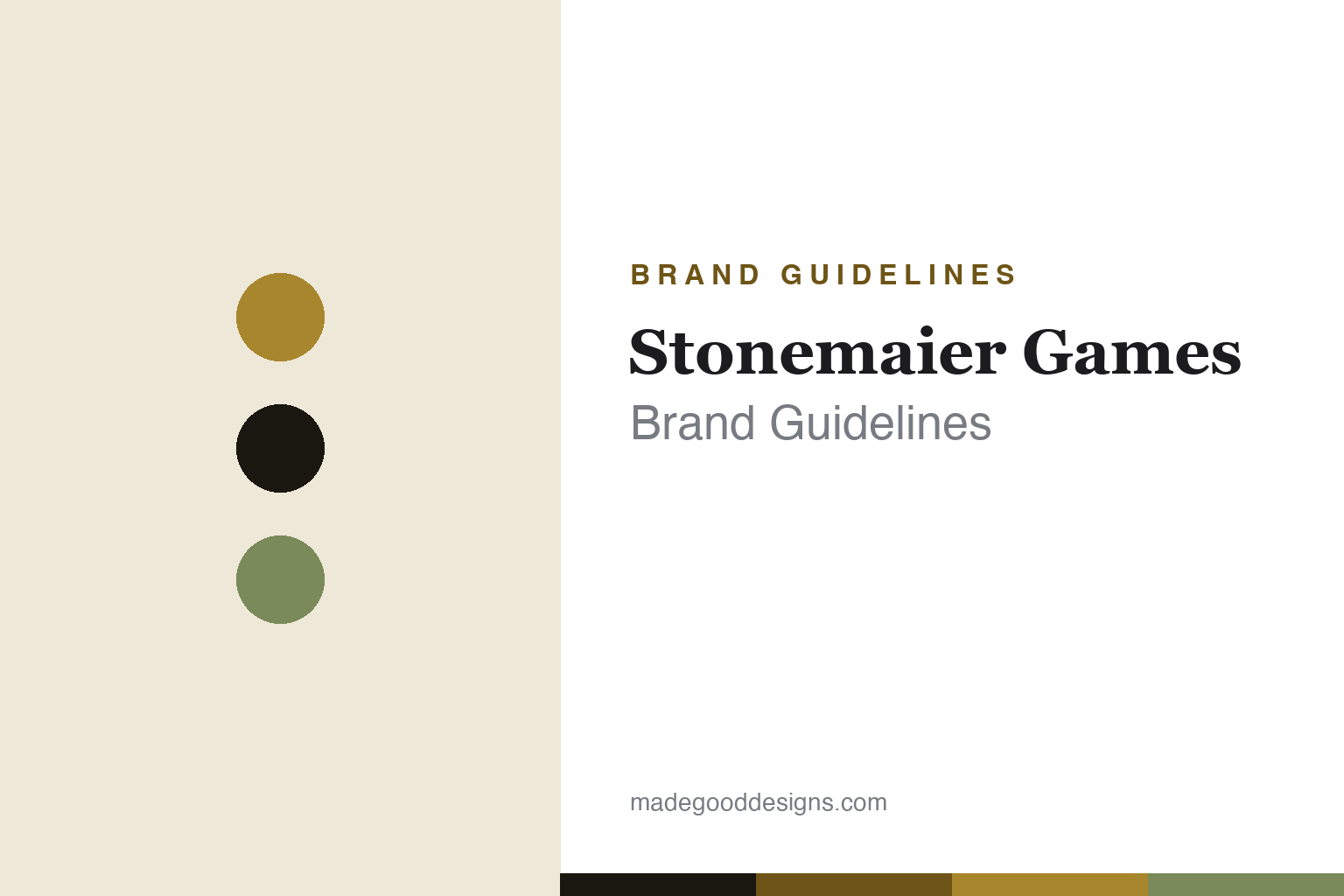
Stonemaier Games Brand Guidelines
From Kickstarter to the mainstream — Scythe, Wingspan, and an unusually open publisher.
Aa
Two constants: a brass-and-sage palette and a characterful serif. Abstract homage — not the Stonemaier wordmark or logo.
From Kickstarter to the mainstream
Stonemaier built a studio on crowdfunding.
Stonemaier Games is a lesson in building a modern studio on crowdfunding and openness. Founded in 2012 by Jamey Stegmaier and co-founder Alan Stone — the name “Stone-maier” combines their surnames — and based in St. Louis, Missouri, it launched with a Kickstarter for its first game, the wine-making Viticulture (funded 2012, released 2013), and grew into one of the great tabletop-crowdfunding success stories.
Two games made its name. Scythe (2016) — Stegmaier’s alternate-history 1920s Eastern Europe with dieselpunk mech-walkers, wrapped in Jakub Różalski’s striking “World of 1920+” art — became a modern hit (its Kickstarter raised over $1.8M). Then Wingspan (2019), designed by Elizabeth Hargrave, a bird-themed engine-builder, became a genuine mainstream phenomenon — winning the Kennerspiel des Jahres 2019 and reaching audiences far beyond the usual hobby. Others followed: Tapestry, Red Rising, Expeditions.
What makes Stonemaier distinctive beyond the games is its transparency: Stegmaier has long publicly shared what he learns about crowdfunding and publishing (the “Kickstarter Lessons” blog and a book), making the studio an unusually open, community-facing operation — and a proudly independent one, a deliberate contrast to the industry’s conglomerates. (Honest notes: Wingspan was designed by Elizabeth Hargrave, not Stegmaier; the studio is independently operated; figures like copies sold are point-in-time; and no official brand hex is published.)
Colour
Stonemaier lives in a brass-and-sage palette. Click a swatch to copy the hex.
Stonemaier’s identity is crafted, natural and considered — a warm brass, ink black, and a muted sage. The palette reads as its two hits: the brass and rust of Scythe’s dieselpunk machinery, and the natural sage of Wingspan’s birds and meadows. It’s a thoughtful, grown-up world that signals craft, engine-building depth and quality. It’s a brass-and-sage palette that signals a modern indie studio. The honest caveat: Stonemaier publishes no official brand hex, so the brass, ink and sage here are an original, unofficial interpretation, not first-party values.
The lesson is a brass-and-sage palette signals crafted, natural depth. Stonemaier’s world reads as considered and grown-up. For designers, it’s a reminder that warm metallics with a natural muted green feel crafted and mature — fitting for games that reward thoughtful play. The takeaways: pair a warm metallic with a muted natural tone for crafted maturity; let the flagship worlds set the palette; and treat any single hex as unofficial when there’s no published spec.
Typography
The wordmark spirit is a characterful serif — crafted and modern.
Stonemaier’s identity carries a crafted, characterful, modern spirit — a “Stonemaier” wordmark whose warm, slightly vintage forms suit its dieselpunk-and-nature worlds. A characterful serif captures the mood: it’s crafted and distinctive, matching a studio whose games reward thought and whose art (Różalski’s Scythe) is a signature. Set against a brass palette, the characterful serif feels considered and rich — exactly the Scythe, Wingspan personality Stonemaier carries. It’s crafted rather than generic, mirroring a beautifully produced engine-builder. (Stonemaier’s real wordmark is a trademark we describe but don’t reproduce.) Because the exact mark isn’t ours to use, the honest description is “a characterful serif spirit,” not the Stonemaier logo. The type behaves like the brand: crafted, characterful and modern.
Aa
A characterful serif spirit — crafted and modern. (Specimen set in Fraunces, a characterful serif; NOT the Stonemaier logo, which is a trademark.)
Independence and openness as the difference
Stonemaier shares as it grows.
Stonemaier Games is a lesson in growing through community and transparency, not consolidation. While much of the industry consolidated under conglomerates, Stonemaier took the other road: it built directly with players through Kickstarter, stayed independent, and — unusually — shared its playbook openly, with Stegmaier publishing years of candid lessons on crowdfunding and publishing. That openness became part of the brand: backers and fans feel like insiders, trust is high, and other creators learn from it. Paired with genuine hits that crossed into the mainstream (Wingspan reached people who’d never bought a hobby game), it shows that a values-forward, transparent independent can thrive alongside the giants — winning loyalty precisely by being open and its own.
For designers and brand-builders, Stonemaier offers a clear takeaway: transparency and independence can be a brand advantage, not a handicap. The lessons: build directly with your community (crowdfunding) and treat them as insiders; share what you learn to compound trust; and keep the facts precise — Stonemaier is Jamey Stegmaier and Alan Stone’s 2012 St. Louis studio behind Scythe and Wingspan. It’s also a reminder to keep it honest: Wingspan was designed by Elizabeth Hargrave; the studio is independently operated (not owned by a conglomerate); sales/figures are point-in-time; and no official brand hex is published, so the palette here is an interpretation. Stonemaier shares as it grows — proof that openness can be the difference.
Explore & save
Keep Stonemaier Games’s identity on hand — save it to a board in the Made Good inspiration library.
Stonemaier identity set
Pin the brass-and-sage palette and the characterful-serif spirit to your own board.