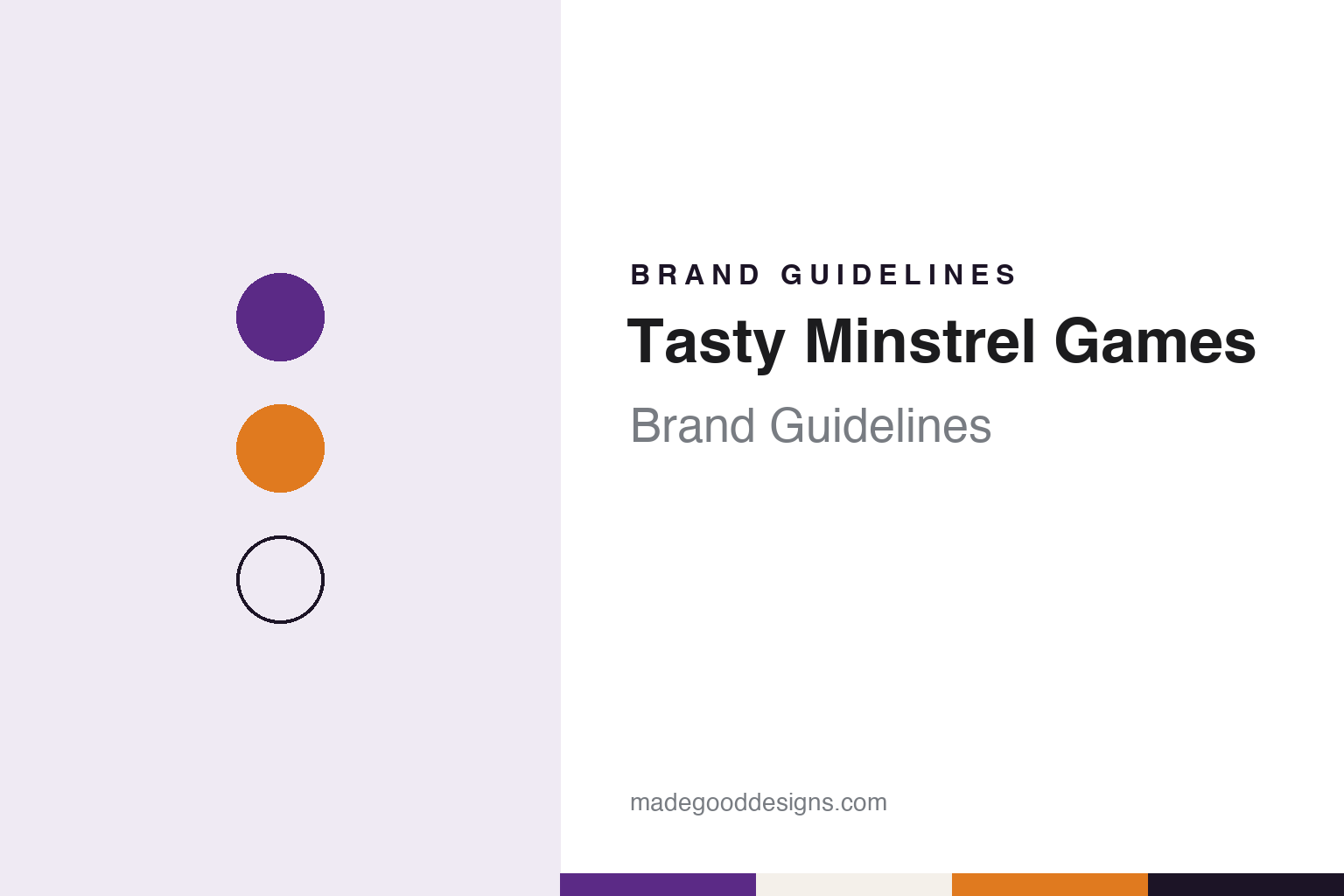
Tasty Minstrel Games Brand Guidelines
Michael Mindes’s TMG, Dargon and the Deluxified line.
Aa
Two constants: a Tasty Minstrel purple and orange palette and a bold grotesque register. Abstract homage — not a Tasty Minstrel Games product or mark; no box, mascot or logo is reproduced.
A Monty Python name
A financial adviser’s deferred dream.
Tasty Minstrel Games, usually shortened to TMG, is an American board-game publisher founded by Michael Mindes. The company dates itself to March 2009: its “About TMG” page, as archived in January 2013, said it “began in March of 2009 after many years of deferring occupational dreams,” and an earlier version of the site, archived in May 2009, said it was “founded in early 2009.” According to that early page, Mindes had prepared to publish board games as he graduated from college in 2005, then set the idea aside and worked as a financial adviser at A.G. Edwards; a 2017 version of the site said he had worked as an adviser with his father.
From the start he worked with Seth Jaffee, the company’s head of development, whom the 2017 site called Mindes’s “good friend.” In an interview with Luke Laurie for The League of Gamemakers in February 2015, Mindes said Jaffee had been part of TMG from the beginning, shaping which games it chose and how they were developed, and that the first employee besides the two of them started on 1 January 2014. He also recalled that the company’s first manufactured games, in 2009, arrived with serious problems, and that he and Jaffee spent a week in an Atlanta warehouse fixing them by hand.
The name is a joke. The 2013 site explained that the founders loved Monty Python and the Holy Grail and found the scene about eating Sir Robin’s minstrels particularly funny — and added that in one Dungeons & Dragons campaign Jaffee had played a bard who “might” have died after his companions left an antidote behind. The same page set out the company’s mission, “to heal the world by providing games that strengthen family unity, communication, and love,” a line Mindes repeated to The League of Gamemakers in 2015.
Colour
Eminent Domain, Belfort and Dungeon Roll.
TMG’s first two games, according to its 2017 history page, were ready in 2009: Terra Prime, designed by Jaffee, and Homesteaders. By early 2011 its website listed those two with the party game Train of Thought and the card games JAB: Real-Time Boxing and Eminent Domain, designed by Jaffee, which Mindes told The League of Gamemakers had introduced many players to TMG. English Wikipedia records Belfort, a worker-placement game of elves, dwarves and gnomes building a city, as a 2011 TMG release. The company’s 2017 history also named Dungeon Roll among its hits.
TMG also brought European games to American players. Its own history says Mindes played Orléans at Spiel in Essen and “knew that he had to publish it for the U.S. market”; German Wikipedia records the game as designed by Reiner Stockhausen, published by dlp games in 2014, and issued in an English edition with Tasty Minstrel Games. Mindes’s 2015 interview also mentioned Village, Scoville, Harbour and AquaSphere among the games TMG had published, and a November 2015 interview on Theology of Games discussed Flip City, Gold West and a reprint of Luna.
The company’s own words set out what it wanted its games to look like. Its 2013 “About” page listed four aims: “significant strategic depth,” rules “without exceptions,” “gorgeous and clear artwork and graphic design,” and rulebooks that “taught the game right the first time.”
Typography
Design and documentation.
The seven brands in this group are all board-game publishers: Deep Water Games, Sit Down! Games, Funforge, Tasty Minstrel Games, Brotherwise Games, 25th Century Games and CMYK. Publishers of this kind sit between the people who design games and the people who play them: they choose which designs to back, commission the art, the box and the components, and arrange for the finished game to be manufactured, translated and sold.
Many of them work across borders. A game designed in one country is often licensed to publishers elsewhere and sold under a different title in each market; in July 2024, for example, the Spiel des Jahres jury in Germany gave its Kennerspiel des Jahres to “e-Mission (Daybreak),” a game sold in Germany by Schmidt and in English as Daybreak by CMYK, according to the award’s website and BoardGameWire. Crowdfunding is another route to market: CMYK, for one, took its first game, Monikers, to Kickstarter in June 2014, Kill Screen reported.
For a publisher, identity is carried less by a single product than by a name, a logo and the look its boxes share on a shelf, while each game keeps its own title, art and designers. That makes the plain questions worth asking: who started each company, who owns it now, and where it is based.
Each guide separates what independent sources record from what the company says about itself — its founding story, its owners over time, its best-known games and how its look has changed — and marks plainly what rests only on the company’s own word.
Aa
A bold grotesque — the register of a Kickstarter banner. (Specimen set in Archivo, a sans STAND-IN; NOT the Tasty Minstrel Games logo.)
Tasty Minstrel Games
Dargon, the Gamer’s Champion.
TMG’s most distinctive branding device was a mascot. Its 2017 “About” page introduced Dargon, a dragon “existing beyond the realms of time and space,” who searches for amazing games and people to play them with; the company called him “the Gamer’s Champion” and its staff “the Minstrels of Dargon.” By 2022 the website was also promoting a range of Dargon’s Dice. The second recurring device was the Deluxified edition: the 2017 history says Orléans was the first game to get “the Deluxified treatment,” and the 2022 site described limited “Deluxified™” titles offered through Kickstarter, among them a Deluxified edition of Stefan Feld’s Luna with new content, listed by Mindes from Salt Lake City, Utah.
Crowdfunding was central to that model. The company’s 2017 history said its home office was then based in Utah, with several employees working remotely. Mindes had told Theology of Games in November 2015 that TMG planned to use Kickstarter much less often. The 2017 team page listed Mindes as founder and chief executive, Daniel Hadlock as president and Jaffee as head of development, with a director of global licensing for translated editions.
In 2022 its website said it had a “10+ year history” of making board games, and a TMG post displayed there said that “TMG will not be printing games for a while,” directing fans of Jaffee’s Crusaders: Thy Will Be Done to a reprint by Renegade Game Studios. By 2024 the original tastyminstrelgames.com address redirected to a placeholder page in Wayback Machine captures.
For a design guide, Tasty Minstrel Games shows how a small publisher can build a recognisable voice from a joke name, a mascot and a premium-edition label. Compare Renegade Game Studios, which took on the Crusaders reprint, and Bézier Games, another American publisher. For this guide we use purple, orange and parchment with a sans, an unofficial interpretation; no product or logo is reproduced.
Explore & save
Keep Tasty Minstrel Games’s identity on hand — save it to a board in the Made Good inspiration library.
Tasty Minstrel Games identity set
Pin the Tasty Minstrel purple and orange palette and the bold grotesque register to your own board.


