Ludonaute Brand Guidelines
A small French publisher that invited players to travel — and then chose to stop.
Aa
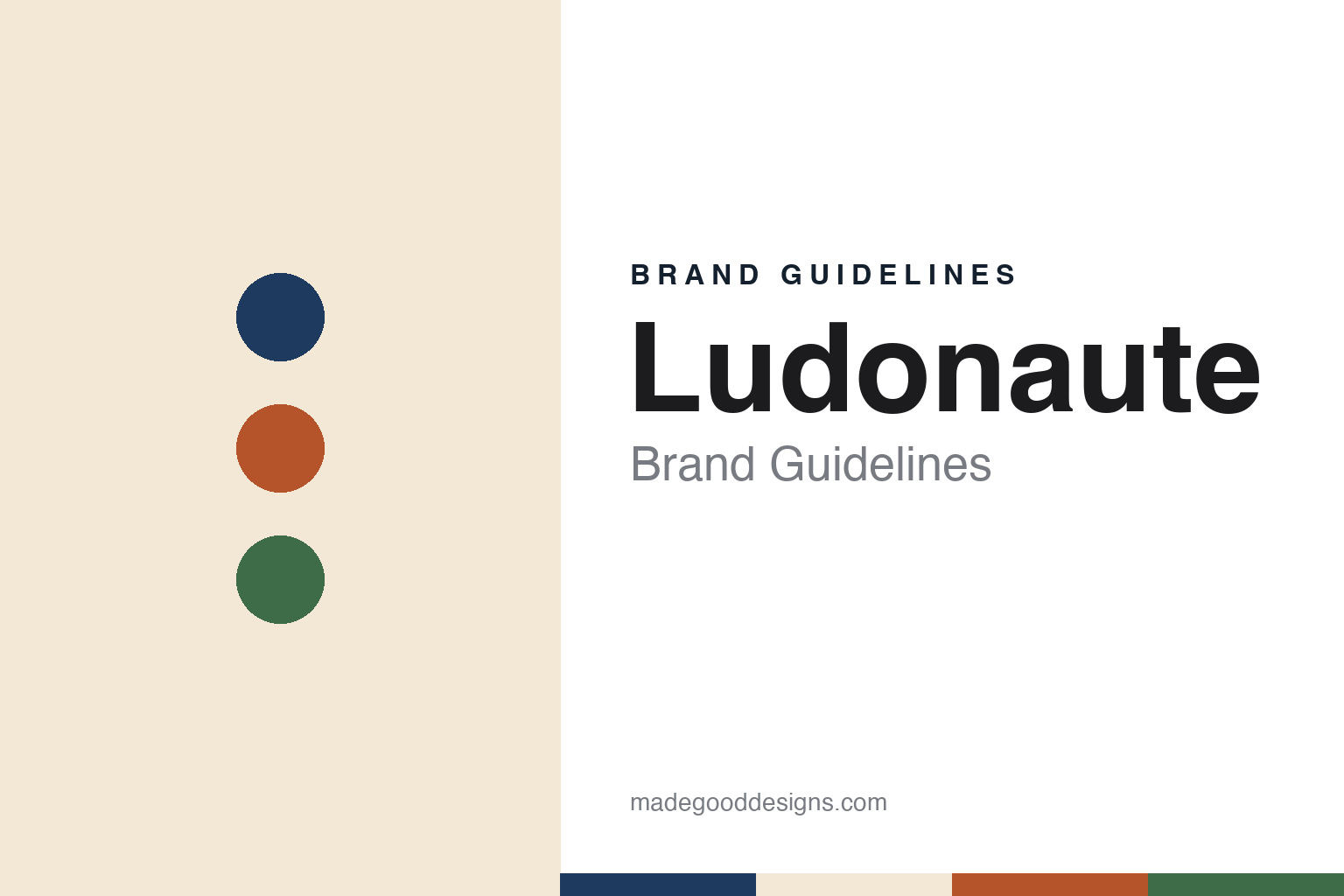
Two constants: a navy, parchment, rust and forest palette and an expedition serif register. Abstract homage — not a Ludonaute product or mark; no box, card, logo or artwork is reproduced.
Les Explorateurs Ludiques
Two players who started a publishing house.
Ludonaute is a French board game publisher founded by Anne-Cécile and Cédric Lefebvre. The founding year differs between the company’s own documents: its 2025 press release says the couple founded it in 2009, “without knowing anything about the publishing trade, but with a great deal of humility and passion,” while the “about” page of its website says 2010. BoardGameWire, reporting in September 2025, gives 2009.
The company began in Istres, in the south of France, and later moved to Nontron in the Dordogne, its website says. The same page describes the founders as both players and game designers, and the business as a small one: “we publish a small number of board or card games,” each developed over months, with outside authors, illustrators and designers joining each project around a core team of four full-time staff.
The house style was set out plainly. “The themes of our games are an invitation to travel to mythical, imaginary or exotic worlds,” the website says, and the company adds that it cares about the quality of components and artwork because they are part of the pleasure of play. The header of its website carries the line “Les Explorateurs Ludiques” — the playful explorers.
Colour
A train robbery, an expedition and a burning forest.
Three games are the ones the company itself chose to pass on when it wound down: Lewis & Clark, Colt Express and Living Forest, the titles named in its 2025 press release and in BoardGameWire’s report of the sale.
Colt Express was designed by Christophe Raimbault. On the website of the Spiel des Jahres jury, the German association behind the award, the game carries the Spiel des Jahres 2015 prize and is listed with Ludonaute as publisher. The jury described it as “a game like a Western parody,” in which bandits rob passengers aboard a three-dimensional train and players program their actions with cards, only seeing the results — fistfights, gunshots and the arrival of the marshal — at the end of each round.
Living Forest is by the designer Aske Christiansen, in which players use nature spirits to put out fires, replant trees and gather lotus flowers to restore a sacred grove. The jury’s site shows it with the Kennerspiel des Jahres 2022 prize, the award for more experienced players, in its German edition from Pegasus Spiele.
Set beside the website’s promise of “mythical, imaginary or exotic worlds,” the three show the range: a Western train robbery, an expedition named after two explorers and a forest guarded by spirits. The company described its output as deliberately small — “a small number of board or card games” — and its press release says each title was, for the founders, “an adventure in its own right.”
Typography
Design and documentation.
The seven brands in this group are all board-game publishers: Fowers Games, Alley Cat Games, Dire Wolf, Rebel, Ludonaute, Catch Up Games and Next Move Games. Board-game publishers in general sit at many different points in the trade, from small studios still run by the people who started them to labels that now belong to much larger games groups, and a single name can appear everywhere from a hobby-shop shelf to a department-store toy aisle.
A publisher’s identity is usually carried less by a single box than by a logo on many boxes, a house style of art and graphic design, and the games it becomes known for, because the company behind the name may have changed hands, merged its studios or moved its production far from where it started. That makes the questions behind each name worth asking plainly: who started it, who owns it now, and where its games are designed and made.
Each guide separates what independent sources record from what the company says about itself — its founding story, its owners over time, where its games are made and how its look has changed — and marks plainly what rests only on the company’s own word.
Aa
An expedition serif — a register for “Les Explorateurs Ludiques.” (Specimen set in Fraunces, a serif STAND-IN; NOT the Ludonaute logo.)
Ludonaute
A planned stop, not a sale of the company.
In 2025 Ludonaute announced that it would stop publishing new games. Its press release says that during the summer the company decided to sell to Tycoon Games, the publisher of Everdell, the right to exploit Colt Express, Living Forest and Lewis & Clark; BoardGameWire reported on 8 September 2025 that the sale had been revealed at the end of July. The company said it would release two last titles first: Arigatō, a card-combination game designed by Mélodye Ladrat and Florian Sirieix, and Limit, by Alexandre Poyé, which the press release says has a political dimension, about relations between peoples and with the planet. Arigatō, it adds, is the kind of game Cédric most likes to develop, was created by friends and was published in record time compared with the company’s other titles.
The founders explained the decision in their own words. Over recent years, the press release says, they had watched the trade move from “a small world of enthusiasts” towards a professional sector “where passion has given way to what is called economic reality”; they wrote that too many games are now produced and that they no longer recognised themselves in that. “We did not want to sell the company,” they wrote, but for it to wind down its publishing of new games progressively, adding that they did not want it to fall into the hands of a large group. The sale of the three titles, they said, would keep paying the authors and illustrators who worked on them, let employees leave in calmer conditions and fund a new personal project for the couple.
Today the website lists Arigatō and Limit under “our latest games, released at the end of 2025.” The rights to the three titles sold now sit with Tycoon Games; the Ludonaute name remains attached to their first editions and to the jury records of 2015 and 2022.
For a design guide, Ludonaute shows how a publisher’s identity can rest on a promise of travel and on games built as objects. Compare Iello, another French publisher, and Catch Up Games, a Lyon studio of a similar size. For this guide we use navy, parchment, rust and forest green with a serif, an unofficial interpretation; no product or logo is reproduced.
Explore & save
Keep Ludonaute’s identity on hand — save it to a board in the Made Good inspiration library.
Ludonaute identity set
Pin the Ludonaute navy, parchment, rust and forest palette and the expedition serif register to your own board.