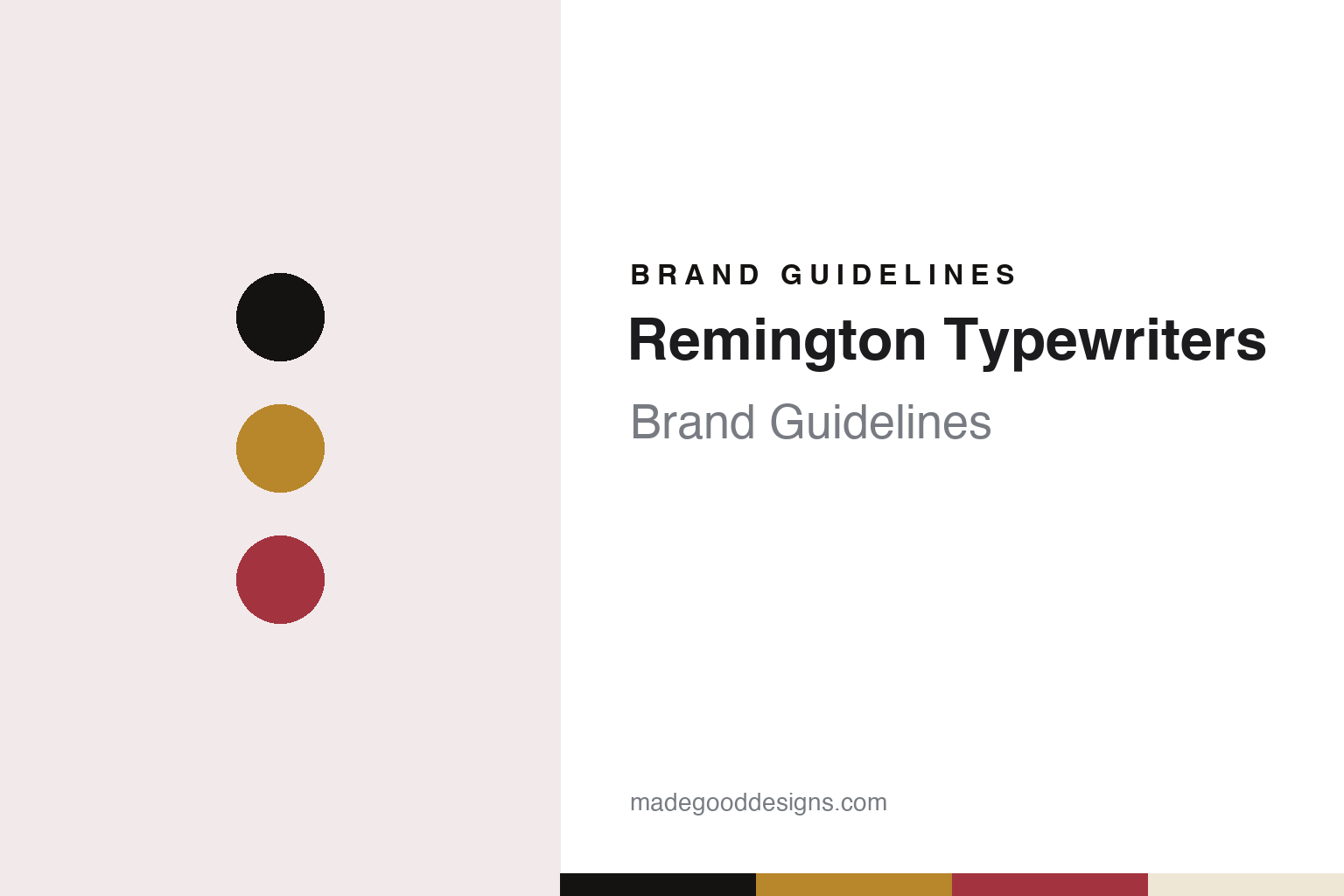
Remington Typewriters Brand Guidelines
The gunmaker’s typewriter that carried QWERTY into the office.
Aa
Two constants: a japanned black, gilt and floral red palette and a Victorian serif register. Abstract homage — not a Remington product or mark; no typewriter, logo or nameplate is reproduced.
Ilion, 1873
A gunmaker takes on the Type-Writer.
Remington typewriters came out of an arms factory. Eliphalet Remington II founded the business in 1816 making rifle barrels, and moved it to land beside the Erie Canal at what became Ilion, New York, English Wikipedia says. With his sons Philo, Samuel and Eliphalet III it became E. Remington & Sons. When military orders fell after the American Civil War, the company turned to other products, including agricultural tools and sewing machines.
The typewriter arrived from outside. On 23 June 1868 Christopher Latham Sholes, Carlos Glidden and Samuel W. Soule were granted a patent for a “Type-Writer”, and the backers James Densmore and Yost brought the machine to Remington. English Wikipedia says the company signed a contract to build it on 1 March 1873, gave a wing of the Ilion factory over to it and spent months re-engineering it. Production began that September, and the machine went on sale on 1 July 1874.
The Sholes and Glidden, later sold as the Remington No. 1, typed capital letters only. Its keyboard used the QWERTY arrangement designed by Sholes. The Remington No. 2 of 1878 added lower-case letters through a shift key, and English Wikipedia credits that machine’s success with spreading the QWERTY layout.
Sales were slow at first. In 1878 Remington handed marketing to the scale maker E. & T. Fairbanks, and later to the agency Wyckoff, Seamans & Benedict, which agreed to take all the machines produced. Its marketing turned the typewriter into a commercial success, the Sholes and Glidden article says.
Colour
Japanned black and floral decals.
The earliest Remington typewriter looked like a household machine. Production was overseen by Jefferson Clough and William K. Jenne, manager of Remington’s sewing-machine division, and English Wikipedia says the redesigned machine took on the sewing machine’s character: a japanned black case with floral ornamentation, mounted on a stand with a treadle that worked the carriage return. The treadle was later replaced by a hand lever. The same article says the sewing-machine look also let Remington share manufacturing with that division and was meant to help the typewriter into the home.
The early customers were individuals as much as businesses. Mark Twain was among the early buyers, English Wikipedia says, and the machine was shown at the Centennial Exhibition in Philadelphia in 1876. Before Remington took on the machine, Sholes’ daughter had demonstrated it and posed for promotional images, and Remington’s sales agents went on to use women demonstrators at trade shows and in hotel lobbies. English Wikipedia connects that marketing with the movement of women into clerical work in the decades that followed.
The Remington name passed with the typewriter. In 1886, as E. Remington & Sons went into receivership, it sold the typewriter business to the Standard Typewriter Manufacturing Company, including the right to use the Remington name. The buyers were William O. Wyckoff, Harry H. Benedict and Clarence Seamans, all of whom had worked for Remington. On 7 March 1888 the arms business itself was sold to Marcellus Hartley and the Winchester Repeating Arms Company and renamed Remington Arms, English Wikipedia says, so the guns and the typewriters went separate ways under one surname.
The typewriter company, later known as the Remington Typewriter Company, merged with the Rand Kardex Corporation of James Rand Jr. in 1927 to form Remington Rand. Its name appeared on the Remington Rand Building at 315 Park Avenue South in New York, and the company was a regular co-sponsor of the CBS panel show What’s My Line?.
Typography
Design and documentation.
The seven brands in this group are all typewriter names: Royal, Remington, Olympia, Erika, Groma, Torpedo and Optima. Typewriter brands in general sit at many different points in the history of office machines, from factories that carried a founder’s name to names that passed between owners, changed countries or outlived the machines that made them familiar, and a single nameplate can turn up on an office desk, a portable in a case or a collector’s shelf.
A typewriter brand’s identity is usually carried less by a single machine than by a nameplate, a decal and the factory behind it, because the company that owned the name may have been sold, divided, renamed or closed long after its last typewriter left the line. That makes the questions behind each name worth asking plainly: who started it, who owned it over time, where its machines were actually made and what became of the name.
Each guide separates what independent sources record from what a company says about itself — its founding story, its owners over time, where its typewriters were made and how its nameplates changed — and marks plainly what rests only on the company’s own word.
Aa
A high-contrast Victorian serif — the register of an 1870s machine decal. (Specimen set in Playfair Display, a serif STAND-IN; NOT the Remington logo.)
Remington Typewriters
From Remington Rand to Sperry and Unisys.
Remington Rand kept making typewriters while it grew into a conglomerate. In its first year it bought adding-machine, accounting-machine and loose-leaf binder businesses, English Wikipedia says, and it sold the Kardex filing line inherited from Rand. A strike at its plants in 1936 and 1937 ended in a 1937 National Labor Relations Board ruling in favour of the workers. During the Second World War it made M1911A1 pistols under contract.
After the war the company moved into computing. It acquired the Eckert–Mauchly Computer Corporation in 1950 and Engineering Research Associates in 1952, and the UNIVAC I was dedicated on 14 June 1951. In 1955 Sperry Corporation acquired Remington Rand to form Sperry Rand. English Wikipedia says that in the 1970s Sperry sold typewriters, and electric razors, under the name Sperry Remington. In 1978 Sperry Rand sold several divisions, including Remington Rand Systems and Remington Rand Machines, and returned to the Sperry Corporation name. Sperry merged with Burroughs in 1986 to form Unisys.
The Remington name now lives on away from the typewriter. The shaver business, Remington Products, was among the divisions later spun off, and the firearms company has carried the name separately since 1888. The Hagley Museum and Library holds the records of the Remington Rand Division’s advertising and sales promotion department.
For a design guide, Remington shows how an engineering product can borrow the look of a familiar domestic machine to win acceptance. Compare Smith-Corona, another New York State typewriter maker, and Underwood, another American typewriter name. For this guide we use a japanned black, a gilt and a floral red with a serif, an unofficial interpretation; no product or logo is reproduced.
Explore & save
Keep Remington Typewriters’s identity on hand — save it to a board in the Made Good inspiration library.
Remington Typewriters identity set
Pin the japanned black, gilt and floral red palette and the Victorian serif register to your own board.


