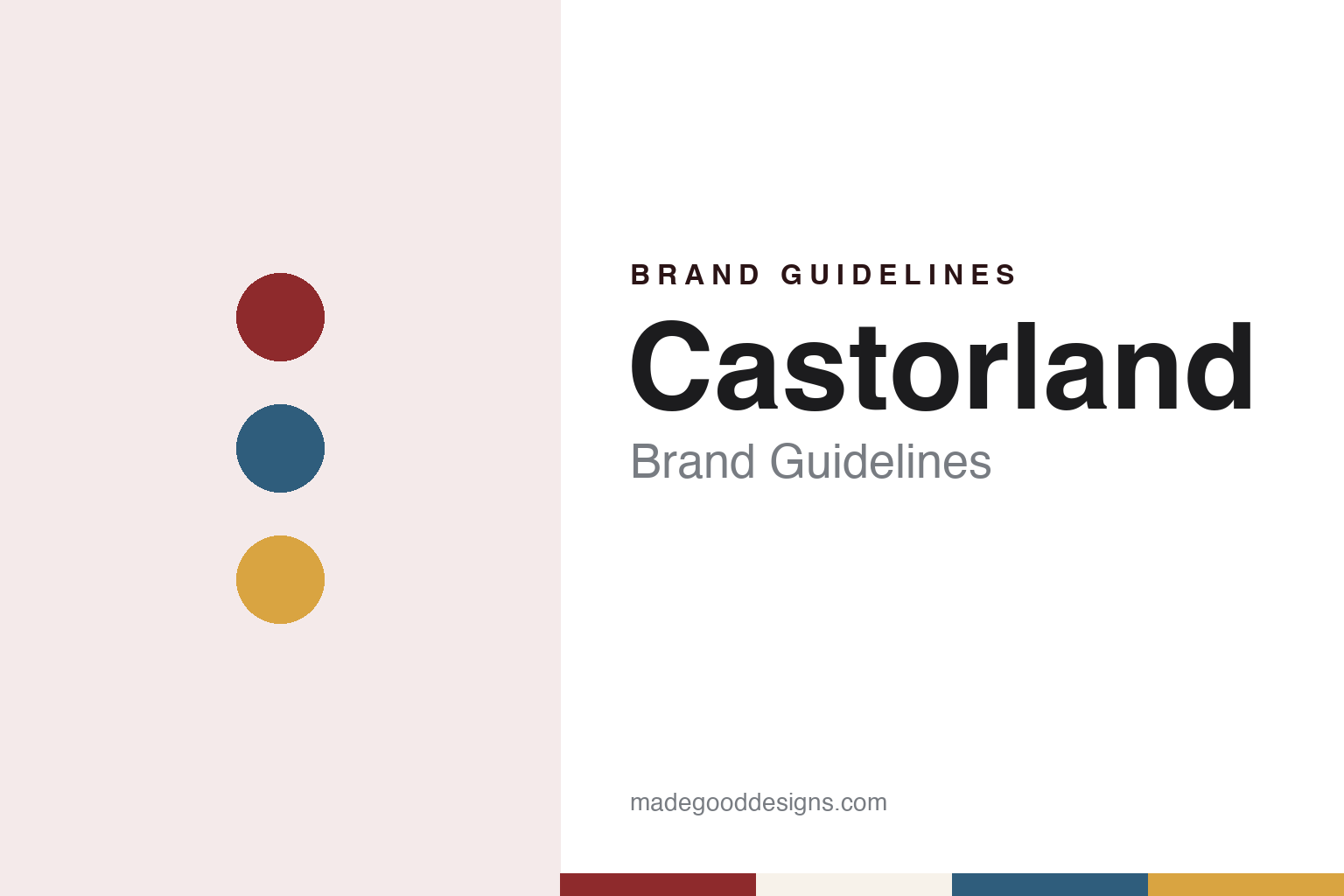
Castorland Brand Guidelines
The Kraków jigsaw brand of a printing house founded in 1989.
Aa
Two constants: a Kraków brick, Vistula blue and amber palette and a book serif register. Abstract homage — not a Castorland product or mark; no box, logo or puzzle image is reproduced.
A printing house in Kraków
A puzzle brand that grew out of a press.
Castorland is the puzzle brand of Castor, a company based in Kraków, in southern Poland. The company’s own website dates the brand’s story to 1989, opening its description with the line that the colourful history of Castorland puzzles “has lasted since 1989.” The same site says, plainly and more than once, that the puzzles are made in Kraków.
The name of the business behind the brand explains a good deal about it. On its contact page the company gives its legal name as Castor Drukarnia i Wydawnictwo — Castor Printing House and Publishing House — set up as a spółka jawna, a Polish general partnership, whose name carries the names of two partners, Marek Bryła and Wojciech Lipiński. A jigsaw is, after all, a printed object before it is a cut one: an image reproduced on paper, mounted on board and then divided into pieces. A printer and publisher making puzzles under its own brand is working within its own trade rather than outside it.
The brand name itself is a simple extension of the company name. Castor is the press; Castorland is the world of pictures it sells in boxes. On the company’s own site the registered trade mark symbol is attached to the brand name, Castorland®, while the company’s footer and contact details use the shorter Castor. The contact page places the partnership, its press and the puzzle brand in the same city, Kraków.
That legal name, as the contact page gives it in October 2026, ends with the words w likwidacji — “in liquidation” — the standard Polish suffix for a company that has formally opened a winding-up process. The company’s website remains online with its catalogue, shop and blog.
Colour
Pictures chosen, edited and cut in Kraków.
Castorland does not describe its puzzles in terms of a single artist or a single house style. What it puts first, in the short company statement on its home page, is how the pictures are chosen and prepared. The company says that what sets it apart is “the way images are selected and the graphic editing of the pictures,” and that this brings out a wealth of detail that can be recognised on each “precisely cut” piece. Those are the company’s own claims, but they describe the parts of a puzzle that a buyer actually handles: the picture, the print and the cut.
The company also says that years of experience, focused on developing its own technology, allowed it to create a product of world standard. It does not, in that statement, name the machinery, the board or the printing process, so the claim is best read as the company’s account of its approach rather than a technical specification.
The catalogue is divided in two. Castorland’s site sends visitors to separate catalogues for children and for adults, alongside a shop, a blog and a contact page. That simple division is the clearest structure the company itself gives to its range: picture puzzles for young children on one side, and the landscapes, cityscapes and art images aimed at adult puzzlers on the other.
Retail listings outside Poland describe the brand in the same terms — a Polish puzzle maker, with its puzzles made in Kraków — which is consistent with what the company says about itself. The place of manufacture is the company’s own statement; it is not something an independent source has set out in detail.
Typography
Design and documentation.
The seven brands in this group are all jigsaw puzzle makers: Eurographics, Galison, Castorland, Jumbo, MasterPieces, Heye and Mudpuppy. Puzzle brands in general sit at many different points in the trade, from family firms that still carry a founder’s name to labels that now belong to larger toy, games or publishing groups, and a single brand can be sold everywhere from a toy shop to a museum gift store.
A puzzle brand’s identity is usually carried less by a single picture than by a box, a name and the artwork it commissions, because the company behind the name may have changed hands, moved its production or grown far beyond the place where it started. That makes the questions behind each name worth asking plainly: who started it, who owns it now, and where its puzzles are actually made.
Each guide separates what independent sources record from what the company says about itself — its founding story, its owners over time, where its puzzles are made and how its boxes have changed — and marks plainly what rests only on the company’s own word.
Aa
A book serif for a printer’s puzzle brand. (Specimen set in Lora, a serif STAND-IN; NOT the Castorland logo.)
Castorland
A press, a picture and a box.
Castorland’s identity rests less on a mascot or a slogan than on two things the company repeats: 1989 and Kraków. The home page puts the year and the city side by side, and the brand’s boxes are sold on the strength of the pictures inside them. For a brand that comes out of a printing house, that is a coherent position: the product is the printed image, and the brand is the promise that the image has been chosen, edited and reproduced with care.
The Castor name also shows how a puzzle brand can sit on top of a different kind of business. Where some puzzle makers began as toy or games companies and later added jigsaws, Castorland’s legal parent describes itself first as a printer and a publisher. The puzzle line is the part of that business which carries a consumer-facing brand.
Castorland is not the only Polish puzzle brand in this series. Trefl, from Gdynia on the Baltic coast, is the other Polish name in this series; Castorland comes from Kraków in the south of the country. The two companies describe themselves differently: Castorland’s parent through its printing and publishing name, and through the statement that its puzzles have been made in Kraków since 1989.
The company’s blog and shop sit on the same website as its catalogue, so the brand speaks to buyers directly as well as through the retailers that stock its boxes in Poland and abroad.
For a design guide, Castorland shows how a printer’s name, a founding year and a home city can carry a puzzle brand — compare Trefl, the Gdynia puzzle maker, and Ravensburger. For this guide we use Kraków brick, Vistula blue and amber with a serif, an unofficial interpretation; no product or logo is reproduced.
Explore & save
Keep Castorland’s identity on hand — save it to a board in the Made Good inspiration library.
Castorland identity set
Pin the Castorland brick, Vistula blue and amber palette and the book serif register to your own board.


