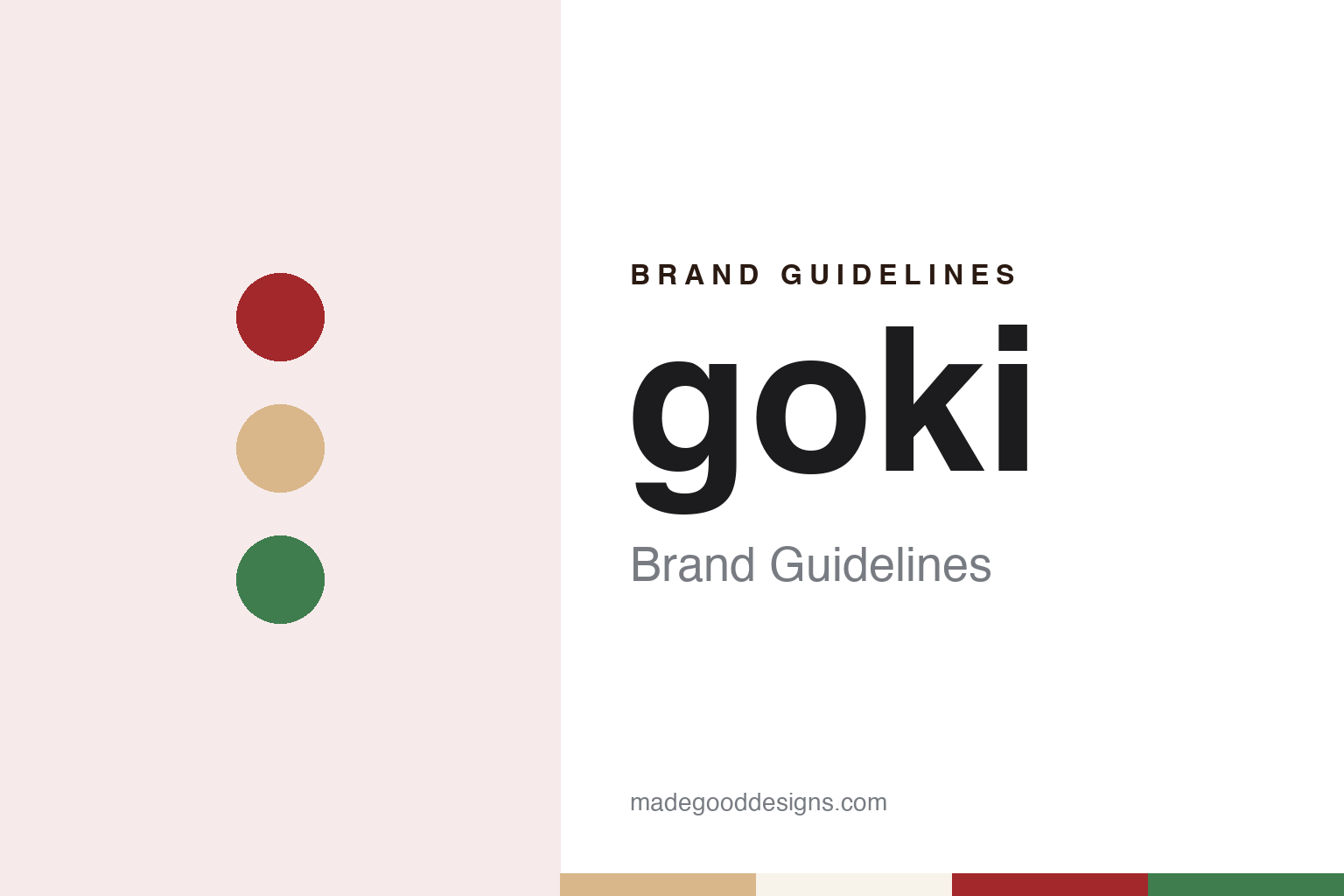
goki Brand Guidelines
The Hamburg-born wooden toy brand behind the birthday train.
Aa
Two constants: a train red, beech and leaf green palette and a rounded sans register. Abstract homage — not a goki product or mark; no toy, logo or packaging is reproduced.
Gollnest & Kiesel
Two partners selling wooden toys in Hamburg.
goki is the toy brand of Gollnest & Kiesel, and the company dates its own story to a specific month. Its “About us” page says that in May 1981 Gerhard Gollnest and Fritz-Rüdiger Kiesel began selling wooden toys in Hamburg, and that at the start there were just the two of them.
The business later moved out of the city. The company now gives its seat as Güster, a village in Schleswig-Holstein, and its legal name on its own website is Gollnest & Kiesel GmbH & Co. KG. German Wikipedia, in its articles on the designer Heike Wiechmann and on the court case described below, refers to the firm simply as the wooden toy maker Gollnest & Kiesel, with “Goki” in brackets — the brand and the company are treated as one and the same.
The company describes a portfolio with two names at its centre. One is goki itself, which it divides into the product lines goki evolution, goki66 and goki baby. The other is HOLZTIGER, a range of wooden animal and character figures that the company says are made by hand.
The goki range is broad rather than narrow. The company’s online catalogue, as it stood in October 2026, sorted products into baby items such as pram chains and grasping toys; play items such as marble runs, puzzles, memory games, shop counters, rocking horses and pull-along animals; building and sorting toys; learning toys including clocks and arithmetic sets; and a separate music section running from xylophones and kalimbas to rain sticks and harmonicas. There is also an outdoor range of flower presses, hobby horses and garden tools for children, plus seasonal assortments for Easter and Christmas.
Colour
A birthday train that changed German copyright law.
One small goki product ended up before a federal court. German Wikipedia says that in 1998 the designer Heike Wiechmann designed a table decoration for children’s birthday parties for Gollnest & Kiesel, called the Geburtstagszug or “birthday train”: a wooden locomotive and a set of wagons onto which numbers and candles can be slotted. The encyclopedia, citing the trade union magazine ver.di Publik, says the train sold widely for the company.
Wiechmann argued that the fee she had been paid was too low given the product’s success, and, supported by the services union ver.di, sued for further remuneration under the so-called bestseller clause of German copyright law, section 32a of the Copyright Act. German Wikipedia says the Regional Court of Lübeck dismissed the claim in 2010 and the Higher Regional Court of Schleswig did the same in 2012, on the ground that the design, as applied art without sufficient originality, could be protected only as a registered design and not by copyright.
The Bundesgerichtshof, Germany’s Federal Court of Justice, saw it differently. In 2013 it set aside the appeal judgment and sent the case back to Schleswig. In doing so, German Wikipedia says, the court abandoned a line of case law going back to a 1911 Reichsgericht decision, under which applied art had to clear a higher bar for copyright than fine art. The court reasoned from the European design directive that design law was no longer a “small copyright” underpinning copyright, but a separate right, so a special threshold for applied art could no longer be justified.
The headnotes quoted by German Wikipedia set out the new rule: for copyright, works of applied art need only reach a level of creativity that people receptive to art would call an artistic achievement; they no longer have to stand clearly above the average design. A further headnote limits the effect of the ruling for uses before the reform of German design law took effect on 1 June 2004. Since the “Geburtstagszug” judgment, German Wikipedia says, German copyright law has applied the same threshold to applied art as to fine art — which means a wooden birthday train from Güster is now a standard reference in German design law.
Typography
Design and documentation.
The seven brands in this group are all toy names: Djeco, Janod, Tegu, Kapla, SmartGames, goki and Le Toy Van. Toy brands in general sit at many different points in the trade, from family firms that still carry a founder’s idea to labels that now belong to larger groups, and a single brand can be sold everywhere from a small independent shop to a department store.
A toy brand’s identity is usually carried less by a single object than by a box, a name, a colour and a way of drawing, because the company behind the name may have changed hands, moved its production or grown far beyond the place where it started. That makes the questions behind each name worth asking plainly: who started it, who owns it now, and where its toys are actually designed and made.
Each guide separates what independent sources record from what the company says about itself — its founding story, its owners over time, where its toys are made and how its boxes and logos have changed — and marks plainly what rests only on the company’s own word.
Aa
A rounded sans for a wooden toy brand. (Specimen set in Nunito, a sans-serif STAND-IN; NOT the goki logo.)
Güster
Trees, schools and a second brand.
Gollnest & Kiesel presents itself as a company that works with wood and so carries responsibility for forests. On its sustainability page the company says that since 2004 it has planted a tree for every child born in Schleswig-Holstein, using beech, oak and maple, and that the planting is meant to turn monocultures into mixed woodland; it says the work is done partly in cooperation with the retailer Müller. Its “About us” page adds that the company plants trees at the end of each year and supports the building of schools in countries including Mali, Peru and Uganda.
The company has also had a link to a historic German building toy. German Wikipedia’s article on the Anker stone building sets of Rudolstadt says that the Ankerstein manufactory was for a time owned by Gollnest & Kiesel, before the welfare organisation AWO Rudolstadt took over the business in 2017 and began running it as an inclusive employer.
For a design guide, goki shows how a broad wooden toy catalogue can sit under one short lower-case name, and how a single product — a train of numbered wagons — can carry a brand into legal history. Compare it with HABA, another German family toy company, and with Grimm’s, the German maker of open-ended wooden toys. For this guide we use a train red, beech and leaf green palette with a rounded sans, an unofficial interpretation; no product or logo is reproduced.
Explore & save
Keep goki’s identity on hand — save it to a board in the Made Good inspiration library.
goki identity set
Pin the goki train red, beech and leaf green palette and the rounded sans register to your own board.


