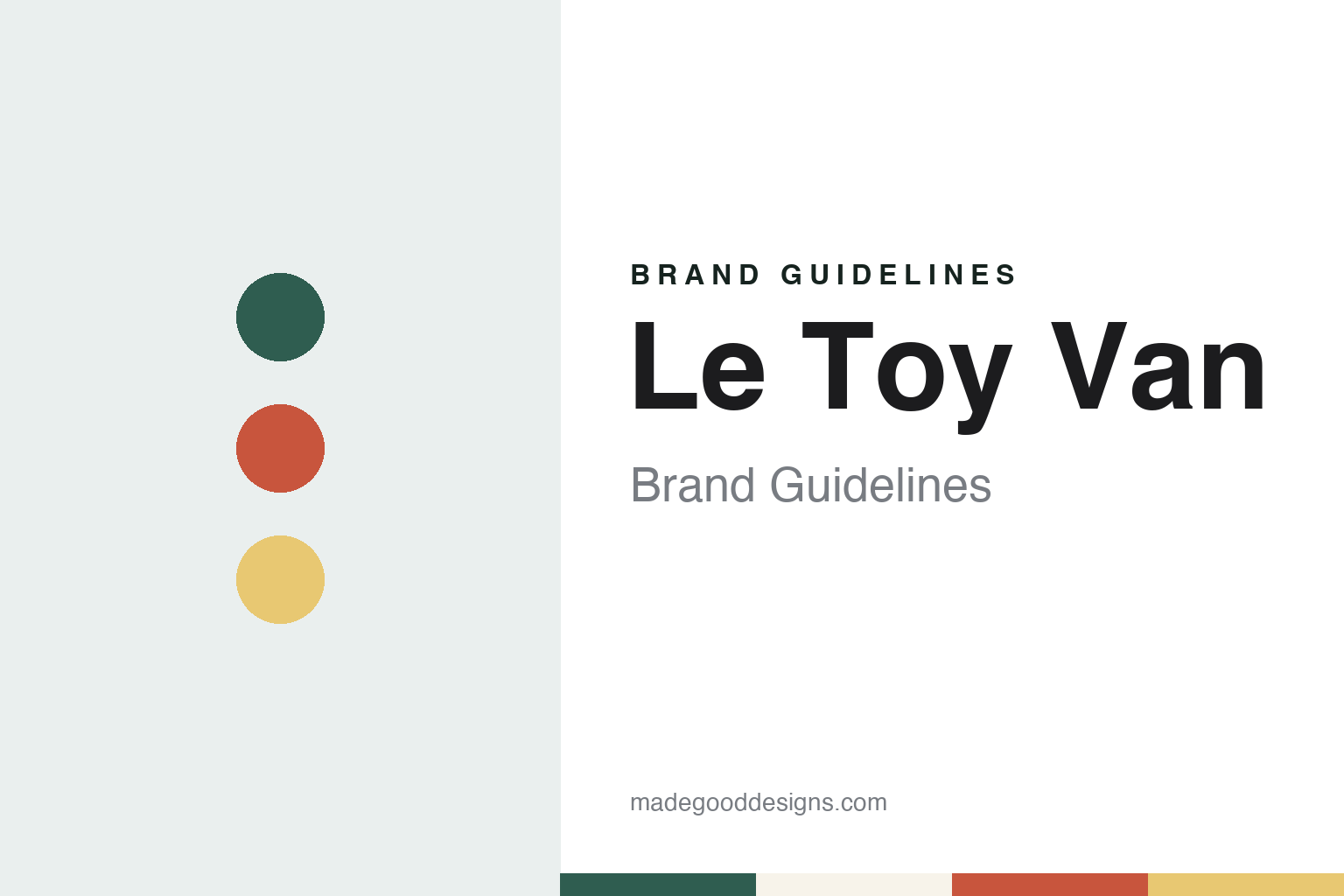
Le Toy Van Brand Guidelines
The Le Van family’s wooden dolls house maker.
Aa
Two constants: a shed green, brick red and honey palette and a storybook serif register. Abstract homage — not a Le Toy Van product or mark; no box, logo or toy image is reproduced.
A dolls house from a work shed
One house, made for one boy.
Le Toy Van is a family name as much as a brand name. The business is registered at Companies House as Le Toy Van Limited, a private company incorporated in England on 21 December 1995, and the register lists its founder, Georges Le Van, as a director from that day. Collette Le Van-Gilroy is also listed among the first directors, serving until July 2000.
The company’s own telling of how it started is short and domestic. Le Toy Van says that in 1995 Georges made the first toy in his work shed: a wooden dolls house modelled on his own home, built for his son to play with. In the company’s account, the children in the neighbourhood liked it so much that he began making houses for them too, and the idea for a toy business grew from there. Retailer copy written from the company’s material repeats the same story and names the son as Steven.
The next step, as the company tells it, came in 1998, when Georges took his dolls houses to Spielwarenmesse, the international toy fair held each year in Nuremberg. Le Toy Van says it was there that he won his first large commercial order, and that he sold his Austin-Healey car to pay for making it. Those details rest on the company’s word; the register records only the company itself, its officers and their dates.
Le Toy Van says that around 2000 it widened its team of toy designers and its partners abroad, and began adding new wooden toys beyond the dolls house to its catalogue.
Colour
A handover inside the family.
The second generation arrived in stages, and the register shows the steps. Steven Le Van was appointed a director of Le Toy Van Limited on 5 March 2013. Georges Le Van resigned as a director on 31 December 2015, the close of the company’s twentieth year. Marie Le Van joined the board on 1 July 2021, and both she and Steven are listed as current directors.
The company frames the same sequence in its own words. Le Toy Van says that Georges retired to mark twenty years of the business, handing it to his son Steven and his daughter-in-law Marie, and it describes itself today as family-run. The register also shows a second company, Le Toy Van International Limited, incorporated on 5 March 2019 at the same Ascot address as the original firm, and the brand’s American website trades under the name Le Toy Van, Inc.
On where the toys come from, Le Toy Van says its toys are “thoughtfully designed in the UK”. It also says it can take more than a year to develop a single toy, from the mechanism to the choice of colour. The company says it works only with FSC-certified wood and that almost all of its toys are free of plastic.
The way the company talks about its own design is consistent across its pages. Le Toy Van calls itself “a little obsessed with toy design” and describes its staff as “meticulous creators”. It sets out its values under four headings — quality and design, wonder, sustainable play and community — and pictures the play it has in mind as a teddy tea party, a busy shop or a world built from imagination. It describes its toys as made to be played with, passed on and kept for years, and says they draw on timeless design, playful storytelling and “a touch of nostalgia”.
Typography
Design and documentation.
The seven brands in this group are all toy names: Djeco, Janod, Tegu, Kapla, SmartGames, goki and Le Toy Van. Toy brands in general sit at many different points in the trade, from family firms that still carry a founder’s idea to labels that now belong to larger groups, and a single brand can be sold everywhere from a small independent shop to a department store.
A toy brand’s identity is usually carried less by a single object than by a box, a name, a colour and a way of drawing, because the company behind the name may have changed hands, moved its production or grown far beyond the place where it started. That makes the questions behind each name worth asking plainly: who started it, who owns it now, and where its toys are actually designed and made.
Each guide separates what independent sources record from what the company says about itself — its founding story, its owners over time, where its toys are made and how its boxes and logos have changed — and marks plainly what rests only on the company’s own word.
Aa
A storybook serif for a family wooden-toy maker. (Specimen set in Fraunces, a serif STAND-IN; NOT the Le Toy Van logo.)
Le Toy Van
Dolls houses, play shops and a family name.
The catalogue still grows outward from that first house. On its own websites Le Toy Van groups its range into dolls houses and accessories, baby and toddler toys, role-play sets, play kitchens and play food, shops and markets, cars and transport, soft toys and playroom furniture, with a car range it calls the GT Series. In October 2026 its UK and US sites both trailed a Paddington collection, marked as coming soon and carrying the trademark sign for the licensed bear.
The company has also set out a timeline of environmental steps, all in its own words. Le Toy Van says that in 2019 it partnered with the tree-planting charity One Tree Planted and took plastic out of its packaging, that it became FSC-certified in 2022, and that in 2025, its thirtieth year, it was certified as a B Corp.
What holds the brand together is less a single logo than a manner: painted wood, small houses and shops, and a story told as a family history from a shed to a second generation. The company name itself carries the founder’s surname, and the register shows the Le Van family at the head of the business from 1995 to today. Both companies list their registered office in Ascot, Berkshire. On B Corp status, Le Toy Van says certification “isn’t a destination” but the beginning of a journey.
For a design guide, Le Toy Van shows how a domestic origin story can carry a wooden-toy brand — compare Hape and BRIO. For this guide we use shed green, brick red and honey with a storybook serif, an unofficial interpretation; no product or logo is reproduced.
Explore & save
Keep Le Toy Van’s identity on hand — save it to a board in the Made Good inspiration library.
Le Toy Van identity set
Pin the Le Toy Van shed green, brick red and honey palette and the storybook serif register to your own board.


