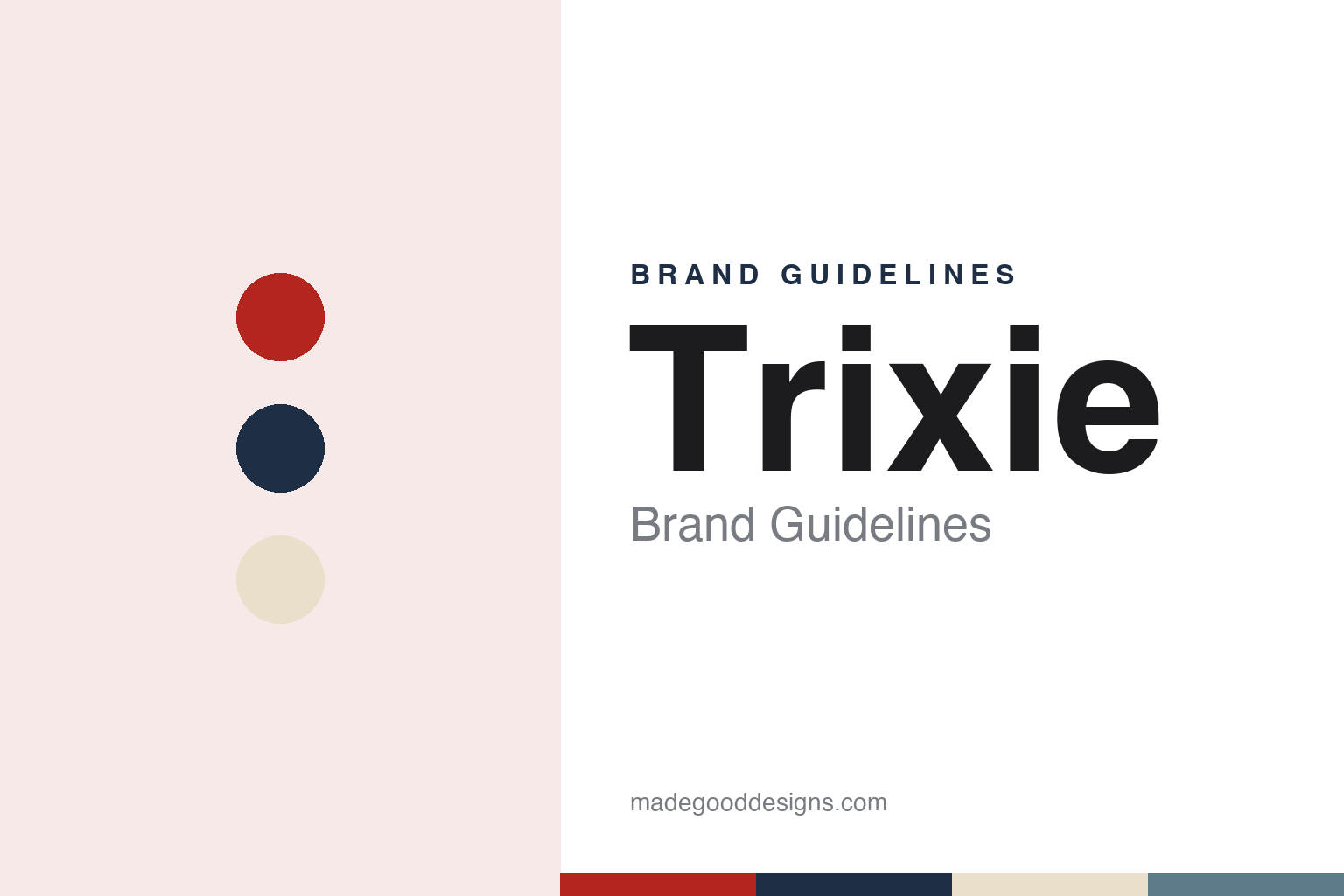
Trixie Brand Guidelines
The Tarp pet supplies house that began with one lorry.
Aa
Two constants: a signal red, harbour navy and dune sand palette and a sturdy grotesque sans register. Abstract homage — not a TRIXIE product or mark; no pack, product or logo is reproduced.
A wholesaler from the far north
A Danish founder, a lorry and a town near the border.
Trixie is a German maker and wholesaler of pet supplies based in Tarp, a town in the district of Schleswig-Flensburg in Schleswig-Holstein, not far from the Danish border. The company writes its own name in capitals, as TRIXIE, and the legal entity is Trixie Heimtierbedarf GmbH & Co. KG; German Wikipedia records that spelling, the Tarp seat and the founding year of 1974, and notes that the business serves both wholesale and retail customers. Central Garden & Pet, in a release filed with the US Securities and Exchange Commission on 27 July 2026, also gave 1974 as the founding year and Tarp as the headquarters.
The founder is Bonnik Hansen. The company tells the origin story on its own “Über uns” page, and tells it as a story about a vehicle: the history of TRIXIE, it says, “began with a lorry and a Dane.” In 1974, according to the company, the entrepreneur Bonnik Hansen loaded his truck with dog leads, toys and chews, and at that point it was a one-man business. The same page says the company has kept its feet on the ground as it grew, that everyone there uses the informal du, and that the tone it aims for with customers and suppliers is friendly and “typically north German.”
The range has long since grown past those first leads and chews. The company says it accompanies an animal “from birth to old age, at home and on the road, at play and at sport and in every season,” and its product navigation is split into dogs, cats, small animals, birds, garden animals and terrarium animals, with seasonal goods and spare parts listed separately. Central’s July 2026 release described the assortment as products for dogs, cats, birds, reptiles and small animals, and listed accessories, toys, treats, snacks, habitats, apparel, bedding and travel solutions among them.
Colour
An in-house design team, and a field sales force across western Europe.
Trixie presents itself as a company that designs much of what it sells. On its “Über uns” page it says that many of its product lines are developed, checked and tested in house by specialists and designers, and that external animal experts and developers also play an important part. Central’s release in July 2026 made the same point from the buyer’s side, referring to a strong in-house design team that introduces new products every year, and to the company’s logistics and fulfilment operation in Tarp as one of the strengths it was buying into.
The business model is that of a specialist supplier to the trade. German Wikipedia describes Trixie as both a manufacturer and a wholesaler, and the company’s site has a dealer login, a page for retailers who want to stock the range and a dealer locator for pet owners. The company says its field sales staff cover customers in Germany, Austria, England, France, the Netherlands, Belgium and Luxembourg, and that orders are shipped from the company seat in Tarp. It also says it is a training company offering several apprenticeships, and its site has sections on sustainability, social engagement and a workplace programme it calls Kollege Hund, or “colleague dog.”
Taken together, the company’s own account describes a division of labour: product ideas, checks and testing in Tarp, outside experts brought in alongside its own staff, and orders shipped from the company seat to specialist retailers.
Typography
Design and documentation.
The brands in this group are pet accessory names, five of them European and one American: Trixie, Karlie, Kerbl, Ferplast, Beeztees and Tuffy. Pet accessory brands in general sit at many different points in the trade, from family firms that still carry a founder’s name to wholesalers that supply shops under several labels, and a single name can be sold everywhere from a village pet shop to a garden centre or a farm store.
A pet accessory brand’s identity is usually carried less by a single collar or toy than by a catalogue, a name and the packaging that hangs on a shop wall, because the company behind the name may have changed hands, moved its warehouses or grown far beyond the town where it started. That makes the questions behind each name worth asking plainly: who started it, who owns it now, and where its products are actually designed and made.
Each guide separates what independent sources record from what the company says about itself — its founding story, its owners over time, where its products are made and how its labels have changed — and marks plainly what rests only on the company’s own word.
Aa
A sturdy grotesque for a name the company sets in capitals. (Specimen set in Archivo, a sans-serif STAND-IN; NOT the TRIXIE logo.)
Trixie
From a founder-owned firm to a pending majority sale.
On 27 July 2026 Central Garden & Pet, the Walnut Creek, California consumer goods group whose pet brands include Nylabone, announced that it had entered into a definitive agreement to acquire a majority interest in Trixie from Bonnik Hansen and the shareholders Dirk Jessen and Volker Haak. The release said Jessen and Haak would remain minority shareholders, that Haak would continue as a consultant, and that management would continue to be led by Jessen, Burkhard Friedrichsen and Danny Bollerey. Trixie is to sit within Central’s Pet segment.
Hansen was quoted in the release. “In looking for a partner, it was important to us to find a company that shares our values, our culture, and our long-term thinking,” he said. The German public broadcaster NDR reported on 28 July 2026 that Friedrichsen had told a staff meeting in Tarp that day that nothing would change for the workforce or the site. “We now have a stronger partner behind us, with whom we can expand our product portfolio in order to reach even more customers in Europe,” he said, according to NDR, which also reported the aim of establishing Trixie in the American market. The Frankfurter Allgemeine Zeitung covered the sale on 27 July 2026.
The deal had not closed by October 2026. Central said it expected completion in the first half of its fiscal 2027, subject to regulatory approval and other customary conditions, and NDR reported that it could be completed in early 2027 once approvals were in place. Until then Trixie remains in the hands of its existing shareholders.
For a design guide, Trixie shows how a north German wholesaler built a trade brand around an all-capitals name, a broad multi-species range and a founding story told through a single lorry. Compare Karlie, another German pet supplies house founded in the 1970s, and Nylabone, a sister brand under Central once the deal completes. For this guide we use signal red, harbour navy and dune sand with a grotesque sans, an unofficial interpretation; no product or logo is reproduced.
Explore & save
Keep Trixie’s identity on hand — save it to a board in the Made Good inspiration library.
Trixie identity set
Pin the Trixie signal red, harbour navy and dune sand palette and the sturdy grotesque sans register to your own board.


