Nathan Brand Guidelines
The Paris publisher’s name on games, sold on and licensed.
Aa
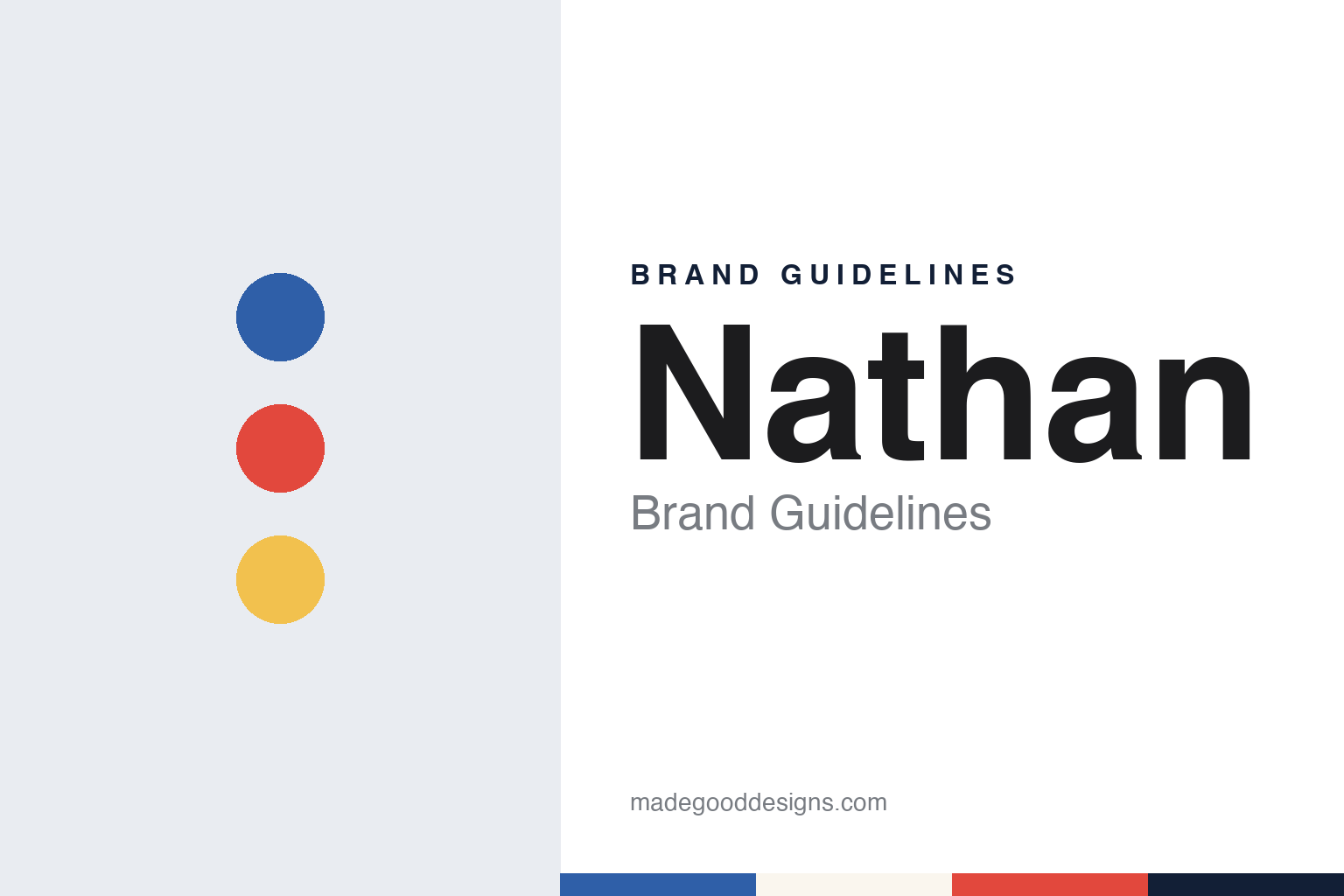
Two constants: a schoolbook blue, poster red and crayon yellow palette and a bookish serif register. Abstract homage — not a Nathan product or mark; no logo, box or game is reproduced.
From a Paris publisher to a games name
A bookseller’s clerk, a publishing house and a games arm.
The Nathan name began in books. French Wikipedia’s article on Fernand Nathan says he first worked for the Paris bookseller and publisher Charles Delagrave, and that on 8 June 1881, at the age of 23, he set up his own publishing house in Paris. The article notes that Nathan was the name he went by; he was born Fernand Cahen. The company that grew from that start, Nathan, became a familiar publishing name in France, and the same surname was later carried onto board games, puzzles and activity sets.
Those games were published by Jeux Nathan. French Wikipedia describes it as a France-based publisher of board games, headquartered in Paris, that belonged to the Nathan publishing house. Its catalogue, the article says, took in electronic games, puzzles and the Mako moulding sets, sold as “Mako moulages”, in which children cast and painted their own small figures. That last line sits closest to the construction and making toys in this group: a box of moulds and plaster rather than a box of bricks, but the same idea of a child building something to keep.
Within the Nathan group, French Wikipedia says, the games business passed through several owners in turn: CEP Communication, then Havas, and then Vivendi. Over the same decades it built up a list of family and quiz games. The article lists, among others, La Conquête du pétrole in 1974, Shogun in 1979, Richesses du monde in 1982, games based on the television quiz shows Questions pour un champion and Des chiffres et des lettres in 1996, and Enigmo in 1997.
Colour
A sale, a factory closure and a name that stayed behind.
The games and the name went separate ways in 1998. French Wikipedia says that in June 1998 Vivendi sold Jeux Nathan to the German games and puzzle maker Ravensburger while keeping the Nathan publishing house; it cites Le Parisien, which reported on 6 July 1998 that the sale was being signed that day. German Wikipedia’s article on Ravensburger also records the takeover of Jeux Nathan in 1998.
The new owner moved quickly on production. Citing L’Usine nouvelle of 15 October 1998, French Wikipedia says that three months after the takeover Ravensburger decided to stop making toys at the Nathan site in Méru, in the Oise, which became a storage site; puzzle production went to Ravensburger’s plant at Chalon-sur-Saône, and the Nathan learning games went to its factory in Ravensburg. The same article says the Chalon plant was closed in 2001, citing Les Échos of 26 April 2001, and that the Méru site followed in 2006, citing Le Parisien of 4 May 2006.
The name itself did not travel with the games for long. French Wikipedia, again citing L’Usine nouvelle, says Ravensburger was not authorised to use the Nathan mark, which remained the property of the publishing house, so the games moved under the Ravensburger brand and the Jeux Nathan brand disappeared about two years after the sale. German Wikipedia’s Ravensburger article gives a different picture, listing Nathan among the group’s brands as a French puzzle brand from 1998 and citing Ravensburger’s own 2012 annual report. The two accounts are set side by side here rather than reconciled.
For a design reader, the episode is a clear case of a brand and a business being separable things. The factories, the staff and the catalogue could be bought and moved; the word on the box belonged to a publisher, and the publisher kept it.
Typography
Design and documentation.
The six brands in this group are construction, building and game names: Magformers, Geomag, Quercetti, K’NEX, CONNETIX and Nathan. Construction-toy brands in general sit at many different points in the trade, from family firms that still carry a founder’s name to names that now belong to larger toy groups or are used under licence, and a single brand can be sold everywhere from a supermarket aisle to a specialist toy shop.
A construction-toy brand’s identity is usually carried less by a single piece than by a name, a box and a system of parts, because the company behind the name may have changed hands, moved its production or licensed its mark to another maker. That makes the questions behind each name worth asking plainly: who started it, who owns it now, and where its pieces are actually made.
Each guide separates what independent sources record from what the company says about itself — its founding story, its owners over time, where its toys are made and how its look has changed — and marks plainly what rests only on the company’s own word.
Aa
A bookish, schoolroom serif. (Specimen set in Libre Baskerville, a serif STAND-IN; NOT the Nathan logo.)
Nathan
A licensed name, made and sold from Spain.
The Nathan name came back to games through licensing. French Wikipedia says that since March 2007 the Spanish company Diset has published new games, mostly aimed at early learning, under the Nathan brand on licence for the general toy and games market. It says manufacturing, sales and marketing are handled by Diset in Barcelona, and that Diset’s French distribution subsidiary is based at Artigues-près-Bordeaux, in the Gironde.
That arrangement gives the brand an unusual shape. The name on the box goes back to a Paris publisher of 1881; the games carrying it today, as French Wikipedia describes them, are made and marketed by a Spanish company under licence, while the earlier Jeux Nathan catalogue and factories passed to Ravensburger in 1998. A buyer in a French toy shop sees one continuous name, but behind it sit three different businesses across more than a century.
The older catalogue also carried the names of French game designers. French Wikipedia’s list of Jeux Nathan titles credits Club Voyage of 1989 to Sylvie Barc and Philippe des Pallières, Dinosaurus of 1993 to Philippe des Pallières, Patrice Pillet and Didier Jacobée, and Le Fantôme de Mac Gregor of 1998 to Dominique Ehrhard. The same list shows comic-strip licences on the boxes, with games built around Tintin in 1991, the Marsupilami in 1993 and Spirou in 1995.
For a design guide, Nathan shows how a publisher’s surname can outlast the sale of the games that made it familiar, and be lent back to a new maker years later — compare BRIO, the Swedish wooden-railway name that Ravensburger bought in 2015, and KAPLA, the French wooden-plank building toy. For this guide we use schoolbook blue, poster red and crayon yellow with a serif, an unofficial interpretation; no product or logo is reproduced.
Explore & save
Keep Nathan’s identity on hand — save it to a board in the Made Good inspiration library.
Nathan identity set
Pin the Nathan schoolbook blue, poster red and crayon yellow palette and the bookish serif register to your own board.