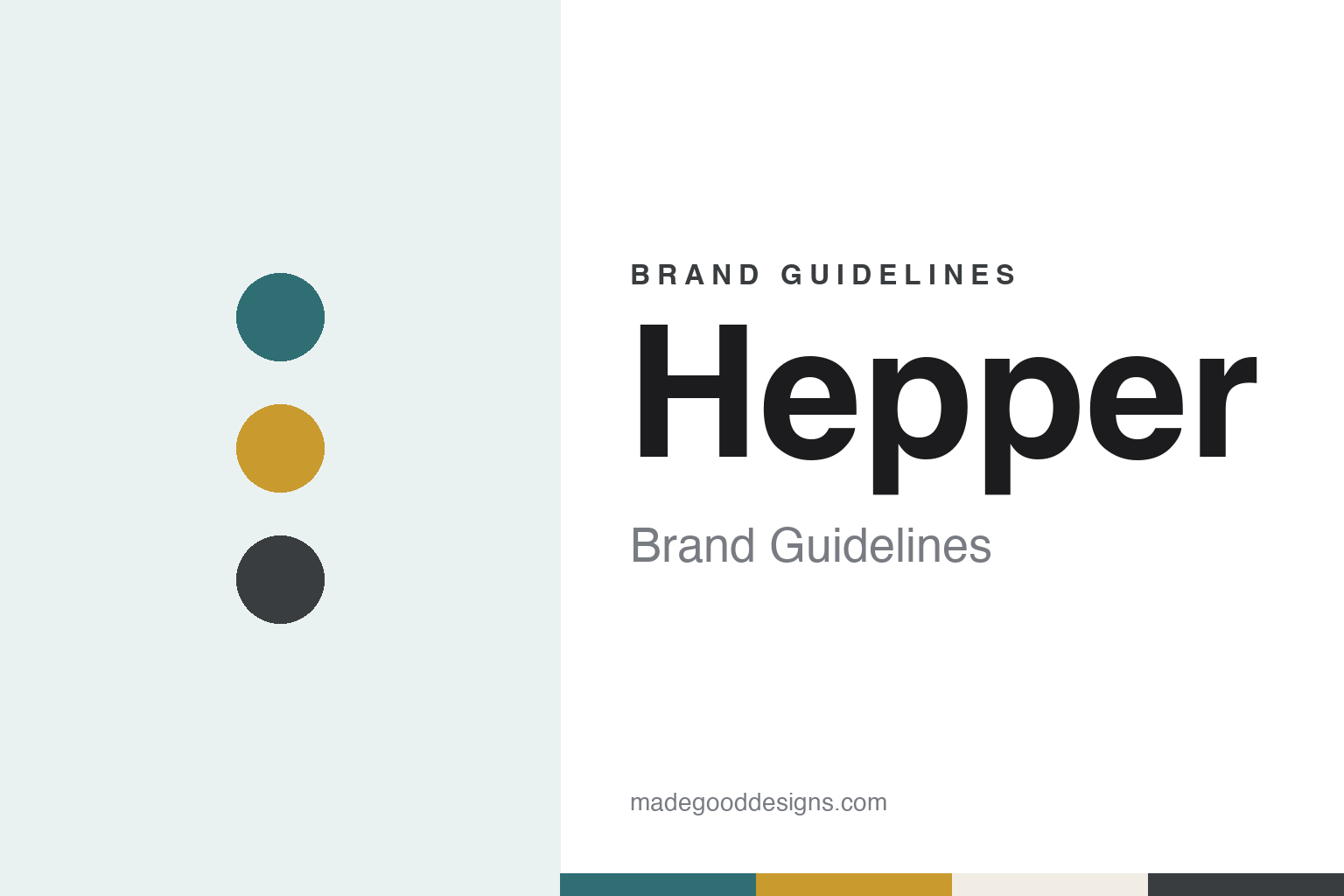
Hepper Brand Guidelines
Modern cat furniture, from a Vermont design studio to a pet media group.
Aa
Two constants: a mid-century teal, graphite and herringbone palette and a geometric mid-century sans register. Abstract homage — not a Hepper product or mark; no bed, pack or logo is reproduced.
A better way to bed a cat
A Vermont-designed line of modern cat beds.
Hepper is an American brand of modern pet furniture, built first around beds for cats. The company’s own about page says it launched in March 2007 and has been “on a mission to make pets and their humans happy” ever since. Today it describes its work in a single line: “At Hepper, we craft modern pet furniture and supplies for cat and dog parents.”
The design story was told early. On 14 November 2007, the industrial design site Core77 introduced Hepper as a new pet products company whose entire line was designed by the industrial designer Jed Crystal in his studios in Burlington, Vermont. The post described the range as mod-pods, cosy loungers and streamlined hang-out spots for pets, and said Hepper had been born from the thought that “there’s got to be a better way.” It called the pieces “tastefully designed with the most discerning pets and pet owners in mind.” Later, in a post dated 25 November 2014, the cat design blog Hauspanther referred to “the company’s founder Jed Crystal” and said its writer had worked with Hepper since both started out in the cat product business.
The name has a story of its own. The design blogger Kim Vallée, writing on 23 April 2008, reported that the company was named after a cat nicknamed Hepper — short for Hepburn, as a nod to the style of Audrey Hepburn. The same post presented the line as hip, modern pet furniture meant to blend with home décor, and noted that some of the models were large enough for small dogs as well as cats. Vallée set the beds against other design-minded options of the day, among them a cat stand from Cat Interiors and a rattan raised bed from IKEA, as other choices for readers shopping for pet furniture that would sit alongside their own décor.
Colour
Pod, Podium, Nest and Wave — and the redesigns that followed.
By spring 2008 the range had four named beds, according to Vallée’s post. The Pod was an enclosed bed with a removable top; the Podium was described as a Pod without its top; the Nest was a “cocooning” design; and the Wave was a hammock-style bed suited to larger cats or more than one cat. The post said the Podium came in two extra colours beyond the Pod’s range, racetrack graphite and herringbone. The line was sold through Hepper’s own online store as well as through the design retailer Design Public and the pet boutique Muttropolis.
The beds were revisited over the following decade. Hauspanther’s 2014 post presented a new Nest Bed: a circular bed for curling up inside, built on a flexible moulded foam shell — the same material, it said, as the Hepper Pod Bed — and fitted with a removable, washable sherpa fleece liner. Three years later, on 8 December 2017, the same blog announced a redesigned Pod Bed, calling the original “an icon of modern cat design.” The new version had a larger interior and entrance, a newly designed metal frame standing on four legs with non-slip rubber pads, and a removable sherpa fleece and microfiber liner. Its top could still be lifted off to turn the pod into an open raised bed. The post listed the colours as grey and herringbone, and said Hepper had “REALLY listened to feedback from their customers” on the design.
The current range is broader. Hepper’s about page lists the Nest Bed, the Pod Bed and a “Just A Box” bed, the Hi-Lo Cat Scratcher with replacement cardboard, the NomNom Cat Bowl, a stainless steel water fountain, toys, grooming tools and cleaning products, and says the company has expanded to include products for dogs.
Typography
Design and documentation.
The brands in this group all make furniture, scratchers, toys or other accessories for cats. Cat accessory brands in general sit at many different points in the pet trade, from small workshops run by their founders to names that now belong to much larger pet companies or investment groups, and a single brand can be sold everywhere from a specialty pet shop to an online marketplace.
A cat accessory brand’s identity is usually carried less by one product than by a name, a mark, its packaging and the way its range is organised and described, because the company behind the name may have changed hands, moved its production or grown well beyond its first workshop or catalogue. That makes the questions behind each name worth asking plainly: who started it, who owns it now, and where its products are actually designed and made.
Each guide separates what independent sources record from what the company says about itself — its founding story, its owners over time, where its products are made and how its range and packaging have changed — and marks plainly what rests only on the company’s own word.
Aa
A geometric sans for a brand that borrowed its name from Audrey Hepburn. (Specimen set in Josefin Sans, a sans-serif STAND-IN; NOT the Hepper logo.)
Hepper
From a designer’s studio to part of a pet media group.
Hepper is now part of Pangolia. Hepper’s about page names Pangolia as its parent company and lists Simon Treulle as Pangolia’s founder, alongside a small team covering operations, editorial content, design and social media. When the pet trade site Pet Insight reported on 20 October 2023 that Pangolia had bought the Catster and Dogster brands from Belvoir Media Group in an all-cash deal, it described Pangolia as a digital media and e-commerce start-up founded by Treulle in 2019, and listed Hepper among the sites it ran, together with Petkeen and Excited Cats. Treulle was quoted as saying, “Pangolia is a proudly digital-first content producer.”
Under that ownership the brand still leads with design in its own words: its about page says, “Our products aren’t just for lounging—they’re for living,” and speaks of “creating a space where pets can be themselves, and humans can feel truly at home.”
For a design guide, Hepper shows how a pet brand can borrow the language of mid-century furniture — named pieces, a short catalogue, colours such as graphite and herringbone, and a name that nods to Audrey Hepburn — and keep its signature object recognisable through more than one redesign. Compare Tuft + Paw, another cat furniture brand built around interior design, and PetFusion, the cat scratcher brand now part of Petmate. For this guide we use mid-century teal, graphite and herringbone with a sans, an unofficial interpretation; no product or logo is reproduced.
Explore & save
Keep Hepper’s identity on hand — save it to a board in the Made Good inspiration library.
Hepper identity set
Pin the Hepper mid-century teal, graphite and herringbone palette and the geometric mid-century sans register to your own board.


