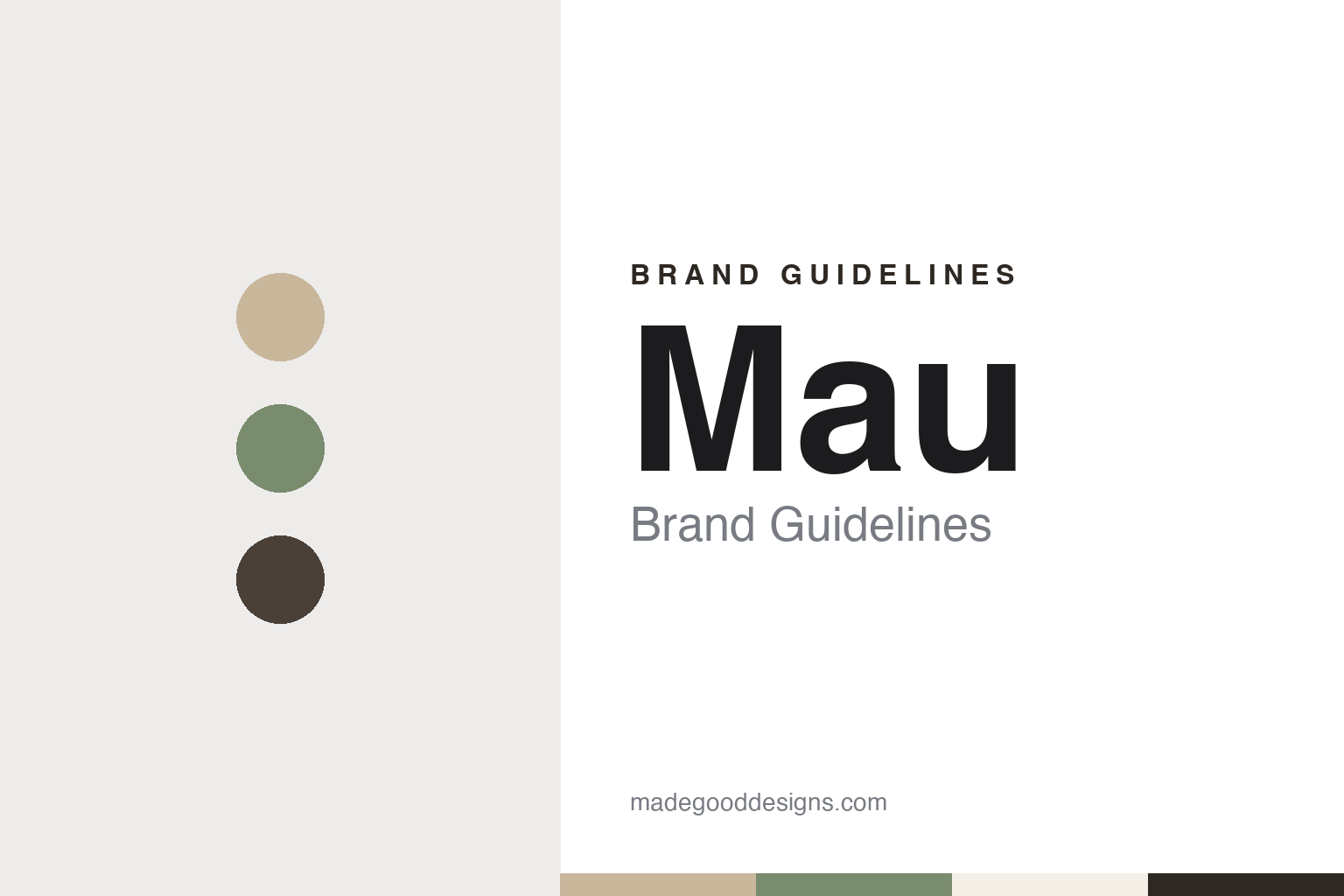
Mau Brand Guidelines
Cat furniture meant to stay in the room.
Aa
Two constants: an oat, sage and walnut palette and a gallery serif register. Abstract homage — not a Mau product or mark; no tree, bed or logo is reproduced.
Furniture you would not hide
A cat furniture brand built on the idea that a cat tree belongs in the room.
Mau is a cat furniture brand that sells through its own website, maupets.com, under a short name and the tagline of a design label rather than a pet shop. Its founder is Joel Dickstein, who explained the idea behind the company in a “Behind the Brand” interview with the pet magazine Kinship, written by Mai Lynn Miller Nguyen and updated on 16 October 2023. The writer introduced Mau as a company that makes high-end products for cats on the principle that cat furniture should be part of a room’s design, not something to be hidden away when guests come round.
Dickstein described the start of the business in plain terms. “We’ve always thought of cats as family members,” he told Kinship, and said that as pet owners the team had noticed a lack of quality in the cat product industry, “in both materials and design, so we set out to do it ourselves.” The design philosophy had evolved over the years, he said, but at heart it came from making products that are appealing to the human eye while giving cats comfort and use. He put the limit of that idea with a joke: “As much as we’d like to design the next Mona Lisa, we have to keep in mind that our products have to be kitty friendly.”
The company’s own pages today give a business address in Pembroke Park, Florida, in the footer of the site. Its About page states the mission in one line: “To create beautiful spaces for cats to thrive and for cat lovers to admire.” The same page says Mau works with cat behaviourists, engineers, industrial designers and interior designers, and that its pieces should look as if they come “from an art gallery and not a flea market.”
Colour
From cat and dog furniture with Italian names to a range of trees, scratchers and beds.
The earliest substantial version of the site held by the Internet Archive, captured on 14 November 2019, shows a slightly different business. The page title then read “Cat & Dog Furniture Designed For You,” the menu was split between cats and dogs, and the header offered both an English and a German version of the site. The featured cat products carried Italian-sounding names, among them Cento, Leone, Rizzo and Alba. The mission statement of the time promised “the best design for humans and best functionality” for pets, and the company said its cat trees used real branches taken from trees that no longer bear fruit.
That sourcing claim has stayed with the brand. The current sustainability page repeats that the branches of its cat trees come from trees that no longer bear fruit, and that worn parts can be replaced rather than the whole piece thrown away. In the 2023 interview Dickstein confirmed the point about the wood and said the company plants a tree for every purchase. Giving to animal welfare and environmental causes is presented on the site as part of the business model, and he described it to Kinship as a duty owed by animal lovers to the animals that bring them joy.
The catalogue has since moved toward cats alone. The site’s menu now sorts the range into trees, scratching posts, caves and beds, and wall furniture, with a separate section for upgrades and replacement parts. Names such as Ivy, Vevo, Torii and Lua appear in the current range.
Typography
Design and documentation.
The brands in this group all make furniture, scratchers, toys or other accessories for cats. Cat accessory brands in general sit at many different points in the pet trade, from small workshops run by their founders to names that now belong to much larger pet companies or investment groups, and a single brand can be sold everywhere from a specialty pet shop to an online marketplace.
A cat accessory brand’s identity is usually carried less by one product than by a name, a mark, its packaging and the way its range is organised and described, because the company behind the name may have changed hands, moved its production or grown well beyond its first workshop or catalogue. That makes the questions behind each name worth asking plainly: who started it, who owns it now, and where its products are actually designed and made.
Each guide separates what independent sources record from what the company says about itself — its founding story, its owners over time, where its products are made and how its range and packaging have changed — and marks plainly what rests only on the company’s own word.
Aa
A refined serif for a brand that compares its cat trees to gallery pieces. (Specimen set in Cormorant Garamond, a serif STAND-IN; NOT the Mau logo.)
Mau
Shapes taken from nature, and products tested by cats.
Mau describes its designs through images from nature. Its About page says the pieces are “inspired by elements found organically in nature,” and names three: the phases of the moon, the fluidity of waves and the sculptural form of trees. The aim, the company says, is furniture designed to fit as well in a home as it would in nature. The same page frames the brand around a change of reaction, from apologising for having a cat to being proud of it, and calls Mau “a different breed of cat furniture for people who love cats as much as they love their homes.”
Materials and texture are the other half of the pitch. Asked by Kinship about the Vevo bed, Dickstein described its adjustable sides, which fold down for warmth or stand up to give a sense of enclosure for cats that like to hide, and its thick, velvety, knotted texture, which he said “almost hugs the cats when inside.” Materials and their textures, he said, can make all the difference in whether a cat likes a product. He said every product is “cat approved” by a group of “meowdels” drawn from Mau employees, friends and family, and the About page now introduces its own panel of named cat product testers under the line “At Mau, cats rule.”
The brand’s way of talking to buyers is light and playful. The 2023 interview sorted cats into climbing “tree cats” and hiding “bush cats,” and Dickstein advised owners to watch how a cat sleeps and what it does each day before choosing a tree, an enclosed bed, a basket or a flat platform. The site’s newsletter promises “purr-ks,” and its product pages keep the short single-word names that have run through the range since 2019.
For a design guide, Mau shows how a cat furniture brand can borrow the language of the design gallery, with nature-based forms, one-word product names and a promise that the furniture stays on show. Compare Tuft + Paw, another design-led cat furniture brand, and Hepper, the modern cat furniture maker. For this guide we use oat, sage and walnut with a serif, an unofficial interpretation; no product or logo is reproduced.
Explore & save
Keep Mau’s identity on hand — save it to a board in the Made Good inspiration library.
Mau identity set
Pin the Mau oat, sage and walnut palette and the gallery serif register to your own board.