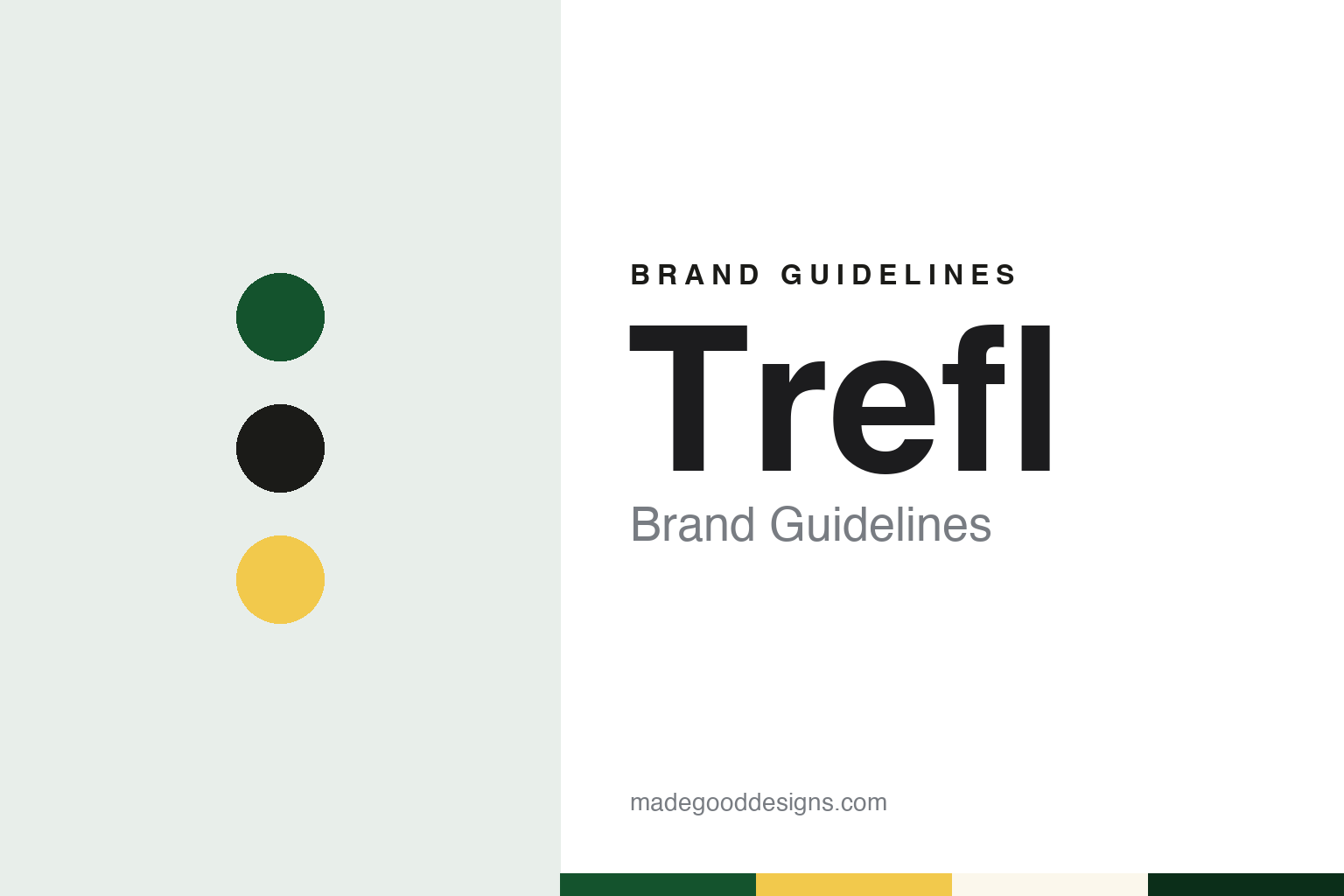
Trefl Brand Guidelines
The Gdynia puzzle maker named after a card suit.
Aa
Two constants: a clover green, yellow and black palette and a rounded sans register. Abstract homage — not a Trefl product or mark; no puzzle, box or logo is reproduced.
A card suit in Gdynia
A puzzle workshop on the Baltic coast.
Trefl began in Gdynia, the port city on Poland’s Baltic coast, in 1985. Its founder was Kazimierz Wierzbicki, who started by making jigsaw puzzles, according to English Wikipedia and to a 2025 profile in the magazine of the Spielwarenmesse, the toy trade fair in Nuremberg. The magazine describes him as the company’s founder and owner, and says Trefl sees itself as “a dynamically developing family business.” English Wikipedia describes Wierzbicki as a former basketball, skiing and volleyball instructor, and the magazine calls him a sports enthusiast and a supporter of the arts and culture.
The name is a word every Polish card player knows: trefl is Polish for clubs, the suit of playing cards marked with a three-leafed clover. Cards became part of the business too. In 1998, English Wikipedia says, Trefl became the major shareholder of a playing-card maker in Kraków, which now trades as Fabryka Kart Trefl-Kraków, the Trefl Playing Card Company.
English Wikipedia sets out the early milestones. In 1989 the company received a permit to export its products, and since 1991 the Walt Disney Company has been a major licensing partner. Trefl began making three-dimensional puzzles in 2004. The Polish Wikipedia article describes Trefl S.A. as a Gdynia company that makes puzzles, board games, toys and books, and that distributes toy brands including SIKU, VTech and Hape in Poland.
The company marked its 40th anniversary in 2025 with a large cake on its stand at the Spielwarenmesse, the fair’s magazine reported.
Colour
Puzzles first, then games, cartoons and books.
Jigsaw puzzles remain Trefl’s main business, according to the Spielwarenmesse magazine, which describes a range running from simple puzzles for toddlers to very large panoramas for adults. The magazine singles out two lines the company promotes: Prime, built around picture compositions, and Wood Craft, wooden puzzles with shaped pieces — one of them the Eiffel Tower — and pieces cut in irregular forms.
The company says its products are made with children and their parents in mind, and the magazine reports that it aims for engaging and safe products that encourage curiosity about the world and shared time together. Licensed pictures are a large part of the range. The magazine names partners including Barbie, Star Wars, Harry Potter and Hello Kitty, and Polish Wikipedia lists licences from Disney, Mattel, Hasbro and Marvel alongside Trefl’s own characters, the Rodzina Treflików, or Treflik family. The Treflik family also became a cartoon: the company says it opened its own animated-film studio, KAZstudio, in 2013, and English Wikipedia lists a children’s publisher, Wydawnictwo Trefl, and a media company among the group’s other businesses.
Board games became a second pillar. The Spielwarenmesse magazine reported that Trefl moved into the German market in 2021 with a range of designer games, including titles by Reiner Knizia, Wolfgang Kramer and Klaus-Jürgen Wrede. Knizia told the magazine that Trefl brought his game At the Office to market in 2023, and that the publisher had used members of its own editorial team for the office hierarchy drawn on the playing sheets. The magazine also names an in-house brand, Spy Guy, a cooperative game line in which players race the clock.
Trefl also makes puzzles for other companies. Its contract-manufacturing arm, Trefl Factory, says its factory is in Gdynia and that it produces puzzles, board games and packaging to order for publishers, marketing agencies and public institutions, from prototype to finished product. It lists ISO 9001, FSC and Sedex ethical-audit credentials; those are the company’s own statements.
Typography
Puzzles in print and in wood.
The seven brands in this group are all jigsaw puzzle makers: Clementoni, Educa, Schmidt Spiele, Piatnik, Trefl, Wentworth and Liberty Puzzles. Puzzle brands in general sit at many different points in the trade, from family firms that still carry a founder’s name to labels that now belong to larger toy and games groups, and a single brand can be sold everywhere from a toy shop to a museum gift store.
A puzzle brand’s identity is usually carried less by a single picture than by a box, a name and the way its pieces are cut, because the company behind the name may have changed hands, moved its production or grown far beyond the place where it started. That makes the questions behind each name worth asking plainly: who started it, who owns it now, and where its puzzles are actually made.
Each guide separates what independent sources record from what the company says about itself — its founding story, its owners over time, where its puzzles are made and how its boxes have changed — and marks plainly what rests only on the company’s own word.
Aa
A rounded sans for a puzzle and games company. (Specimen set in Rubik, a sans STAND-IN; NOT the Trefl logo.)
Trefl
A puzzle company with its own teams.
Outside the toy trade, the Trefl name also appears in sport. The company says Trefl SA owns two sports companies supporting the teams Trefl Sopot, in basketball, and Trefl Gdańsk, in volleyball, both of which play in Poland’s top leagues. English Wikipedia dates the volleyball club to 2005 and the basketball club to 2009, when it was set up in Sopot after the city’s previous club moved to Gdynia; the basketball team plays in yellow and black. The Spielwarenmesse magazine says Wierzbicki established the basketball team himself and in 2010 founded the Trefl Pomorze association, which works with the local community. The company says the association brings together the teams’ fans and representatives of businesses in Pomerania, the region around Gdańsk, Gdynia and Sopot.
The company is run from Gdynia, where Trefl Factory says its production takes place, and English Wikipedia names Jakub Siemiątkowski as president of the management board.
For a design guide, Trefl shows how a company named after a playing-card suit grew from a puzzle workshop into a group spanning games, cards, cartoons and sport. Compare Piatnik, the Vienna card and puzzle maker, and Schmidt Spiele, the Berlin games publisher. For this guide we use clover green, yellow and black with a rounded sans, an unofficial interpretation; no product or logo is reproduced.
Explore & save
Keep Trefl’s identity on hand — save it to a board in the Made Good inspiration library.
Trefl identity set
Pin the Trefl clover green, yellow and black palette and the rounded sans register to your own board.


