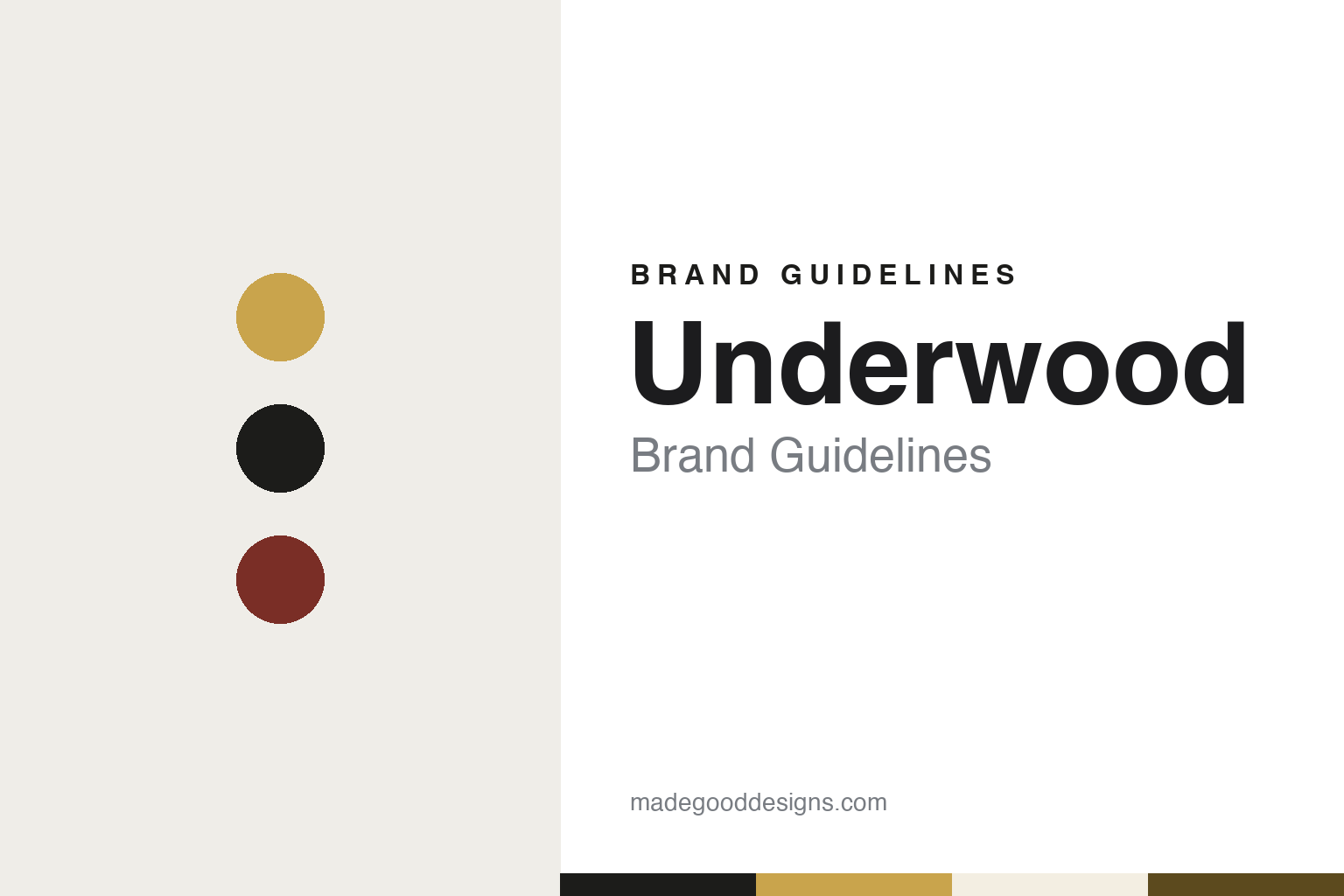
Underwood Brand Guidelines
A ribbon maker’s typewriter from Hartford, merged into Olivetti in 1963.
Aa
Two constants: an enamel black, gold and paper cream palette and a typewriter slab serif register. Abstract homage — not an Underwood product or mark; no machine, decal or logo is reproduced.
From ribbons to typewriters
A supplier’s family, an inventor’s machine and a factory town.
The Underwood name entered typewriting from the supply side. English Wikipedia says that in 1874 the Underwood family was making typewriter ribbon and carbon paper, and that it was one of several firms producing those goods for Remington. When Remington decided to make its own ribbons, the encyclopedia says, the Underwoods chose to make typewriters themselves.
The machine came from an inventor. English Wikipedia credits the original Underwood typewriter to Franz Xaver Wagner, a German-American, who showed it to the entrepreneur John Thomas Underwood; Underwood backed Wagner and bought the company. The typewriter collection of Georg Hamann, hosted by the Berliner Hochschule für Technik, puts the start in 1895, when Wagner founded a company in New York to produce a model he called “Complete Visible Writing,” and says the firm became the Underwood Typewriter Company once John T. Underwood, a maker of carbon paper, ink and ribbons, became involved. English Wikipedia also gives 1895 as the founding year.
The company moved its making to Connecticut early. The Connecticut Historical Society’s “Typing History” article by Karen DePauw (October 2021) says Underwood, then with its factory in New Jersey, first advertised in the Hartford Courant in 1898, moved its factory to Hartford in 1901, and that by 1911 the factory complex stretched for blocks along Capitol Avenue. English Wikipedia describes the company as headquartered in New York City, with manufacturing in Hartford.
The model most associated with the name is the Underwood No. 5, which English Wikipedia says was launched in 1900. The encyclopedia cites The Classic Typewriter Page for the model and for a list of writers who used or endorsed Underwood machines, among them William Faulkner, F. Scott Fitzgerald, Ernest Hemingway and Robert E. Howard.
Colour
A name on the machine, a giant on a pier.
Underwood promoted its name on a grand scale. English Wikipedia says that in the years before the Second World War the company built an outsized typewriter to promote itself, which was displayed for several years on the Garden Pier in Atlantic City, New Jersey, and that young women were often seated on its keys for the crowds. The encyclopedia says the machine was scrapped for its metal when the war began.
The war changed what the Hartford works made. English Wikipedia, citing the NRA Museum, says Underwood produced M1 carbines from late 1942 to May 1944, and also made carbine barrels that the United States government passed to other manufacturers that lacked the machinery to make them.
Corporate identity shifted in the same decades. According to English Wikipedia, Philip Dakin Wagoner became president of the Elliott-Fisher Company after the First World War, and Elliott-Fisher became the parent of the Underwood Typewriter Company and the Sundstrand Adding Machine Co. In 1927, citing Time of 5 December that year, the encyclopedia says Wagoner reorganised the group as Underwood Elliott-Fisher, with John Thomas Underwood as chairman and Wagoner as president; it later became the Underwood Corporation. In 1945, English Wikipedia says, Wagoner was elected chairman of the board and Leon C. Stowell president. The Hamann collection dates the Underwood Corporation name to 1945.
The name has also had a long second life on screen. English Wikipedia lists Underwood machines in the television series House of Cards, where the fictional Frank Underwood writes a letter on one, and in Parks and Recreation, as well as in the films The Day of the Jackal and Finding Forrester.
Typography
Design and documentation.
The seven brands in this group are all typewriter names: Olivetti, Smith-Corona, Underwood, Hermes, Imperial, Facit and Triumph-Adler. Typewriter brands in general sit at many different points in their histories, from names that moved on to computers and office equipment to marques that closed their factories long ago and now live on mainly through collectors, archives and old advertising.
A typewriter brand’s identity is usually carried less by a single machine than by a nameplate, a decal, a case and the advertising around it, because the company behind the name may have merged, changed hands, moved production or stopped making typewriters altogether. That makes the questions behind each name worth asking plainly: who started it, who owns the name now, where its machines were made, and when typewriter production ended.
Each guide separates what independent sources record from what the company says about itself — its founding story, its owners over time, where its machines were made and how its marks have changed — and marks plainly what rests only on the company’s own word.
Aa
A typewriter slab serif for a name that was built to be typed. (Specimen set in Special Elite, a typewriter-style STAND-IN; NOT the Underwood logo or any Underwood typeface.)
Underwood
From Hartford maker to an Olivetti name.
The independent company ended in an Italian merger. English Wikipedia says Olivetti bought a controlling interest in Underwood in 1959 and completed the merger in October 1963, after which the business was known in the United States as Olivetti-Underwood, headquartered in New York City, and moved into electromechanical calculators. The Hamann collection describes the same sequence as close cooperation with Olivetti from 1959, followed by an acquisition in which Underwood lost its separate identity.
The name outlasted the Hartford era. A caption in English Wikipedia shows an Underwood 255 portable made in Japan around 1977, and the encyclopedia notes that in the 1970s and 1980s the established typewriter makers faced competition from Asian manufacturers such as Brother Industries and Silver Seiko. Citing an archived Olivetti page from 2021, English Wikipedia says the Underwood brand appeared on some cash registers produced by Olivetti. Underwood is therefore best read today as a historic typewriter name held within Olivetti, not as a company still building typewriters in Connecticut.
For a design guide, Underwood shows how a supplier’s surname became the word on the front of a machine, then a corporate name, then a label carried forward by a new owner. Its story sits beside that of its eventual parent Olivetti and of fellow American maker Smith-Corona. For this guide we use enamel black, gold and paper cream with a typewriter slab serif, an unofficial interpretation; no product or logo is reproduced.
Explore & save
Keep Underwood’s identity on hand — save it to a board in the Made Good inspiration library.
Underwood identity set
Pin the Underwood enamel black, gold and paper cream palette and the typewriter slab serif register to your own board.


