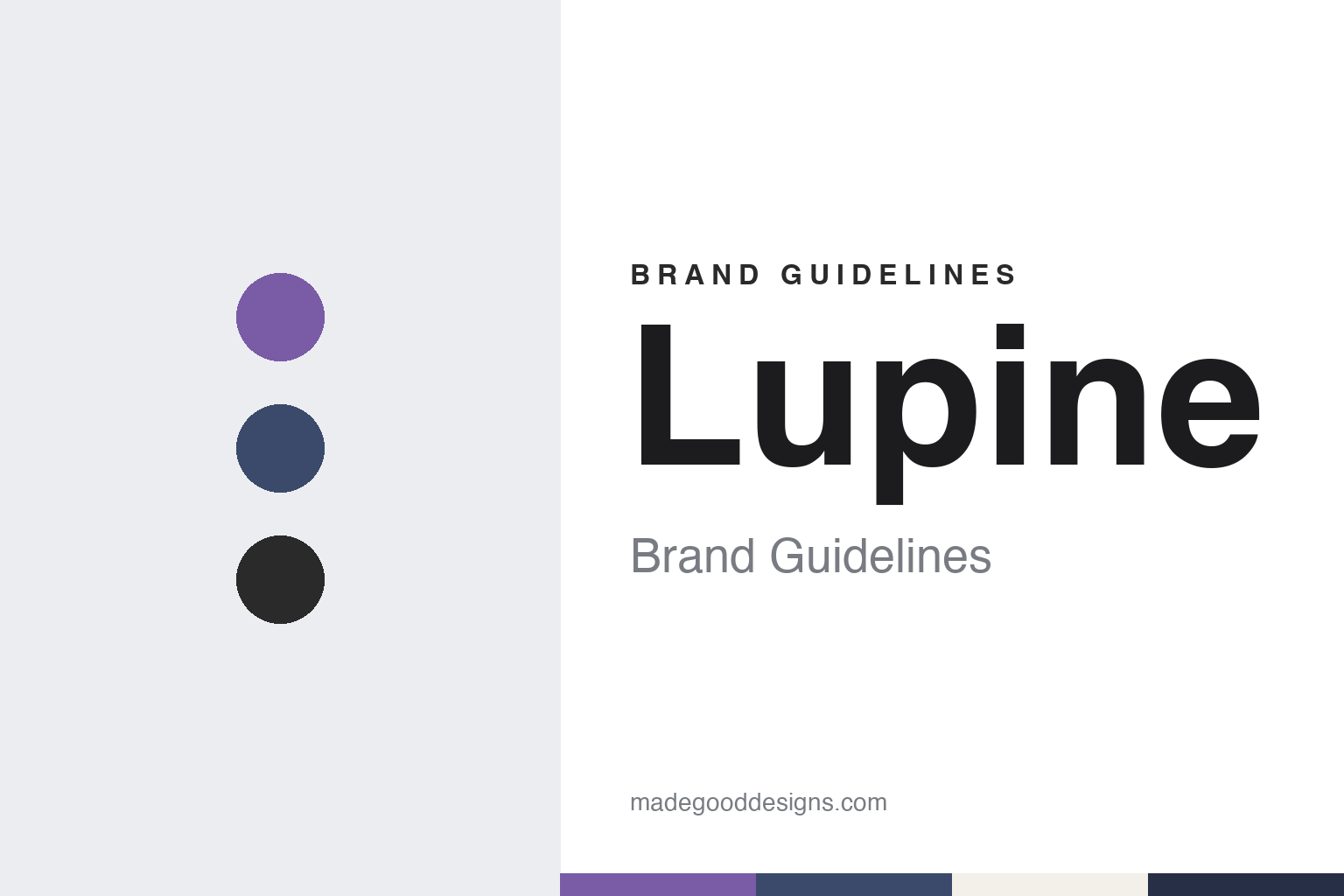
Lupine Brand Guidelines
The howling-wolf collar maker of the White Mountains.
Aa
Two constants: a violet, slate and charcoal palette and a heavy workshop sans register. Abstract homage — not a Lupine product or mark; no collar, lead or logo is reproduced.
A collar for a wolf hybrid called Blaze
From a video shop in the Mount Washington Valley to a collar workshop.
Lupine, which trades online as LupinePet, is a maker of dog collars, leads and harnesses based in Conway, New Hampshire, in the White Mountains. Its story starts not with pet gear but with a video shop. The Mount Washington Valley magazine MWV Vibe, in a profile by Christine Thompson published on 8 November 2021, reported that Dave Jensen and Scott Badger had been roommates at Dartmouth College in the 1980s, and that after Badger heard a local shop called Valley Video was for sale, he asked Jensen to buy it with him. Jensen became co-owner and manager of the shop in 1989, the magazine said, and when the business did well enough to open a second store, Badger left his job to work on it.
The third founder arrived from France. MWV Vibe wrote that Valerie Meunier came to the valley to explore the United States and visit her aunt, Marie Meunier, of the local outdoor shop Wild Things. At the video store she met Badger’s dog, Blaze, a wolf hybrid who had become the shop’s unofficial mascot. With her aunt’s help, the magazine said, she designed a collar for Blaze using webbing from Wild Things, modelled on the climbing gear of the time and fastened with a three-pass buckle of the kind used on a climbing harness.
People noticed. Badger told MWV Vibe that people kept asking where he had got the collar, “and that’s where the idea for Lupine was born.” Jensen and Meunier married in 1990, the magazine reported, and in 1991 Meunier became the company’s chief financial officer, while Jensen took charge of production and engineering. The company’s own site gives the same two dates from its side: it says the first colourful Lupine collar was made by hand in 1990, and that Lupine incorporated in 1991.
Colour
A climbing-gear collar, a howling wolf and a guarantee.
The name and the mark both trace back to Blaze. MWV Vibe reported that the Lupine logo is a silhouette of a howling wolf, a tribute to Badger’s dog.
Selling the idea took time. The founders made a few more prototypes, the magazine said, and Jensen and Badger drove to Portland, Maine, to try to sell them. “Neither of us were salespeople,” Badger recalled; they showed the product, packed it back into paper bags and left. Once early sales picked up, the company rented production space above a local shop called Video World before moving, MWV Vibe reported, to a warehouse in Center Conway. Along the way the founders also tried selling snowboard leashes. The magazine credited a designer named Nadine with the patterns that set the brand apart, and said Lupine’s wholesale prices sat above most of the market because of its design and materials.
The other constant is the guarantee. MWV Vibe wrote that Lupine instituted a lifetime guarantee that became one of its strongest marketing tools, and that the simple exchange process won it loyal customers. Today the company calls it the “Even if Chewed” guarantee and runs the phrase, with a registered-trademark sign, across the top of its website; its terms say the guarantee covers the original purchase for the lifetime of the product, with a replacement claimed by sending photographs of the damaged item.
Typography
Design and documentation.
The seven brands in this group are all dog toy and accessory names: Planet Dog, Petstages, ZippyPaws, Petmate, Multipet, Coastal Pet and Lupine. Toy and accessory brands for dogs sit at many different points in the pet trade, from small workshops that still carry a founder’s story to names that now belong to larger pet-products groups, and a single brand can be sold everywhere from an independent pet shop to a national chain.
A pet brand’s identity is usually carried less by one toy or collar than by a name, a mascot and the promise printed on its packaging, because the company behind the name may have changed hands, moved its production or grown far beyond the town where it started. That makes the questions behind each name worth asking plainly: who started it, who owns it now, and where its toys, collars and leads are actually made.
Each guide separates what independent sources record from what the company says about itself — its founding story, its owners over time, where its products are made and how its packaging and marks have changed — and marks plainly what rests only on the company’s own word.
Aa
A heavy sans for a workshop brand with a mountain backdrop. (Specimen set in Archivo Black, a sans-serif STAND-IN; NOT the Lupine logo.)
Lupine
A New Hampshire workshop that has stayed put.
Lupine’s strongest brand message is place. Its website carries the line “Made in the USA — Conway, NH Since 1991” in its banner, and its about page says the products have been “Proudly Built” in the White Mountains of New Hampshire since the company incorporated. The company says its workshop has stayed where it started, in Conway, and that every item is made by hand. Those are the company’s own statements; MWV Vibe’s 2021 profile, which followed the business from the rooms above Video World to its warehouse in Center Conway, places production in the same valley.
The company also ties its look and build back to the outdoors that shaped the first collar. LupinePet says its pet gear takes its inspiration from the components found in climbing and hiking gear, the same source MWV Vibe described for the three-pass buckle on Blaze’s collar. Its current range, as listed on its site, runs from dog collars and leads to harnesses, martingale training collars and ID tags.
The name needs a little care in searches. The company’s web address and its trademarked styling use LupinePet, while the founders’ story and the older trade name use plain Lupine; the word is also the common name of a flowering plant and of lupin beans, so unrelated results crowd searches for the single word.
For a design guide, Lupine shows how a small-town origin story — a borrowed climbing buckle, a wolf-hybrid mascot and a promise to replace chewed gear — can carry a brand, with a howling-wolf mark and a New Hampshire place name doing the work. Compare Ruffwear, the dog-gear maker that grew out of the outdoors, and Coastal Pet, the Ohio collar and lead maker. For this guide we use violet, slate and charcoal with a heavy sans, an unofficial interpretation; no product or logo is reproduced.
Explore & save
Keep Lupine’s identity on hand — save it to a board in the Made Good inspiration library.
Lupine identity set
Pin the Lupine violet, slate and charcoal palette and the heavy workshop sans register to your own board.