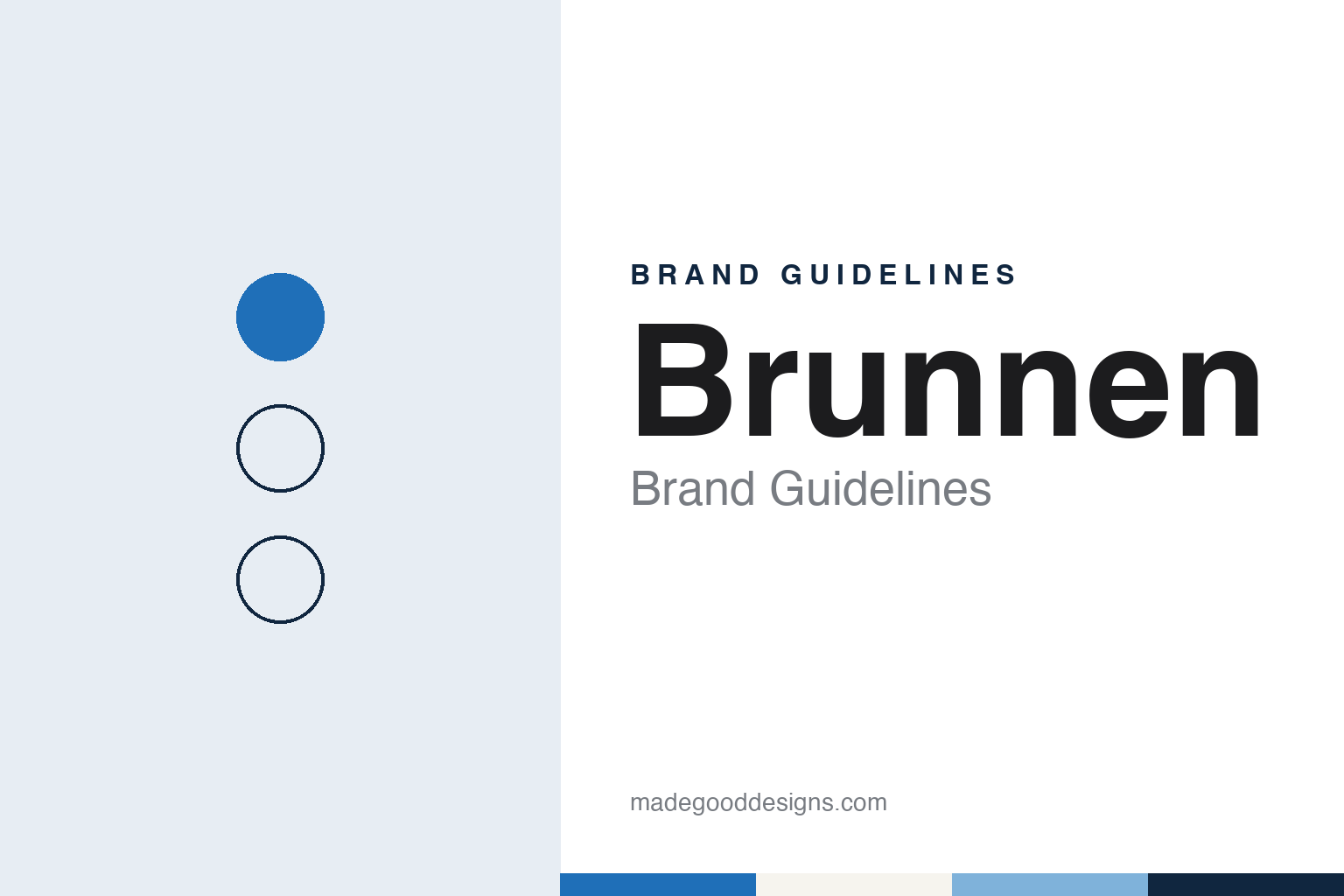
Brunnen Brand Guidelines
The Heilbronn paper house behind calendars, pads and exercise books.
Aa
Two constants: a Brunnen blue, water tint and ledger white palette and a clear sans register. Abstract homage — not a Brunnen product or mark; no calendar, exercise book, logo or packaging is reproduced.
Heilbronn, 1877
Two employees buy the wholesale they worked for.
Brunnen is the brand name of Baier & Schneider, a paper converter in Heilbronn on the Neckar. The company says that Julius Baier and Andreas Schneider bought the wholesale business of their former employer on 1 May 1877; German Wikipedia names that employer as Gustav Ziegler and describes his firm as a paper, writing-goods and haberdashery wholesale. Heilbronn already had a paper industry of its own, built on the mills along the Neckar.
The partnership changed early. In 1879 Richard Mayer joined as a partner in Baier’s place, German Wikipedia says, and the established company name was kept. Demand soon led the wholesaler into manufacturing, starting with ruled papers. In 1888 Baier & Schneider bought a former newspaper printing works and installed two fast presses, which let it add business ledgers and other printed books to the range.
Factories followed on what was then the edge of town, on the Wollhausstraße. German Wikipedia dates two large factory buildings there to 1894 and 1903; the company’s own history says administration, printing and bookbinding were brought together on the Wollhausstraße in 1893. An old Art Nouveau element still decorates the works building there, according to a caption on the German Wikipedia page.
The family moved into management in the next generation. Andreas Schneider’s eldest son, Richard Schneider, an engineer with a doctorate, led the company from 1921, German Wikipedia says, while his father and Richard Mayer stayed on as advisers until 1929 and 1932. He is credited with the idea for an in-house magazine titled BRUNNEN, which German Wikipedia says still appears every year.
Colour
A fountain, a letter H and a rebuilt works.
The brand name comes from the company’s first address. German Wikipedia says the name Brunnen — German for a well or fountain — is said to derive from the former fountain at the Kirchhöfle in Heilbronn, where the business first stood. The company says “BRUNNEN” established itself as a brand as early as 1894 and was protected in 1903 with an “H” for Heilbronn; German Wikipedia gives 1903 as the year the name was registered as a trademark.
The mark itself is a stylised fountain containing the letter H. German Wikipedia says the logo has been adapted to the taste of the time several times since 1903, and that the old fountain mark can still be found, in stylised form, in the modern one. A large Brunnen logo on the company’s logistics centre in the Böllinger Höfe industrial area, planned and built from around 1988, faces the A6 motorway and has become a local landmark, the same account says.
The Second World War ended the first chapter. German Wikipedia says the air raid on Heilbronn destroyed all of the production plant, and that after 1945 the company restarted with 20 workers under Andreas Schneider, the founder’s grandson. By 1970 the works again included typesetting, a ruling department, letterpress and offset printing, plastics processing and several bookbinding halls, with distribution warehouses in Berlin, Hamburg, Dortmund and Cologne.
The next generations shaped sales and production. German Wikipedia says Andreas Schneider’s youngest brother, also named Richard Schneider, sat in the management from 1970 to 2000 as a kind of “brand ambassador” responsible for building national sales, and that Ulrich Schneider, Andreas Schneider’s son, joined the management in 1977 and introduced new plant, logistics projects and electronic data processing.
Growth then came through acquisitions. In 1973 Baier & Schneider took over production and distribution of the insolvent MK-Papier, a firm founded in 1865 by Max Krause, German Wikipedia says.
Typography
Design and documentation.
The seven brands in this group are all office and paper names: Hamelin, Oxford, Exacompta, Atoma, Brunnen, Landré and Avery. Office and paper brands in general sit at many different points in the trade, from family companies that still carry a founder’s name to labels that now belong to much larger stationery groups, and a single brand can be sold everywhere from a school-supplies aisle to a corporate stationery cupboard.
An office or paper brand’s identity is usually carried less by a single notebook or file than by a cover, a name and the system it promises, because the company behind the name may have changed hands, moved its production or grown far beyond the town where it started. That makes the questions behind each name worth asking plainly: who started it, who owns it now, and where its paper goods are actually made.
Each guide separates what independent sources record from what the company says about itself — its founding story, its owners over time, where its products are made and how its covers and packaging have changed — and marks plainly what rests only on the company’s own word.
Aa
A clear sans — the register of calendars and school pads. (Specimen set in Libre Franklin, a sans STAND-IN; NOT the Brunnen logo.)
Brunnen
A family group of paper and craft brands.
Baier & Schneider is now the centre of a family group. German Wikipedia says it belongs to the Schneider Gruppe, which includes legally separate companies in several European countries, citing a report in the Heilbronn newspaper Heilbronner Stimme on Brunnen’s expansion into northern Europe. The acquisitions it lists are the Eilers-Werke, with sites in Bielefeld and Teichröda in Thuringia; Heyda, formerly based in Hagen; Stewo of Wolhusen in Switzerland; the Ajasto group in northern Europe; and Knorr prandell, formerly of Lichtenfels. German Wikipedia places these purchases from 2000 onward; the company’s own history places the Eilers-Werke purchase in the 1990s and dates the Ajasto purchase to 2010.
The company describes Brunnen’s range as calendars, notebooks, college pads, school exercise books and book covers, alongside other school and office supplies, while Heyda and Knorr prandell cover paper crafts and hobby supplies. It lists sites or representatives in Germany, Switzerland, Finland, Estonia, Latvia, Sweden and Norway. In 2016 the promotional-products business moved into a separate company, BRUNNEN & EILERS Promotion Service, which sells Brunnen calendars, notebooks and writing supplies to the promotional trade from Heilbronn and Bielefeld, German Wikipedia says.
Both German Wikipedia and the company write the brand in capitals, BRUNNEN, alongside the sister brands HEYDA and KNORR prandell.
Ownership has stayed in the family. German Wikipedia says the company is run in the fourth and fifth generations by Matthias Schneider and Jan Schneider, with Ulrich Schneider chairing the advisory board.
For a design guide, Brunnen shows how a mark drawn from a single street fountain can carry a range from ledgers to diaries. Compare Herlitz, the Berlin exercise-book house, and Leitz, the Stuttgart maker of the lever-arch file. For this guide we use a fountain blue, a pale water tint and a ledger white with a sans, an unofficial interpretation; no product or logo is reproduced.
Explore & save
Keep Brunnen’s identity on hand — save it to a board in the Made Good inspiration library.
Brunnen identity set
Pin the Brunnen blue, water tint and ledger-white palette and the clear sans register to your own board.


