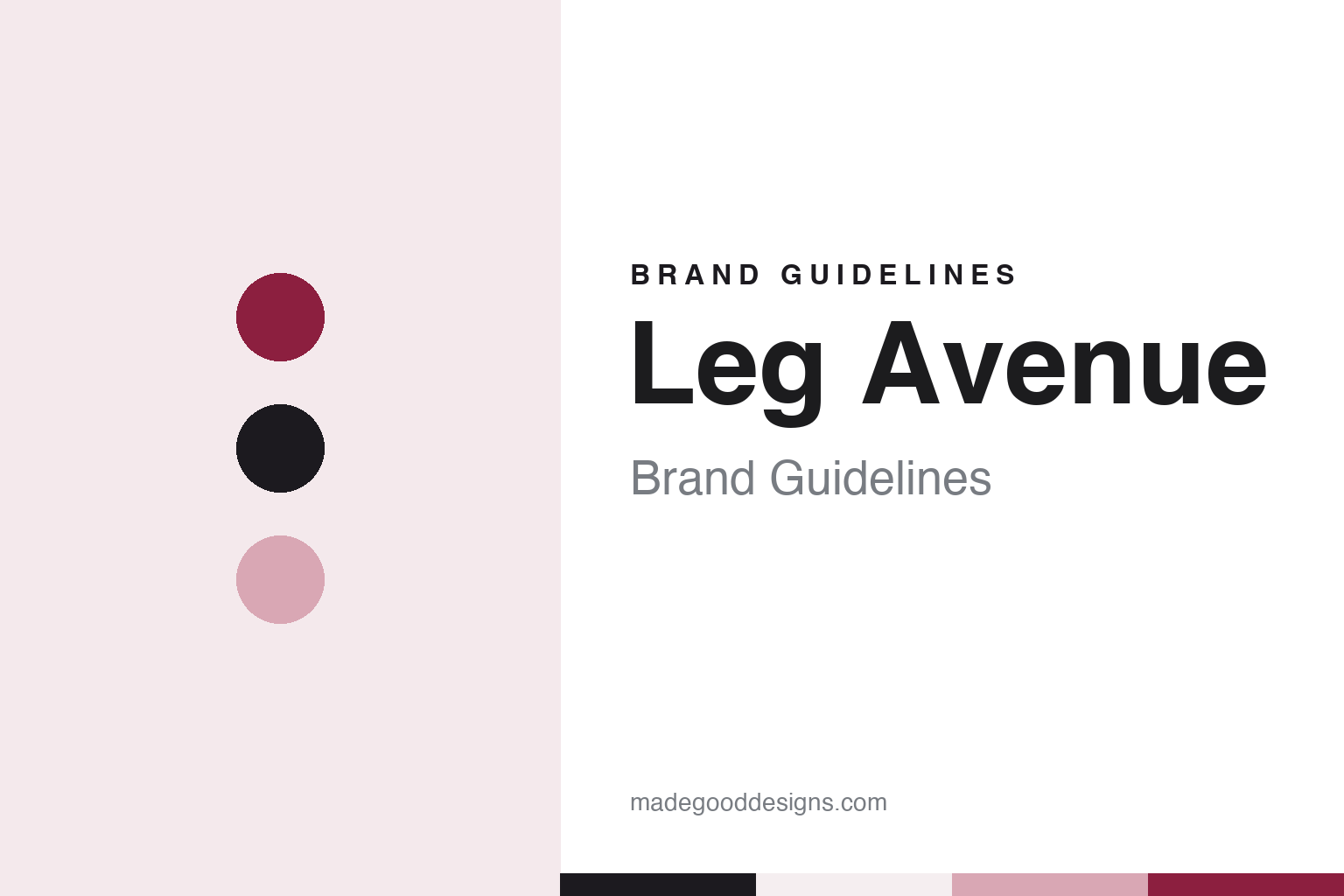
Leg Avenue Brand Guidelines
Stockings first, then the costume rack.
Aa
Two constants: a garnet, night black and powder rose palette and a boutique serif register. Abstract homage — not a Leg Avenue product or mark; no garment, costume or logo is reproduced.
A family stall in Los Angeles
The business started with stockings carried to market.
Leg Avenue began as a family trade in Los Angeles. The company’s own history describes humble roots as a family-owned hosiery business, and says the Tsai family began designing their own stockings and selling them at swap meets and kiosks in the city’s downtown fashion district in 1984. From hosiery, the company says, the business moved into lingerie, and in 1999 the family formed Leg Avenue, Inc. to take its newer product ideas further.
A profile of Amy Tsai on the company’s blog fills in the family side of the story. It says she is an immigrant from Taiwan, and that when the family first arrived in Los Angeles in 1984 they made ends meet by importing low-priced goods and selling them at flea markets around the city. According to the profile, her father chose leggings and tights because they were easy to carry and did not cost much, and Amy and her three siblings sold them at swap meets six days a week.
The same profile credits Amy Tsai with the company’s name. It says she studied music at the University of Southern California while learning business and design in the wholesale clothing market in downtown Los Angeles, that it was she who named the business Leg Avenue, and that she soon became its designer, working on variety in colour and on details such as bows, zips and bits of lace. The company describes her as a co-founder, and the same blog post names her as its chief executive in its headline.
Colour
From tights to the Halloween trade show.
Costumes came out of a conversation at a trade fair. The company’s profile of Amy Tsai says that, while she was still in college and acting as the family’s business representative, a customer at a Halloween trade show in Chicago suggested the company should make costumes, and she put the idea to her family. The following year, 2000, the profile says, she returned to the show with a women’s black cat costume, which the company calls its turning point.
The profile also sets out how the family divided the work. It says the family elected Amy Tsai as its business representative while she was still a student, and that she helped the family grow the business and bring new product concepts to market. The company says its workforce is largely made up of women and credits that team with its success; the profile adds that Amy Tsai does volunteer work with high school students and encourages young women to take on leadership roles in business.
Since then costumes have sat alongside the hosiery and lingerie rather than replacing them. The company’s history says Leg Avenue soon moved into the Halloween business with designs that mix fashion and fantasy, and that its costumes are sold through specialty stores and larger chain stores across the United States. The company describes itself today as an apparel design, manufacturing and retail distribution business, and its blog describes it as a Southern California women’s clothing brand known for Halloween costumes, fashion hosiery and intimate apparel.
The range is still sold under one roof. The company’s own website groups it into costumes, costume accessories, lingerie and hosiery, so the stockings that started the business are listed beside the Halloween outfits that followed them.
Typography
Design and documentation.
Costume and Halloween brands sit at several different points in a seasonal trade. Some design and manufacture costumes, masks and accessories for other shops to sell; some are retailers whose own name is the brand; and many sell licensed characters from films, television and games alongside their own designs. A single name can therefore stand for a factory, a wholesaler, a chain of shops or all three at once.
Because so much of the business is concentrated into a few weeks of the year, a costume or Halloween brand’s identity is often carried less by a logo than by packaging, shop signs and the look of a whole aisle or storefront. The company behind a name may also have changed hands, merged with a rival or moved where its products are made since it began.
Each guide separates what independent sources record from what the company says about itself — who started it, who owns it now, where its products are made and how its packaging and stores have changed — and marks plainly what rests only on the company’s own word.
Aa
A high-contrast fashion serif. (Specimen set in Bodoni Moda, a serif STAND-IN; NOT the Leg Avenue logo.)
Leg Avenue
A family company with a European branch.
The brand has grown beyond Los Angeles while staying, by its own account, a family business. The company continues to describe itself as having grown from the Tsai family’s hosiery trade.
Europe became a second base in the early 2010s. The trade magazine ETO reported in September 2017 that Leg Avenue Europe had just celebrated its fifth anniversary, having opened five years earlier as the European branch of Leg Avenue. ETO named Walter Kroes and Trudy Pijnacker as the managers of the European operation, and repeated the brand’s origin story: a Los Angeles family hosiery business whose stockings were first sold on market stalls and kiosks, which then moved on into lingerie.
That origin is the thread through the brand’s presentation. Leg Avenue’s own pages pair the language of the swap meet and the downtown fashion district with costume photography and lingerie, and the company frames its aim as making the women who wear its clothes feel confident. Hosiery keeps its own section on the site next to the costumes.
The European business carries the same story in its own trade coverage. In the ETO report, Leg Avenue Europe’s Brigit Limmen, who said she had been with the branch from the beginning, credited the friendly customer service the team offers and the passion of its management for the way the operation had developed, and the magazine described the team marking the anniversary with a weekend of activities organised by its managers.
For a design guide, Leg Avenue shows how a hosiery label can carry its fashion-district roots into the Halloween aisle, presenting costumes with the styling of a lingerie brand rather than a toy company. Compare a family costume maker in our Rubie’s brand guidelines and a licensed-character specialist in our Disguise brand guidelines. For this guide we use garnet, night black and powder rose with a serif, an unofficial interpretation; no product or logo is reproduced.
Explore & save
Keep Leg Avenue’s identity on hand — save it to a board in the Made Good inspiration library.
Leg Avenue identity set
Pin the Leg Avenue garnet, night black and powder rose palette and the boutique serif register to your own board.


