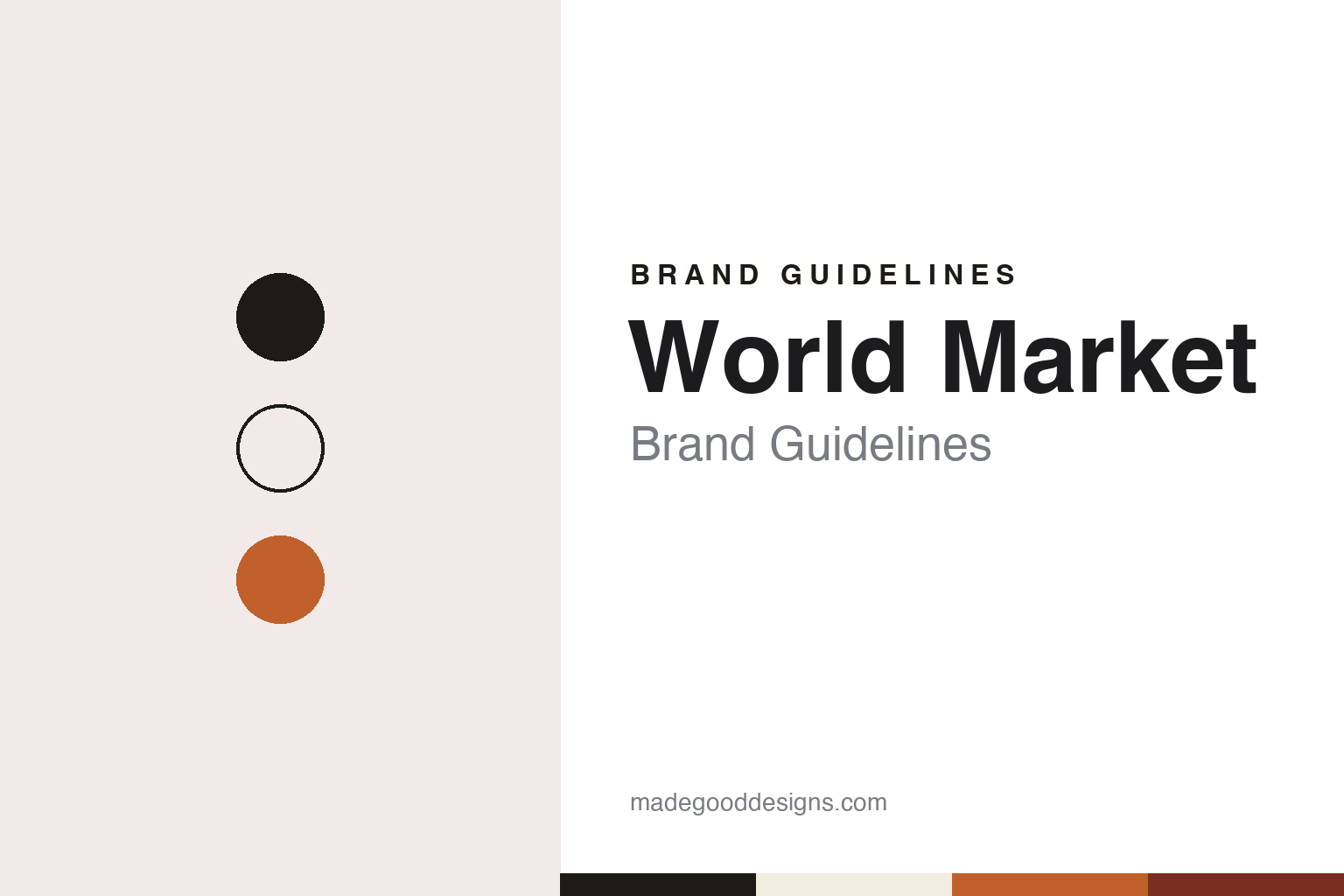
World Market Brand Guidelines
A wicker warehouse on the wharf that became a bazaar of imports and a national chain.
Aa
Two constants: a rattan cream, spice orange and terracotta palette and a market-stall serif register. Abstract homage — not a World Market product or mark; no rug, basket, sign or logo is reproduced.
Cost Plus Imports
Surplus wicker, a warehouse on the wharf and a pricing rule for a name.
World Market began on the San Francisco waterfront. English Wikipedia says that on 23 October 1958 William Amthor and Lincoln Bartlett opened the first Cost Plus Imports store on Taylor Street at Fisherman’s Wharf. The two men worked at the Amthor family’s import business in San Francisco, which, Wikipedia says, had brought in more wicker furniture than it could sell through wholesale channels. A company history published by the Gale Group describes Amthor as the owner of a small family-run furniture store who had not set out to start a chain at all.
The store grew out of that surplus. According to both Wikipedia and the Gale history, Amthor sold off rattan furniture he had kept in storage, found that San Franciscans bought it quickly, and rented warehouse space in the Fisherman’s Wharf area to sell more. Wikipedia says the first store was devoted to the wicker and rattan the business had imported. The Gale history adds that Amthor’s frequent buying trips abroad earned him a reputation as a “world traveler”.
The original name was a description of the business model. Both sources say Cost Plus came from the strategy of pricing imported goods at cost, plus ten percent; Wikipedia notes that this pricing concept was later abandoned while the name stayed. From the start, Wikipedia says, the stores mixed imported furniture and home furnishings and displayed them in the style of a bazaar.
The waterfront store became a local landmark. Wikipedia says it served as the chain’s flagship for many years and records that the 1973 film Magnum Force includes a shootout set at the San Francisco Cost Plus. The same article says the Fisherman’s Wharf location was later reduced in size and closed permanently in 2020, after Bed Bath & Beyond announced in October 2019 that it would close a group of stores that included the original.
Colour
Franchises, a split and a second start.
The first attempt at a chain led somewhere unexpected. Wikipedia says that in 1962, with help from the Tandy Corporation, Cost Plus Imports incorporated and opened its first franchise location in San Mateo, California, followed by further franchised stores in California and Texas. Cost Plus owned the name and imported the goods, while Tandy owned the franchise stores themselves. In 1965, Wikipedia says, Tandy’s managers concluded that the Cost Plus model was built around the large San Francisco store and gave notice that they would start their own operation; by 1966 those stores were importing for themselves and had been renamed Pier 1 Imports. Wikipedia says the two companies remained competitors for decades.
Left with its single San Francisco store, Cost Plus rebuilt. Wikipedia says the company opened its first wholly owned branch, again in San Mateo, at the Hillsdale Shopping Center, and a further store at Mayfield Mall in Mountain View in 1968. Ownership changed in 1987, when, according to both Wikipedia and the Gale history, Bechtel Investments, later renamed the Fremont Group, completed a leveraged buyout of the company.
The modern brand name arrived with a turnaround. The Gale history says Ralph D. Dillon joined in 1990 and led a reworking of the stores, refocusing the merchandise on home décor and gourmet food; the redesigned prototype, it says, was christened Cost Plus World Market. Wikipedia places this in the early 1990s and says stores were branded either Cost Plus World Market or simply World Market, the shorter name used mainly in markets new to the brand in the eastern and southern United States. The Gale history describes the resulting stores as “bazaar-style”, with an open-air market atmosphere, cement floors, high ceilings and exposed beams, a gourmet food and beverage marketplace at the back, a wall of rugs and areas for furniture, glassware and tabletop goods. Wikipedia says the company went public on the NASDAQ in 1996; the Gale history dates the offering to April of that year.
Typography
Design and documentation.
The brands in this group are American home-goods store chains: retailers that fill their shelves with decorative objects, furniture, linens, kitchenware and seasonal pieces, sometimes made to their own specification and sometimes bought from other makers. Some sell at full price under a house name; others buy surplus stock and resell it at a discount, so the goods change from week to week. Between those two models sit chains that mix their own lines with branded stock.
For a chain like this, the visual identity sits mostly outside the products. It lives in the sign above the entrance, the printed circular or catalogue, the price tickets and shopping bags, and the way aisles and displays are arranged. Because such chains are regularly sold, merged, restructured or closed, the history behind each sign deserves a plain account: who founded the business and where, which companies have owned it since, and what became of its stores.
Each guide keeps what independent, dated sources record apart from what a company says about itself, follows its ownership and store history over time, and says clearly where a claim rests only on the company’s own account.
Aa
A warm, slightly quirky serif with the feel of a hand-lettered market sign. (Specimen set in Fraunces, a serif STAND-IN; NOT the World Market logo.)
World Market
Two owners in a decade and a name shortened to two words.
The company changed hands twice in the 2010s and 2020s. Wikipedia says Bed Bath & Beyond acquired Cost Plus in 2012 and owned it until 2021. In 2014, under that ownership, Wikipedia says the retailer launched Craft by World Market, an online marketplace that listed items for a month at a time and produced only those that attracted enough pre-orders.
The current owner took over at the start of 2021. In a press release dated 19 January 2021, the Los Angeles private-equity firm Kingswood Capital Management announced that it had completed its acquisition of Cost Plus World Market from Bed Bath & Beyond Inc., describing the company as a national specialty retailer of home furniture, décor, curtains, rugs, gifts and apparel, as well as coffee, wine, craft beer and food products, headquartered in Alameda, California. The same release said Alexander W. Smith, a former chief executive of Pier 1 Imports, would lead the company as executive chairman. Kingswood Capital Management has owned World Market since 2021, and the firm’s own portfolio page still lists it in 2026.
Today the brand trades simply as World Market. Its website describes the offer as furniture, home décor, rugs, outdoor goods and more, and English Wikipedia now gives the store’s name as World Market, formerly Cost Plus World Market. Kingswood’s 2021 release listed coffee, wine, craft beer and food products alongside the furnishings, the same pairing of home goods and a food marketplace that the Gale history described in the 1990s.
For a design guide, World Market shows how a retailer can carry its founding story in its name and its rooms: a pricing rule that became a brand, a waterfront warehouse filled with imported wicker, and a bazaar layout that turned shopping into a walk through goods from many places. Compare its former parent in our Bed Bath & Beyond brand guidelines and the off-price home chain in our HomeGoods brand guidelines. For this guide we use rattan cream, spice orange and terracotta with a serif, an unofficial interpretation; no product or logo is reproduced.
Explore & save
Keep World Market’s identity on hand — save it to a board in the Made Good inspiration library.
World Market identity set
Pin the World Market rattan cream, spice orange and terracotta palette and the market-stall serif register to your own board.


