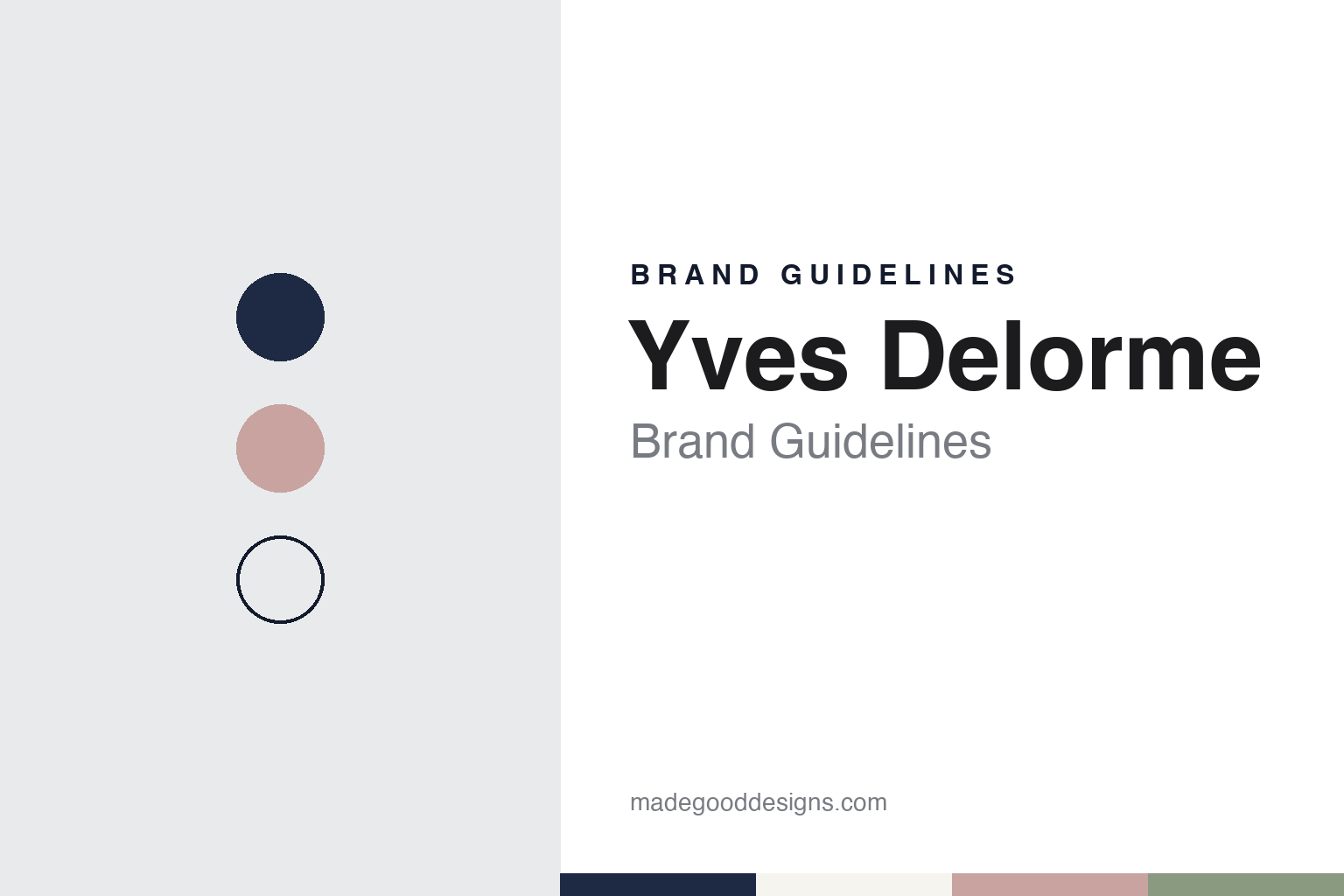
Yves Delorme Brand Guidelines
A Flemish weaving family and a linen stylist, joined under a lion and a swan.
Aa
Two constants: a navy, powder rose and swan white palette and a Didone serif register. Abstract homage — not a Yves Delorme product or mark; no crest, label or logo is reproduced.
A weaving mill in French Flanders
Two family businesses, one in the north and one near Roanne.
The house now called Yves Delorme has two family histories behind it. The older one belongs to the Fremaux family. The Comité Colbert, the association of French luxury houses, says on its member page that Yves Delorme was founded near Lille, in northern France, in 1845, and that the family’s textile craft has been handed down across six generations. Mixte magazine, in an article by Suzanne Duquette published on 30 June 2017, gives more detail: it says Ernestine Fremaux and her husband founded a linen weaving mill near Lille in 1845, that a fire destroyed the mill in 1867, and that the founders’ nephew, Paul Fremaux, helped rebuild the business and added cotton weaving.
According to Mixte, the Fremaux factories later concentrated on sheets, jacquards and fabrics for the clothing trade. Production in the region slowed sharply during the Second World War, the magazine says, but the company survived and modernised afterwards. By the early 1980s, Dominique Fremaux was in charge, and he chose to refocus the group on household linen.
The second history belongs to Yves Delorme himself. French Wikipedia, whose article carries a notice asking for more sources, says his family firm, later known as A. Delorme et fils, was founded in 1928 and specialised in weaving terry cloth, and that he joined it in 1945 and took over its management in 1964. The same article says that from 1969 the company signed licensing agreements with fashion houses including Pierre Cardin, Givenchy, Lanvin, Cacharel and Dior. Mixte describes Delorme as a home-decor stylist who was known for the bath products he sold in his boutique at the Palais-Royal in Paris.
The two men met in the early 1980s. French Wikipedia says Delorme and Fremaux then developed licences for bed and bath linen, and both it and Mixte date the merger of their businesses to 1989. French Wikipedia adds that in 2002 the Fremaux group became the Fremaux-Delorme group, with Yves Delorme as its flagship brand. Mixte said in 2017 that Dominique Fremaux was the president and that his sons, Amaury and Alban, were the general manager and the head of the Asian market respectively.
Colour
A lion from Flanders, a swan, and a long-serving art director.
The clearest piece of Yves Delorme’s visual identity is its emblem. The Comité Colbert says the house’s crest combines the Lion of Flanders, a reminder of its roots in the north of France, with the Yves Delorme swan. French Wikipedia also describes the house’s boutiques as fitted with made-to-measure furniture, finished in white with touches of mahogany, and with the swan logo inlaid into the fixtures.
The patterns are directed from one studio. French Wikipedia says Évelyne Julienne has been the brand’s artistic director since 1984. The Comité Colbert describes the house’s motifs, graphic compositions and colours as drawing on fashion, the decorative arts and nature, and lists engraving, embroidery and weaving as its core skills. French Wikipedia gives an example of a named collection: Silhouette, launched in September 2012, which took its cue from the New Look fashion of the 1950s.
Where the linen is made is documented on two pages. The Comité Colbert says production takes place at French facilities in Nieppe and Sevelinges. The company’s own savoir-faire page adds detail. It says the house opened a new tailoring studio in Nieppe, in the Hauts-de-France region, in spring 2020, and that the building houses every stage of its bed linen production, together with a training centre and, since 2023, a factory outlet selling slightly flawed pieces without brand labels. The same page says that in Sevelinges, a small village, the house runs a weaving studio where it has developed tools for terry towelling and jacquard table linen since 1920.
The international network grew from the 1980s. French Wikipedia dates a subsidiary in the United States to 1983, one in the United Kingdom to 1989 and one in China to 1995, and Mixte says the merged company opened its first boutiques in 1995. The Comité Colbert lists Paris, New York, London and Tokyo among the cities where the house is sold through subsidiaries, boutiques and department stores.
Typography
Design and documentation.
The brands in this group all make bed linen, table linen or both: sheets, duvet covers, pillowcases, towels, tablecloths and napkins. They sit at many different points in the trade, from family weaving mills that still carry a founder’s name to labels that design in one country and have their cloth woven or finished somewhere else, and to names that now belong to larger home-furnishing groups.
A linen brand’s identity is usually carried less by a single object than by a pattern, a colour story, a woven label, a box or a catalogue, because the cloth itself can look much the same from one maker to the next. That makes the plain questions behind each name worth asking: who started it, who owns it now, and where its cloth is actually woven, dyed and sewn.
Each guide separates what independent sources record from what the company says about itself — its founding story, its owners over time, where its linen is made and how its labels and patterns have changed — and marks plainly what rests only on the company’s own word.
Aa
A high-contrast Didone serif in the spirit of a Paris boutique sign. (Specimen set in Bodoni Moda, a serif STAND-IN; NOT the Yves Delorme logo.)
Yves Delorme
A member of the Comité Colbert since 2001.
The house joined the Comité Colbert in 2001, according to the association’s own member page, which places it among French companies that promote French craftsmanship and the art of living. French Wikipedia gives the same year. Membership puts Yves Delorme in the same circle as fashion, perfume and table-arts houses.
The name on the label is Yves Delorme’s, while the company history, as told by the Comité Colbert and by Mixte, begins with a weaving mill near Lille more than a century before Yves Delorme joined the business. The crest resolves the two stories by placing a Flemish lion and a swan side by side.
The product range covers bed, bath and table linen. The savoir-faire page places sheets and other bed linen at Nieppe, and terry towelling and jacquard table linen at Sevelinges, which gives the brand two French workshops with clearly different jobs. Patterns change by season under the art direction French Wikipedia credits to Évelyne Julienne, while the swan and the white boutique interiors stay constant.
For a design guide, Yves Delorme shows how a linen house can carry two family histories in one emblem: a lion for the northern mills, a swan for the name on the label, and seasonal prints set against white. Compare an Italian luxury linen house in our Frette brand guidelines and a French table-linen weaver in our Garnier-Thiebaut brand guidelines. For this guide we use midnight navy, powder rose and swan white with a Didone serif, an unofficial interpretation; no product or logo is reproduced.
Explore & save
Keep Yves Delorme’s identity on hand — save it to a board in the Made Good inspiration library.
Yves Delorme identity set
Pin the Yves Delorme navy, powder rose and swan white palette and the Didone serif register to your own board.


