Lamps Plus Brand Guidelines
A North Hollywood workshop, a first name it gave up and a family lighting business in the San Fernando Valley.
Aa
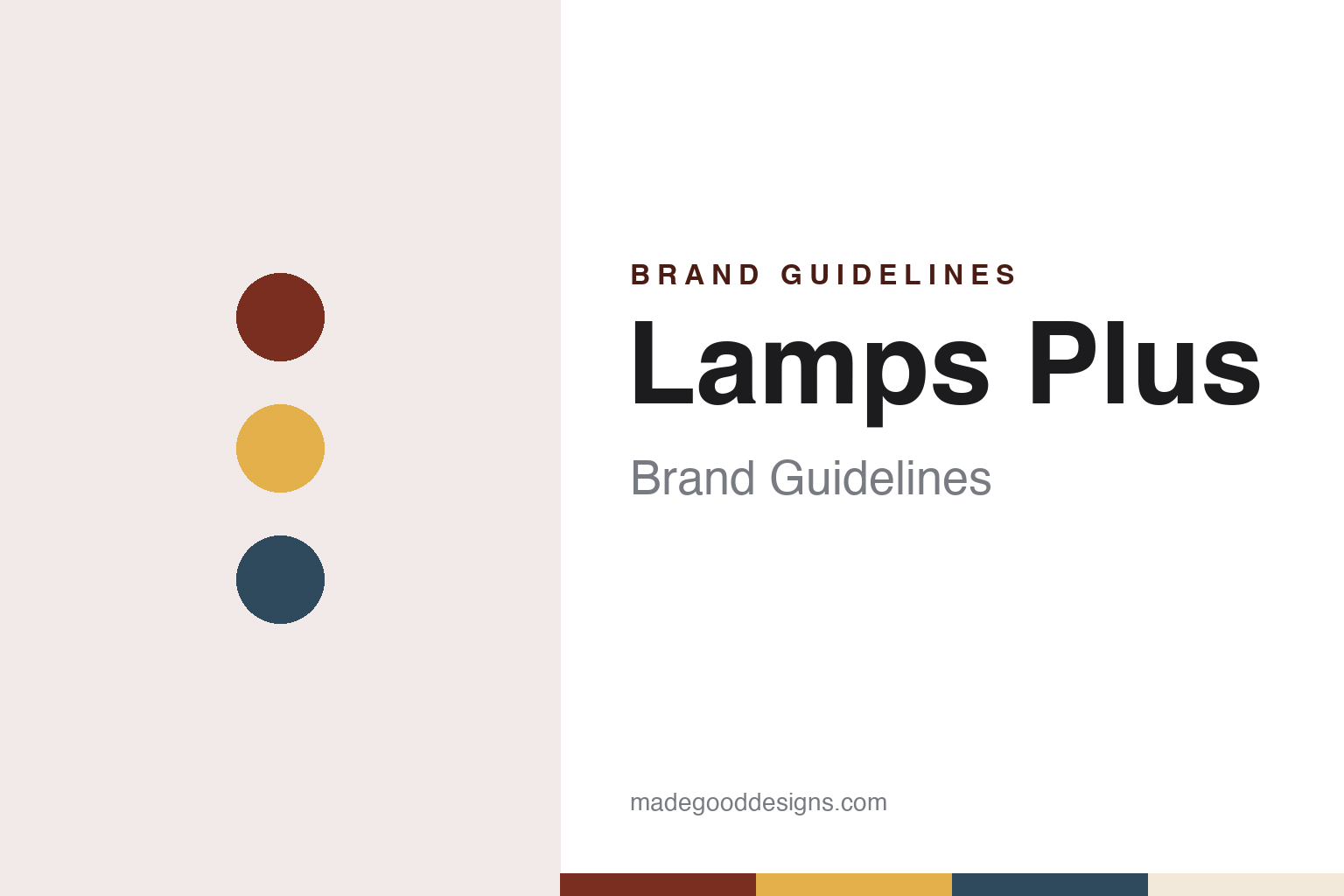
Two constants: a rust, lamplight amber, dusk blue and linen palette and a sturdy retail grotesque register. Abstract homage — not a Lamps Plus product or mark; no lamp, catalogue or logo is reproduced.
A lamp workshop that became a lighting retailer
North Hollywood, a family business and a change of name.
Lamps Plus is a lighting and home-decor retailer from Los Angeles. English Wikipedia says the company was founded in 1976 by Dennis Swanson, its chief executive, and Manja Swanson, its co-owner. The same article describes the business as privately held, with Dennis Swanson as its owner, and places its headquarters in Chatsworth, a district of the San Fernando Valley within the city of Los Angeles.
The first store, Wikipedia says, was in North Hollywood, and it was not only a shop. It served as both a manufacturing and a retail space, so the lamps sold at the counter were designed and made on the same premises. From that start in lamp design and manufacture, the article says, the company moved into retail, and it describes the company today as a full omni-channel retailer, selling in stores and online.
The name came later than the business. According to Wikipedia, which cites a report in the Los Angeles Times from 5 May 1985, the company originally traded as Lamps R Us and changed its name at the request of Toys “R” Us. The new name kept the plain, descriptive idea of the first one: a shop for lamps, and for more besides. It is a name that says what is sold rather than who sells it, and the family name of the founders does not appear in it.
That origin as a maker-retailer still shapes how the company is described. Wikipedia’s account treats Lamps Plus as a business that grew out of a workshop rather than one that began as a buyer of other people’s products, and the Swansons remain the people named at its head.
Colour
Colour ranges, art prints, an NFL namesake and a revived lamp name.
Much of what Wikipedia records about the company’s later years concerns its own product lines and the way it reaches customers. In 2012, the article says, citing Home Accents Today, Lamps Plus launched a collection called Color Plus, which offered its lamps in a wide choice of colours. The name follows the pattern of the company name itself, joining a plain word to “Plus”.
In 2017 the company began an endorsement partnership with the American football player Forrest Lamp, an NFL offensive lineman. Wikipedia cites the sports site For The Win, which reported the deal in April 2017, and Wikipedia describes the arrangement as an annual endorsement partnership. The article says and that a Forrest Lamp signature lamp followed in 2020.
The company has also widened what it sells beyond fixtures. Wikipedia says that in July 2020, citing Homeworld Business, Lamps Plus launched a line of wall art called Giclee Gallery. In March 2021, citing Home Furnishings News, it says the retailer began selling Stiffel-branded lighting exclusively, adding that name to its range.
On the service side, the article cites RIS News in March 2019 for a system that let customers send text messages to store associates without installing an app.
The company’s name is also attached to a case in the US Supreme Court: in Lamps Plus, Inc. v. Varela, decided on 24 April 2019, the Court held that an ambiguous arbitration agreement in an employee’s contract could not be the basis for compelling arbitration on a class-wide basis.
Typography
Design and documentation.
Decorative lighting brands in the United States sit at several different points in the trade. Some began as workshops making fixtures by hand; some are design houses that draw a collection and have it made by factories and artisans elsewhere; some are retailers whose name appears on lamps they commission from others. A single name can be sold through a trade-only showroom, a design-district store, a catalogue and a website at once.
A lighting brand’s identity is usually carried less by one lamp than by a catalogue, a set of finishes, a showroom and the designers whose names appear beside its own. The company behind the name may have changed hands, taken in investors or moved where its fixtures are made since it started. That makes the questions behind each name worth asking plainly: who started it, who owns it now, and where its fixtures are actually made.
Each guide separates what independent sources record from what the company says about itself — its founding story, its owners over time, where its lamps are made and how it presents itself to the trade — and marks plainly what rests only on the company’s own word.
Aa
A sturdy, broad-shouldered grotesque in the spirit of a retail sign and a sale catalogue. (Specimen set in Archivo, a sans STAND-IN; NOT the Lamps Plus logo.)
Lamps Plus
A descriptive name, house collections and a family at the head.
The Lamps Plus identity begins with its name. It is two plain words: the product, and a promise of more. The company arrived at it, Wikipedia says, only after giving up its first name, Lamps R Us, at the request of Toys “R” Us, and the replacement keeps the same directness while avoiding the borrowed construction. The same “Plus” device later turned up in the name of the Color Plus collection, so the brand has used its own name as a pattern for naming its ranges.
The second thread is that the business sells under names of its own as well as stocking other makers. The records summarised above include house collections such as Color Plus, the Giclee Gallery wall-art line and a signature lamp named for an NFL lineman whose surname happened to be Lamp. Each carries a short, descriptive name, and the Forrest Lamp lamp turned a player’s surname into a product name.
The third thread is the move from making to selling. The company’s first premises in North Hollywood were, in Wikipedia’s account, a workshop and a shop together, and the brand grew from there into an omni-channel retailer. In 2021 it added the Stiffel name to the range it sells exclusively, which places a heritage name alongside the house collections rather than replacing them.
The family remains at the centre. Dennis and Manja Swanson are named as founders, with Dennis Swanson recorded as chief executive and owner, and the company is privately held. Its headquarters are in Chatsworth, in the San Fernando Valley, while the first store opened in North Hollywood.
For a design guide, Lamps Plus shows how a plain descriptive name and a habit of naming collections in the same register can carry a retail brand from a single workshop to an omni-channel retailer. Compare a Californian home-furnishings brand in our Williams Sonoma brand guidelines and a lighting-control brand in our Lutron Serena brand guidelines. For this guide we use shade rust, lamplight amber, valley dusk blue and linen with a sans, an unofficial interpretation; no product or logo is reproduced.
Explore & save
Keep Lamps Plus’s identity on hand — save it to a board in the Made Good inspiration library.
Lamps Plus identity set
Pin the Lamps Plus rust, lamplight amber, dusk blue and linen palette and the sturdy retail grotesque register to your own board.