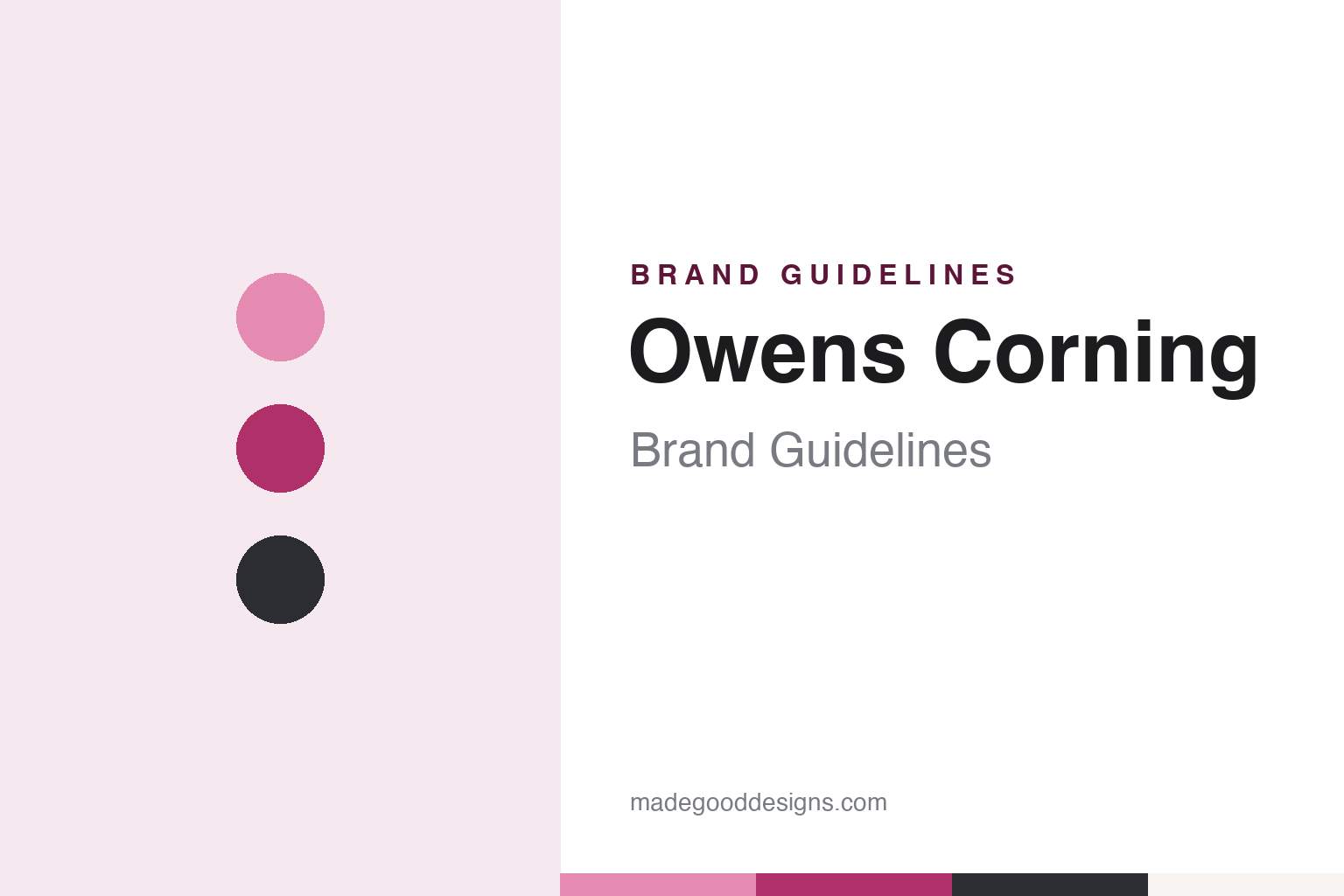
Owens Corning Brand Guidelines
Two glassworks, one new material and a colour that became a trademark.
Aa
Two constants: a pink, rose and charcoal palette and an industrial grotesque register. Abstract homage — not an Owens Corning product or mark; no insulation, character or logo is reproduced.
Two glassworks and a new fibre
Corning, Owens-Illinois and Toledo.
Owens Corning began as a joint project between two American glass companies, Corning Glass Works and Owens-Illinois of Toledo, Ohio. English Wikipedia says the two formed the Owens-Corning Fiberglas business as a joint venture in 1935, and that it became a separate company in 1938 with its headquarters in Toledo, Ohio, where the company is still based. The magazine Modern Mechanix presented the new material to its readers in February 1938. The hyphen and the word Fiberglas, spelled with one s, stayed in the corporate name for decades.
The new company found early uses for glass fibre well beyond houses. English Wikipedia records that in 1939 the US Navy’s Bureau of Ships made Owens-Corning insulation standard in new warship construction, and that the company produced a prototype boat hull of glass-fibre-reinforced plastic in 1944. After the war, the same material was used for car bodies, and General Motors used glass-fibre-reinforced plastic for the body of the Chevrolet Corvette in 1953. The company’s shares were offered on the New York Stock Exchange in 1952, and in 1955 it bought land near Granville, Ohio, for a research and testing centre.
The colour came next. English Wikipedia says that in 1956 the company made a new all-fibre glass wool and added red dye to distinguish it, which turned the insulation pink. According to the same account, the company worried that pink would put off the builders and installers who bought it, removed the dye, then restored it after customers asked for it back.
Roofing joined the business in the 1970s. English Wikipedia records that in 1977 Owens-Corning acquired Frye Roofing and began making glass-fibre mat to replace the paper mat traditionally used inside asphalt shingles. Today its products span insulation, roofing and glass-fibre composites, and it competes on the same American roofs as GAF and CertainTeed.
Colour
A trademarked colour, a cartoon cat and new owners of old names.
The decision that shaped the brand most was legal as much as visual. On 8 October 1985 the US Court of Appeals for the Federal Circuit decided In re Owens-Corning Fiberglas Corp., a case over whether the company could register the pink colour of its insulation as a trademark; the court ruled in the company’s favour, and the decision has been cited in later American cases on colour marks.
The second piece is a borrowed character. Owens Corning has used the Pink Panther, the United Artists cartoon character, as its advertising mascot since around 1980, under a licence agreed with United Artists; English Wikipedia gives both 1979 and 1980 for the start of the arrangement. English Wikipedia, citing a 2005 report in The Blade of Toledo on the character’s twenty-fifth year with the company, quotes a company marketing director describing the panther as an important part of the brand that “brings our trademark color pink to life”. The panther appears in most of the company’s advertising.
The corporate structure changed several times. In May 1994 Owens-Corning acquired UC Industries, maker of Foamular polystyrene insulation, and in 1996 it changed its name to Owens Corning, dropping both the hyphen and the word Fiberglas. In May 1997 it acquired Fibreboard Corporation, a vinyl-siding maker. The company filed for Chapter 11 protection in 2000 amid asbestos litigation and returned to the New York Stock Exchange under the ticker OC in 2006. In 2007 it formed a reinforcements joint venture with Saint-Gobain called OCV Reinforcements. In May 2024 Owens Corning completed its acquisition of Masonite International, a maker of interior and exterior doors.
Owens Corning is a publicly listed company headquartered in Toledo, and its chief executive is Brian Chambers. Its products are made in a network of plants in the United States and abroad: English Wikipedia records a mineral-wool insulation plant west of Joplin, Missouri, announced in July 2015, an insulation plant in Delmar, New York, an insulation plant in the Kansas City area that uses recycled glass from a local supplier, and a composites plant in Gimcheon, South Korea. The company opened an Asia-Pacific division in 1993, and its European business dates back to Owens-Corning Fiberglas Europe, formed in 1965.
Typography
Design and documentation.
The brands in this group make the outside of a house: the shingles and membranes on its roof, the boards and panels on its walls and the decking and railings around it. Roofing, siding and decking names sit at many different points in the building trade, from businesses that grew out of a single product or family firm to names that now belong to much larger groups selling a whole range of exterior materials.
Most homeowners meet these brands only a few times, and often through someone else: a contractor, a dealer, a sample board or a colour card. A brand’s identity is therefore carried less by a single product than by its name, its product families, its colour ranges and the programmes it runs for the people who install its materials. Ownership can change several times while the name on the bundle stays the same.
Each guide separates what independent sources record from what the company says about itself — its founding, its owners over time, where its products are made and how its names and product lines have changed — and marks plainly what rests only on the company’s own word.
Aa
An industrial grotesque — a product-label register. (Specimen set in Archivo, a sans-serif STAND-IN; NOT the Owens Corning logo.)
Owens Corning
A colour, a character and a corporate name.
Owens Corning’s identity works on three levels at once. The first is the corporate name, which still records the two glassworks that founded the business in 1935, although the hyphen and the word Fiberglas were dropped in 1996. The second is the colour. Pink began in 1956 as a dye added to distinguish the company’s glass wool, and the 1985 Federal Circuit decision allowed the colour itself to be registered as a trademark for the product.
The third is the Pink Panther. The licensed character gives the colour a face in the company’s advertising. The company’s roofing, composites and, since 2024, Masonite door businesses each carry their own product names, while the pink and the panther stay most closely tied to insulation.
For a design guide, Owens Corning shows how a colour can become the main carrier of a brand, protected by law, given a face by a licensed character, and attached to a product that sits inside walls and attics. Compare it with GAF, a roofing rival that relies on initials and product names, and CertainTeed, which also makes insulation and roofing for American homes. For this guide we use pink, rose and charcoal with a sans, an unofficial interpretation; no product or logo is reproduced.
Explore & save
Keep Owens Corning’s identity on hand — save it to a board in the Made Good inspiration library.
Owens Corning identity set
Pin the Owens Corning pink, rose and charcoal palette and the industrial grotesque register to your own board.