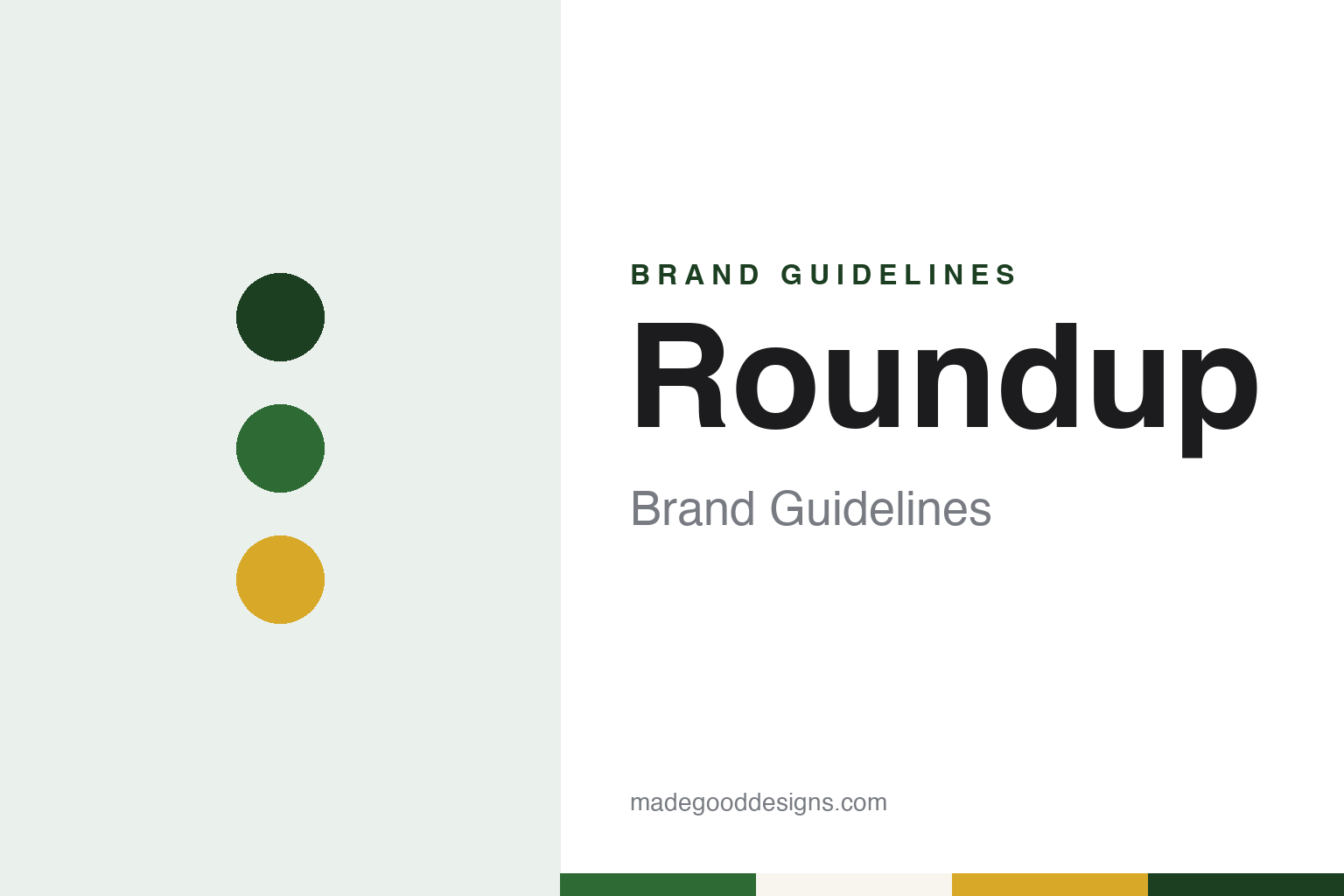
Roundup Brand Guidelines
The Monsanto herbicide name that Bayer now owns.
Aa
Two constants: a leaf green, trigger yellow and path white palette and a heavy grotesque register. Abstract homage — not a Roundup product or mark; no bottle, label or logo is reproduced.
A Monsanto name
A St. Louis chemical company and a 1970 discovery.
Roundup is a brand that has outlived the company that created it. It was launched by Monsanto, the chemical business founded in St. Louis, Missouri, in 1901. NPR, writing in June 2018, recalled that the company took its name from Olga Monsanto, the wife of its founder John Francis Queeny, who began with an artificial sweetener before the business moved, over decades, into agricultural chemicals. English Wikipedia lists its later headquarters in Creve Coeur, Missouri.
The product rests on a single active ingredient, glyphosate. English Wikipedia says the Monsanto chemist John E. Franz discovered glyphosate’s use as a herbicide in 1970, after he took over a research programme on phosphonic acid compounds the year before. Franz himself, the same article notes, described the work as a team effort. Wikipedia dates Monsanto’s patent on the herbicidal use of glyphosate and related compounds to 1971; the US patent was granted in March 1974.
Wikipedia, citing a 2016 paper by Charles Benbrook in Environmental Sciences Europe, dates commercial sale of Roundup to 1974. The name was registered as a trademark with the United States Patent and Trademark Office, and Wikipedia notes that the registration is still in force. The chemical itself became open to others: Monsanto held exclusive rights to glyphosate in the United States until its US patent expired in September 2000, and in other countries protection ended earlier, so glyphosate is now sold by many companies under many names. What Monsanto kept, and what its successors still own, is the word Roundup.
The name also spread from the bottle into the field. Monsanto developed seeds for crops engineered to tolerate glyphosate and sold them as Roundup Ready, so that a herbicide brand also became a label on farm seed, and the word Roundup came to stand for a whole farming system as well as a product on a garden-centre shelf.
Colour
Scotts takes the garden shelf, then Bayer takes Monsanto.
For home gardeners in North America, the company putting Roundup on the shelf has not been Monsanto for more than a quarter of a century. English Wikipedia’s timeline of Scotts Miracle-Gro records a collaboration with Monsanto in 1998, and in 1999 agreements that gave Scotts exclusive agency and marketing rights to Monsanto’s consumer Roundup products in the United States, Canada, the United Kingdom, France, Germany and Australia. In the same year Scotts bought Monsanto’s Ortho lawn-and-garden business.
The arrangement was extended in May 2015. AgriBusiness Global, reporting the announcement on 20 May that year, wrote that since 1999 Scotts, through one of its subsidiaries, had served as Monsanto’s exclusive agent for marketing and distributing Roundup non-selective herbicides in the consumer lawn-and-garden market in the United States and selected international markets. The new agreement gave Scotts an extended licence to use the Roundup brand in new lawn-and-garden product categories and widened its marketing rights into new territories. Monsanto’s Kerry Preete was quoted calling it a sign of “the value of the Roundup brand.”
That licence explains why the Roundup name now appears on products that do not contain glyphosate at all. Michigan State University Extension, in an article dated 31 March 2017, set out the difference between Roundup and Roundup For Lawns, a selective lawn weed killer sold under the same name but built on other active ingredients, and Wikipedia notes that two such different products sharing one brand can confuse shoppers.
Ownership of the brand itself moved in 2018. Bayer, the German chemical and pharmaceutical group, announced in 2016 that it would buy Monsanto, and English Wikipedia says the sale was completed on 7 June 2018 after US and European regulators approved it. Days earlier NPR had reported that the Monsanto company name would disappear in the merger, with the combined business known simply as Bayer, while product names, Roundup among them, would stay the same. The footer of the consumer website today carries a Bayer Group copyright line. Since the acquisition Bayer has faced litigation in the United States over glyphosate-based Roundup, and in June 2020 The New York Times reported that it had agreed to settle many of those lawsuits.
Typography
Design and documentation.
Garden-care and pest-control brands share the shelf with paint, cleaning products and hardware, and they have to be read quickly by someone standing in a store aisle or a garden centre. Their identities are carried by a few repeated signals: a bottle, bag or can in a single strong colour, a name set large on the front panel, and, for some, a mascot or a short slogan that has run in advertising for years.
These packs also carry text the brand does not choose. In the United States, pesticide products are registered with the Environmental Protection Agency, and their labels set out directions for use, precautionary statements and a registration number. That regulatory panel sits beside the brand’s own graphics on the same container, so the designed part of the label and the required part have to work together.
Some of the names in this group have changed owners more than once, while others have stayed with the company that launched them. Each guide in this group sets out who started the brand, who owns it now and how its name and packaging are presented, and marks plainly what rests only on the company’s own word.
Aa
A heavy grotesque — the register of a bold product name on a trigger sprayer in a garden centre. (Specimen set in Archivo, a sans-serif STAND-IN; NOT the Roundup logo.)
Roundup
A brand name that stays put while the products change.
Roundup’s identity is, above all, a name. Short, verbal and easy to say at a shop counter, it describes a job rather than a chemical, and that has let it travel. It was attached first to a single glyphosate herbicide, then to Roundup Ready crop seed, and later, under the Scotts licence, to lawn-and-garden products with different active ingredients. Through each of those steps the word itself stayed fixed.
The consumer website shows how the brand is organised for home use today. Its shop is arranged by the place where the weed grows rather than by formula: landscape beds, driveways and patios, lawns, and poison ivy and tough brush each have their own section. Product lines such as QuickHand and Dual Action sit inside that structure, and the site runs a No Quibble Guarantee alongside its how-to articles, under a “Roundup 101” heading. It is a retail architecture built around a gardener’s problem, with the Roundup name sitting above every route through it.
The site is published for the United States and Canada, in English. Behind it, the ownership is layered in a way that is common in lawn and garden but rarely visible on a label: Bayer owns the brand it inherited from Monsanto, while Scotts Miracle-Gro, the company behind Miracle-Gro, has marketed it to consumers since 1999.
For a design guide, Roundup shows how a strong, short brand name can carry a product family through changes of formula, owner and marketer, and how a retail site can be organised around where a problem sits in the garden. Compare it with Miracle-Gro, the plant-food brand of its consumer marketer, and Ortho, the garden-chemicals brand Scotts bought from Monsanto in 1999. For this guide we use leaf green, trigger yellow and path white with a sans, an unofficial interpretation; no product or logo is reproduced.
Explore & save
Keep Roundup’s identity on hand — save it to a board in the Made Good inspiration library.
Roundup identity set
Pin the Roundup leaf green, trigger yellow and path white palette and the heavy grotesque register to your own board.