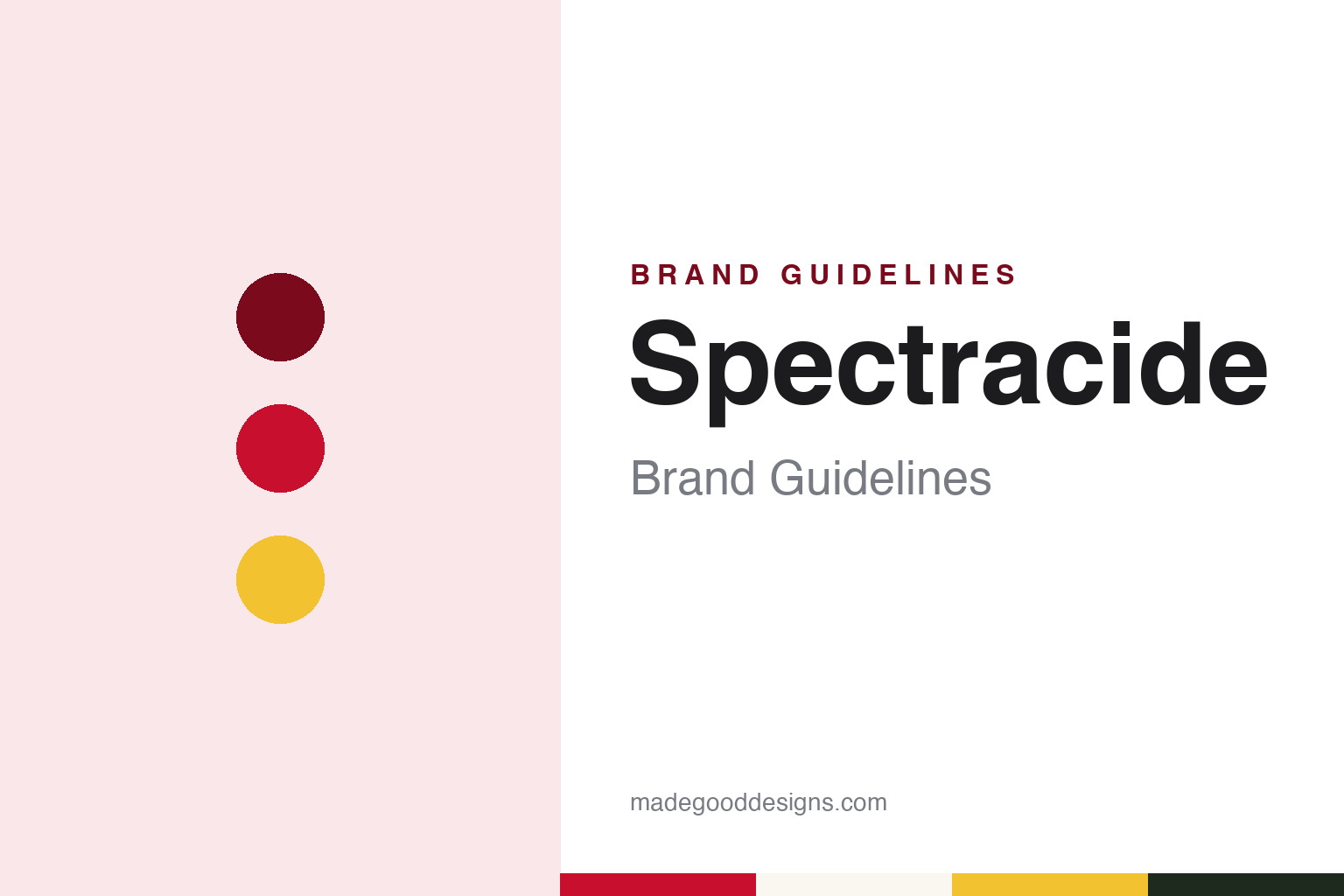
Spectracide Brand Guidelines
The St. Louis lawn and garden brand of United Industries and Spectrum Brands.
Aa
Two constants: a label red, warning yellow and hedge green palette and a heavy shelf sans register. Abstract homage — not a Spectracide product or mark; no bottle, sprayer or logo is reproduced.
A St. Louis portfolio
A bolt maker, a contract chemist and a bundle of brands.
Spectracide’s modern story runs through a company that began by making something else entirely. The company history of United Industries Corporation published by FundingUniverse, drawn from the International Directory of Company Histories, says the business was founded in St. Louis in 1969 by David C. Pratt and started out as a bolt maker. It changed direction in 1973 by acquiring Spray Chem, a contract manufacturer of insecticides and herbicides, and formed a subsidiary called Chemisco to hold the new line of work.
For a dozen years the company made products for other people’s labels. The same history says United Industries moved into branded products in 1985 with the purchase of Real-Kill, and then, three years later, picked up a much larger set of names. In 1988 it bought a group of brands from Chesebrough-Pond’s, the U.S. subsidiary of Unilever: Hot Shot, No-Pest, Rid-a-Bug and Spectracide. From 1988 Spectracide was one of the St. Louis company’s own brands.
The name itself also turns up in chemistry. English Wikipedia’s article on diazinon, an insecticide it says was developed in 1952 by the Swiss company Geigy, lists Spectracide among the compound’s other names, and Wikipedia’s own entry for “Spectracide” redirects to that article. The brand that United Industries built on in the decades after 1988 was wider than any single compound, covering weed killers as well as insect control for lawns, gardens and the outside of the house.
The 1990s added more names around it. The FundingUniverse history records the 1994 purchase of the Cutter insect repellent from Miles Laboratories, a 1995 licence for Peters plant foods from Scotts, and a growing business with the large home-improvement retailers that stocked the company’s lawn and garden ranges.
Colour
New owners, a fertiliser spree and a battery maker.
The ownership of the brand changed twice in six years. The company history says that in 1999 Pratt sold a majority of United Industries to the Boston buyout firm Thomas H. Lee Partners, keeping a small stake himself, and that in November of that year a new management team was installed under Robert L. Caulk as president and chief executive. Caulk, the history notes, had worked at S. C. Johnson, the maker of Raid, before moving into the garage-door business.
Under the new owners United Industries set out to consolidate lawn and garden brands. The history describes the late-2001 purchase of fertiliser lines from Pursell Industries, including Vigoro and Sta-Green; the 2002 acquisition of the Schultz Co., which brought an organic pest-control range sold as Garden Safe; the same year’s purchase of WPC Brands, maker of Repel; and, in 2004, the Canadian lawn and garden company Nu-Gro and the pet-supply business United Pet Group. A 2002 alliance with Bayer CropScience was ended in February 2004. The same history records that the Federal Trade Commission and a group of states challenged the advertising of the company’s Terminate termite stakes, and that United Industries settled in 1999 by agreeing to change its advertising.
Then came the battery maker. The Associated Press reported on 4 January 2005 that Rayovac was buying United Industries, then based in Maryland Heights, Missouri, a suburb of St. Louis, and listed Spectracide and Sta-Green lawn products, Hot Shot and Repel insect control and several pet brands among its products. English Wikipedia says Rayovac completed the purchase in January 2005 and, after also acquiring the aquarium company Tetra, changed its name to Spectrum Brands that year. Spectrum Brands has owned Spectracide since 2005; Wikipedia gives its headquarters as Middleton, Wisconsin, and lists Spectracide and Garden Safe as its lawn and garden brands.
Today the brand’s own website calls itself “Spectracide® Lawn and Garden Products” and sorts its range into three families: weed killers, insect killers and yard care, the last covering lawn fertilisers and treatments for plant and lawn disease.
Typography
Design and documentation.
Garden-care and pest-control brands share the shelf with paint, cleaning products and hardware, and they have to be read quickly by someone standing in a store aisle or a garden centre. Their identities are carried by a few repeated signals: a bottle, bag or can in a single strong colour, a name set large on the front panel, and, for some, a mascot or a short slogan that has run in advertising for years.
These packs also carry text the brand does not choose. In the United States, pesticide products are registered with the Environmental Protection Agency, and their labels set out directions for use, precautionary statements and a registration number. That regulatory panel sits beside the brand’s own graphics on the same container, so the designed part of the label and the required part have to work together.
Some of the names in this group have changed owners more than once, while others have stayed with the company that launched them. Each guide in this group sets out who started the brand, who owns it now and how its name and packaging are presented, and marks plainly what rests only on the company’s own word.
Aa
A heavy shelf sans — the register of a bold label read from the end of a garden-centre aisle. (Specimen set in Archivo Black, a sans-serif STAND-IN; NOT the Spectracide logo.)
Spectracide
Three families, a sprayer and a race driver.
Spectracide presents itself as a toolbox for the yard rather than as a single product. Its website opens with a menu built around problems — driveways and fence lines, lawns, ants and termites, flying and stinging insects, “home invaders” — and the brand describes its products in its own words as giving shoppers “the power to tame invading bugs and weeds.” That problem-first structure is the backbone of the identity: the visitor is asked what is wrong before being shown what to buy.
Hardware is part of the look. The site gives prominent space to the AccuShot sprayer and to the One-Shot weed and grass killer, and runs how-to features such as how to set up an AccuShot and which herbicide delivery system suits a job. Alongside these sit seasonal guides on managing weeds through the year, identifying common pests and comparing indoor and outdoor pest control, so that the brand speaks as much through advice as through packaging.
Its recent marketing leans on people as well as products. The website features a video in which the NASCAR driver Brandon Jones talks about the brand’s wasp and hornet products, with the line “leave wasps & hornets in the rearview mirror,” and it gathers customer stories under the hashtag #WaspWipeOutWithSpectracide. Weed-control testimonials are framed the same way, as “victories” over unruly weeds. The language is brisk, and the brand sat for years in the same portfolio as Hot Shot and Cutter.
The corporate story behind the label is one of steady consolidation. A brand acquired from Chesebrough-Pond’s in 1988 passed from the St. Louis company David C. Pratt founded to a buyout firm in 1999 and to a Wisconsin battery maker in 2005, which renamed itself Spectrum Brands the same year. Through each change Spectracide kept its name and its place in the lawn and garden aisle, while the companies around it added fertilisers, organic ranges and repellents.
For a design guide, Spectracide shows how a garden-chemical brand can organise a wide range around the shopper’s problem and a recognisable sprayer rather than a single hero product. Compare it with Ortho, another American lawn and garden pest-control name, and Raid, the S. C. Johnson insecticide where United Industries’ 1999 chief executive had worked. For this guide we use label red, warning yellow and hedge green with a heavy sans, an unofficial interpretation; no product or logo is reproduced.
Explore & save
Keep Spectracide’s identity on hand — save it to a board in the Made Good inspiration library.
Spectracide identity set
Pin the Spectracide label red, warning yellow and hedge green palette and the heavy shelf sans register to your own board.


