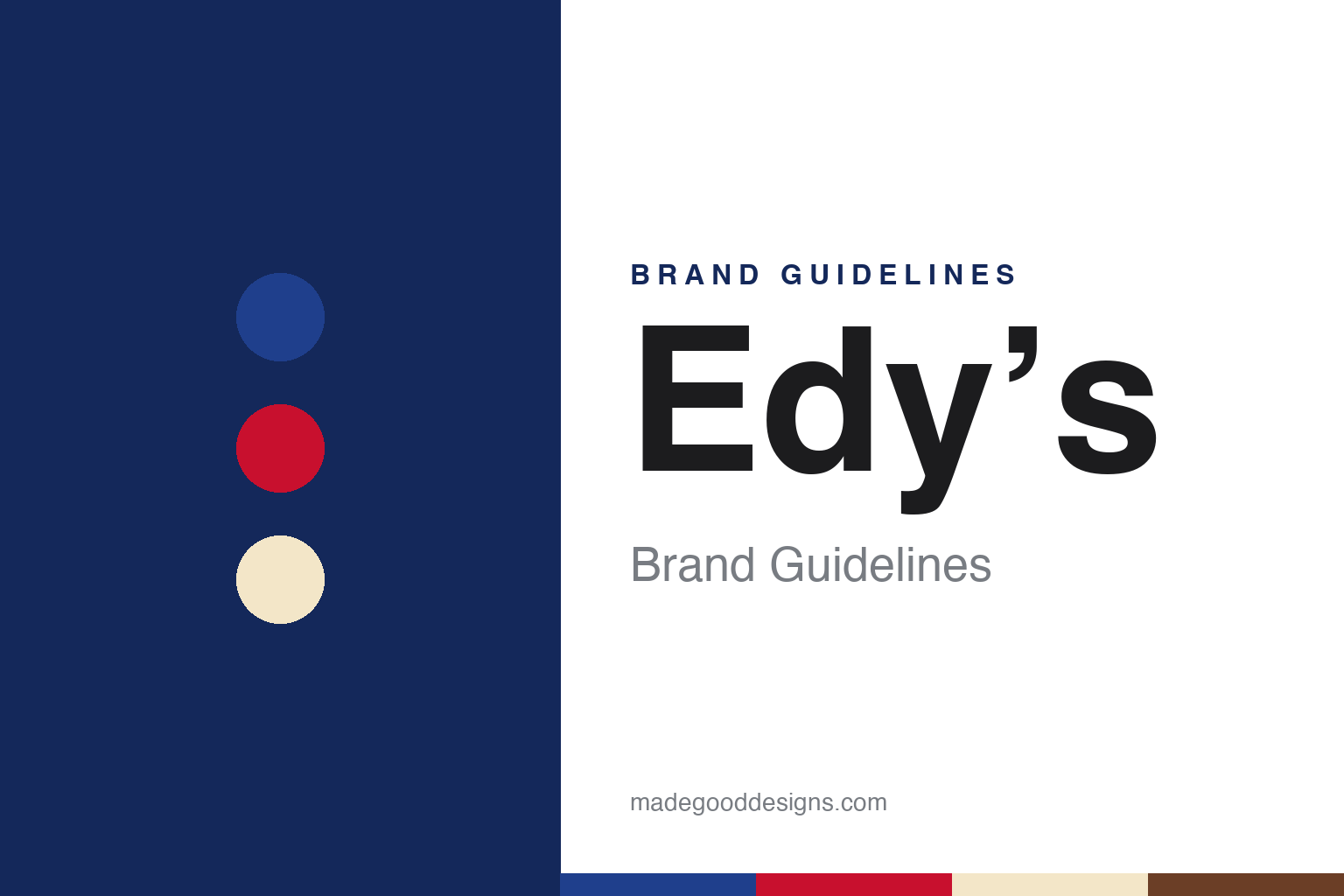
Edy’s Brand Guidelines
One Oakland ice cream, two family names on the carton.
Aa
Two constants: a blue, red, vanilla-cream and chocolate-brown palette and a display serif register. Abstract homage — not an Edy’s or Dreyer’s product or mark; no carton or logo is reproduced.
A candy maker and an ice cream maker
Grand Avenue, Oakland, and a partnership formed in 1928.
Edy’s and Dreyer’s are two names for one ice cream, and both names belong to its founders. English Wikipedia says Dreyer’s Grand Ice Cream was founded in 1928 in Oakland, California, by William Dreyer and Joseph Edy, and that the company’s two signature brands, Dreyer’s Grand Ice Cream and Edy’s Grand Ice Cream, are named after them. The company’s own “Our Story” page, on its icecream.com site, opens with the line “Scooping since 1928” and says Edy and Dreyer formed a partnership in the heart of Oakland that year.
The two men came to ice cream from different directions. Wikipedia says Joseph Edy was a candy maker who had run a candy and ice cream parlour in Billings, Montana, before moving to California, and who opened Edy’s Character Candies in Oakland in 1925. William Dreyer, it says, had run an ice cream manufacturing business in the dairy town of Visalia, and in 1926 was recruited to run a new plant in Oakland for National Ice Cream, which is where he met Edy.
The partners secured a small factory and launched Edy’s Grand Ice Cream. Wikipedia says the word “Grand” came from their street address on Grand Avenue in Oakland; the word appears in both brand names, Dreyer’s Grand Ice Cream and Edy’s Grand Ice Cream. The company says the two men wanted a new flavour to cheer people up as the Great Depression hit, and that they mixed chocolate ice cream with almonds and marshmallows to make Rocky Road. Wikipedia dates Rocky Road to 1929 and says the name described both the texture of the ice cream and the hard economic times; it also credits the partners with Toasted Almond and Candy Mint.
Colour
Why the same carton carries two names.
The partnership did not last. Wikipedia says Edy and Dreyer dissolved it in 1947, after which Edy carried on under the Edy’s name, selling candy and ice cream from shops around the San Francisco Bay Area, while Dreyer built a new manufacturing plant on College Avenue in Oakland. The company’s own timeline says Dreyer built a new plant in Oakland and renamed the business Dreyer’s Grand Ice Cream, Inc. Wikipedia gives two dates for that change: its Dreyer’s article says William Dreyer Jr. took over and changed the name in 1953, while its Breyers article dates the rename to 1948.
Ownership then moved outside the family. Wikipedia says that in 1963 the business passed to three of its officers, Al Wolff, Bob Boone and Ken Cook, and that in 1977 Cook sold it to T. Gary Rogers and W. F. “Rick” Cronk. Wikipedia’s Dreyer’s article says the company went public in 1981 and re-adopted the Edy’s Grand Ice Cream name for ice cream sold east of the Rocky Mountains, so that it would not be confused with Breyers; its Breyers article dates the switch to 1977. Wikipedia says the Dreyer’s brand is sold today in the Western United States and Texas and the Edy’s brand in the Eastern and Midwestern United States.
The Los Angeles Times described the rivalry behind the two names on 19 June 1986. Its reporter Denise Gellene wrote that William A. Dreyer never met William A. Breyer, but that their ice creams were having trouble getting along in Southern California. Breyers, owned then by Dart & Kraft, was moving into the West and ran advertising stressing “It’s Breyers with a B”. The paper said Dreyer’s, based in Oakland, objected to one Breyers commercial that showed the two cartons side by side, saying it broke an agreement between the companies not to confuse consumers. The same report noted that Dreyer’s marketed its ice cream in the East under the Edy’s name and was entering the Baltimore market that summer.
Typography
Design and documentation.
The brands in this group are all American ice-cream names. Ice-cream brands in general reach people in several ways at once: a carton in a supermarket freezer, a wrapped novelty in a corner-shop cabinet, a cone handed out of a truck window or a sundae served at a restaurant counter. A single name can travel through all of these, and the same product can be sold under different names in different parts of the country.
Because the product is frozen, much of an ice-cream brand’s identity is carried by its packaging and its outlets rather than by the ice cream itself: the shape and colour of a carton, the print on a paper or plastic wrapper, the livery of a truck, a jingle or a slogan, and the lettering on a sign. The company behind the name may have changed hands, merged its factories or licensed the name to someone else, so the questions worth asking are plain ones: who started it, who owns it now, and where it is made.
Each guide separates what independent sources record from what a company says about itself, and marks plainly what rests only on the company’s own word.
Aa
A display serif — the classic, grand register of a family ice cream name. (Specimen set in Playfair Display, a serif STAND-IN; NOT the Edy’s or Dreyer’s logo.)
Grand, East and West
From Nestlé to Froneri, with both names intact.
The Grand Ice Cream later passed to a Swiss parent. Wikipedia says Nestlé agreed in 2002 to acquire a majority of Dreyer’s and completed its acquisition of the company in 2006. During those years, Wikipedia says, Dreyer’s introduced a churning process sold under the name Slow Churned, in 2004; earlier lines it lists include Cookies N Cream in 1982 and Grand Light in 1987.
The current owner is Froneri. In a press release dated 11 December 2019, the investment firm PAI Partners announced that Froneri, the ice cream company it had formed with Nestlé in 2016 by combining Nestlé’s European ice cream business with PAI-owned R&R, would acquire Nestlé’s ice cream business in the United States. The release listed the brands covered, among them Edy’s, Dreyer’s, Häagen-Dazs, Drumstick, Outshine and Skinny Cow, and said the deal was expected to close in the opening quarter of 2020 after regulatory approvals. It added that Nestlé would continue to run its remaining ice cream businesses in Canada, Latin America and Asia. The icecream.com site that carries the company’s “Our Story” page presents the brand as Edy’s/Dreyer’s, with one history behind both names.
Wikipedia’s account of the two names turns on geography: the Dreyer’s name west of the Rocky Mountains, the Edy’s name to the east, and in both cases the word Grand from the partners’ Oakland street. The Los Angeles Times report of 1986 tied the eastern name to the Philadelphia brand Breyers, whose own name is one letter away from Dreyer’s.
For a design guide, Edy’s shows how a brand can carry two names for one product across a single country while keeping one founding story, one flavour list and one “Grand” descriptor on both. Compare it with Häagen-Dazs, which Froneri took on in the same 2019 agreement, and Drumstick, another brand in that deal. For this guide we use grand blue, carton red, vanilla cream and a Rocky Road brown with a serif, an unofficial interpretation; no product or logo is reproduced.
Explore & save
Keep Edy’s’s identity on hand — save it to a board in the Made Good inspiration library.
Edy’s identity set
Pin the Edy’s grand blue, carton red, vanilla-cream and chocolate-brown palette and the display serif register to your own board.


