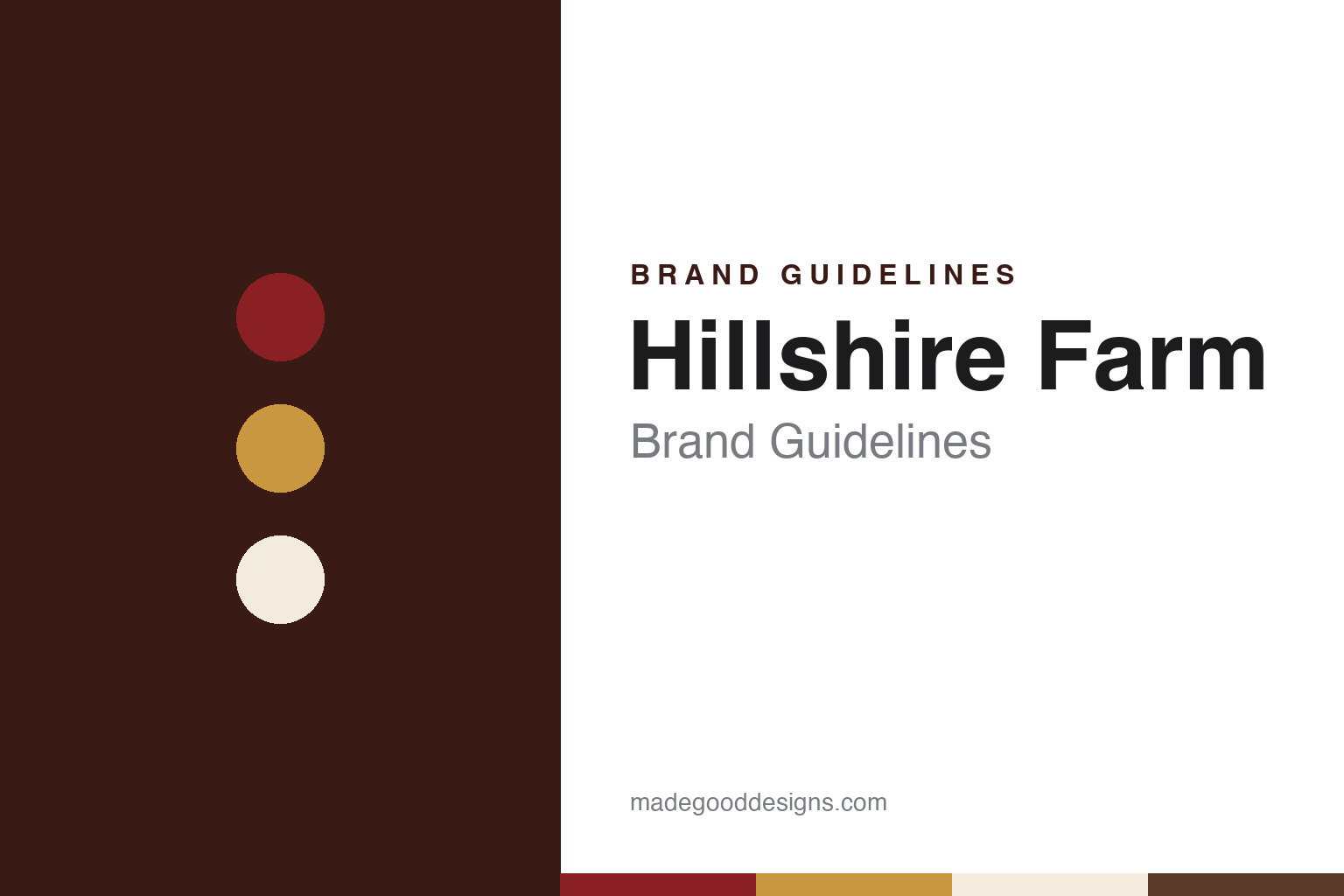
Hillshire Farm Brand Guidelines
A Wisconsin butcher’s smokehouse that became a supermarket sausage.
Aa
Two constants: a smokehouse red, rope gold and butcher paper palette and a slab serif register. Abstract homage — not a Hillshire Farm product or mark; no pack, label or logo is reproduced.
A butcher in New London
An Austrian apprentice, a Wisconsin river town and a packing house.
Hillshire Farm is an American brand of smoked sausage and sliced meats owned today by Tyson Foods. Its story begins in New London, Wisconsin, with a butcher named Friedrich “Fritz” Bernegger and his wife Armella. English Wikipedia dates the business to 1934; the brand’s own website says it has been cooking “since 1935.” The fullest dated account is the citation of the Wisconsin Meat Industry Hall of Fame, run by the animal sciences department of the University of Wisconsin–Madison, which inducted the couple together in 1994.
The Hall of Fame says Fritz Bernegger was educated in Austria, where he grew up with farm work in the family operation and served a three-year apprenticeship from the age of sixteen to become a professional butcher. He came to the United States in 1926, intending, the citation says, to go home after two years. He worked on farms in the Canadian wheat fields, then for the Cudahy Packing Company in St. Paul, Minnesota, the Layton Sausage Company in Milwaukee and the Hopfensperger business in Appleton.
In September 1928 he moved to New London for a job making sausage. The Hall of Fame describes years of struggle to keep a business going before three shops emerged under the name Quality Meat Markets. A slaughterhouse followed in 1934, which lines up with the founding year Wikipedia gives, and in 1938 a full packing house went up on a one-acre site as the Quality Packing House. Bernegger ran it with a partner, Billy Schmidt, and the plant supplied fresh meat and sausage to their stores; the citation says everything there was hand work.
The partnership was dissolved in 1953, with Schmidt taking the retail stores and the Berneggers taking the plant. In 1954 the plant was incorporated as Quality Packing House, Inc. The Hall of Fame says the business, by then known as Hillside Meat Products, was renamed Hillshire Meat Products, and that the plant came under federal inspection in 1969. It credits Armella Bernegger as a full partner in developing, leading and working in the business.
The company’s own telling keeps the same outline in a looser voice. Its “Our Story” page says it all started on a little family farm in New London, with an Austrian butcher bringing European sausage-making skills and a lot of smoke, and that the brand still slow-roasts its lunchmeat and smokes its sausage.
Colour
Consolidated Foods, Sara Lee, Hillshire Brands and Tyson.
The family business joined a much larger one at the start of the 1970s. The Hall of Fame says Fritz Bernegger recognised that it was no longer a family business, and that on 13 December 1971 it was merged into Consolidated Foods, the Chicago group that had bought Kitchens of Sara Lee in 1956. Wikipedia’s Hillshire Farm article dates the purchase to 1971 as well. The citation adds that a few years after the merger the business took the name Hillshire Farm.
Consolidated Foods changed its own name in 1985. Both the Hall of Fame and Wikipedia say it became the Sara Lee Corporation that year; see our Sara Lee guide. In 1989, the Hall of Fame says, Hillshire Farm was merged with Kahn’s as an operating unit of Sara Lee.
The brand then gave its name to the parent. Wikipedia says Sara Lee announced on 28 January 2011 that it would split in two, with its North American operations, including Jimmy Dean, Ball Park and Hillshire Farm, taking the Hillshire Brands name, and its international coffee and tea business becoming D.E Master Blenders 1753. Hillshire Brands, based in Chicago, made its debut on 29 June 2012 and began trading on the New York Stock Exchange that day.
Hillshire Brands did not stay independent for long. Wikipedia says it agreed in May 2014 to buy Pinnacle Foods, and that on 30 June 2014 Pinnacle scrapped that sale, clearing the way for a takeover of Hillshire by Tyson. Tyson Foods announced from Springdale, Arkansas, and Chicago on 28 August 2014 that it had completed its merger with The Hillshire Brands Company, and that Hillshire shares would stop trading before the markets opened on 29 August. The release listed Hillshire Farm among the brands in the combined portfolio, beside Tyson, Wright, Jimmy Dean, Ball Park and State Fair. Tyson Foods has owned Hillshire Farm since 2014, and Wikipedia describes Hillshire Brands as a wholly owned Tyson subsidiary.
Typography
Design and documentation.
The brands in this group sell hot dogs, sausages, sliced deli meats and breakfast meats, foods that are bought chilled or frozen and are often chosen quickly from a long refrigerated case. Packaging in this category has to work at a glance: a name, a colour and a picture of the food have to be legible through clear film or on a small carton, under bright supermarket lighting, next to many similar packs.
That is why identity in this part of the grocery trade tends to rest on a few repeated signals rather than on a single container. A wordmark, a founder’s name, a slogan, a mascot or a jingle can travel across packs, advertising and sponsorships, while the pack itself changes size and format many times over the decades.
The companies behind these names have often changed hands, merged their factories or moved production, so each guide asks plain questions: who started the brand, who owns it now, where its meat is processed and how its look has been presented. Each separates what independent sources record from what a company says about itself.
Aa
A sturdy slab serif — the butcher’s-counter register of a smoked sausage pack. (Specimen set in Zilla Slab, a slab serif STAND-IN; NOT the Hillshire Farm logo.)
A rope of smoked sausage
Smoked links, bite-sized smokies and a holiday summer sausage.
The product that defines the brand is long and curved. Wikipedia says Hillshire Farm’s primary products are smoked sausage and Polska kielbasa, and that its sausages are about two feet long and shaped like a ring bologna. Wikipedia credits the brand with introducing smoked sausage to much of the American public as a supermarket food and a nationally advertised one. The Hall of Fame says the Berneggers were especially proud of the smoked sausage.
The range has grown around that rope. Wikipedia lists Lit’l Smokies, a line of bite-sized smoked sausages; packaged deli-sliced meats for sandwiches; summer sausage, marketed mostly during the Christmas holiday; and traditional bone-in hams, sold whole or spiral sliced. The brand’s website pairs its smoked sausage with skillet suppers and soups, puts Lit’l Smokies into a stew and builds sandwiches around its sliced turkey.
The way the brand talks about itself has changed with its owners. The current “Our Story” page is written in a loud, informal voice, with lines about flavor and sizzle, while it keeps the founder’s name, the Austrian origin and New London at the centre. The company says it has been serving families for more than ninety years, and the Hall of Fame’s dates take the business back to 1928.
In sequence, the brand has been part of Consolidated Foods from 1971, the Sara Lee Corporation from 1985, Hillshire Brands from 2012 and Tyson Foods from 2014. At Hillshire Brands and again at Tyson, Jimmy Dean and Ball Park have been its stablemates.
For a design guide, Hillshire Farm shows how a founder’s town and trade can stay at the centre of a brand story through four changes of corporate parent, and how one product shape, the smoked sausage rope, can stand for a whole range. Compare it with Jimmy Dean, a sibling brand at Tyson, and Sara Lee, the cheesecake that named its old parent. For this guide we use smokehouse red, rope gold, butcher paper and casing brown with a slab serif, an unofficial interpretation; no product or logo is reproduced.
Explore & save
Keep Hillshire Farm’s identity on hand — save it to a board in the Made Good inspiration library.
Hillshire Farm identity set
Pin the Hillshire Farm smokehouse red, rope gold and butcher paper palette and the slab serif register to your own board.


