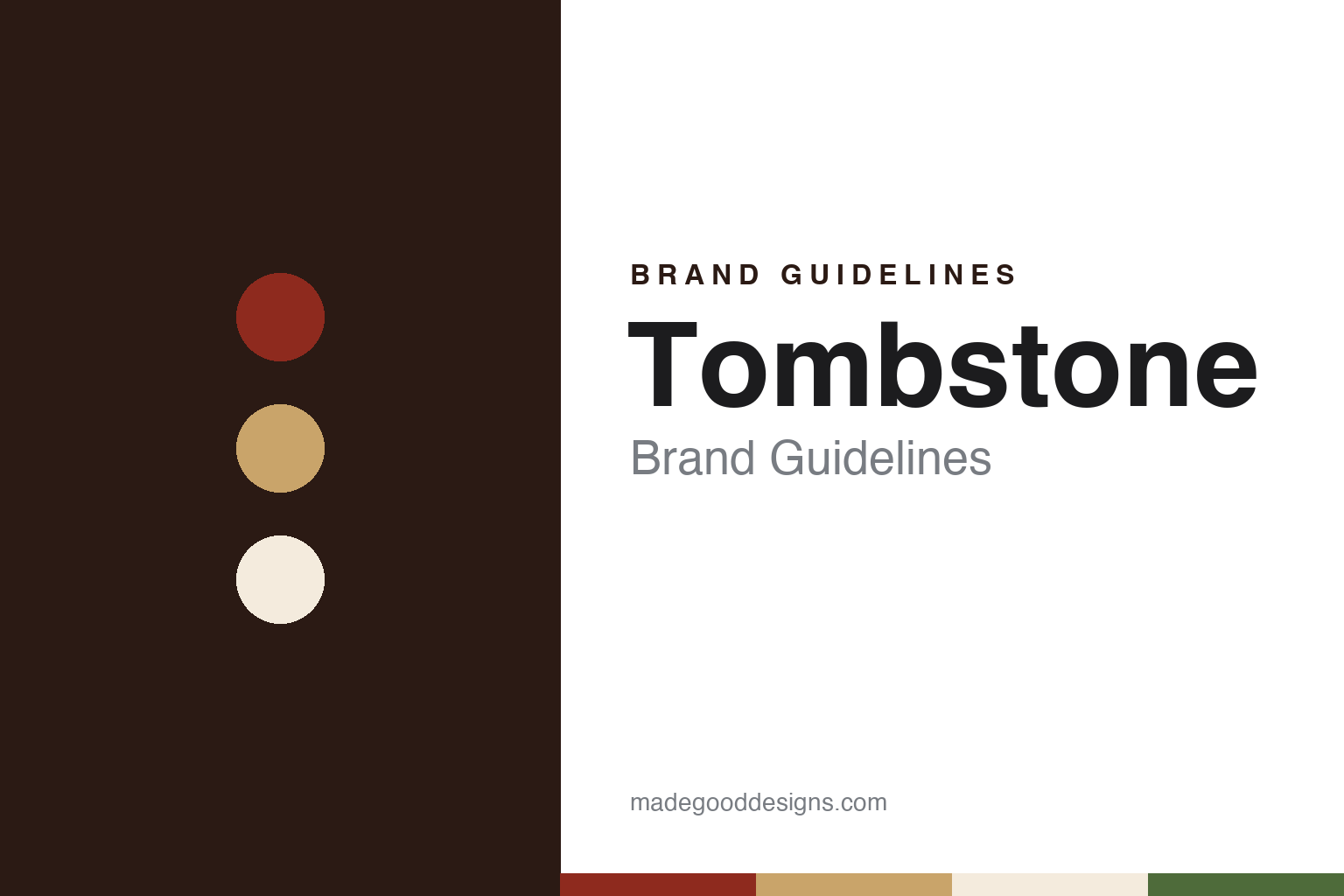
Tombstone Brand Guidelines
A tavern opposite a graveyard, a broken leg and a Cadillac full of dry ice.
Aa
Two constants: a sauce red, prairie tan and crust cream palette and a western display serif register. Abstract homage — not a Tombstone product or mark; no package, box or logo is reproduced.
A tavern across from the cemetery
Two brothers, a small back kitchen and a pizza named after a bar.
Tombstone is an American brand of frozen pizza, owned today by Nestlé. Its name, which sounds like a joke, comes from a real place. The history of the company in the International Directory of Company Histories, published by St. James Press in the 1990s, says that in the 1960s the brothers Joseph “Pep” Simek and Ronald Simek ran a neighbourhood tavern called the Tombstone Tap on the outskirts of Medford, Wisconsin. The tavern was named, the directory says, not for any interest in the occult but because it stood across the road from a cemetery.
The pizza came out of an accident. The directory says Pep broke his leg one night dancing the “Peppermint Twist” and spent the following weeks on crutches, confined to the tavern’s small back kitchen, where he experimented with pizza recipes as a snack for customers. When Pep died in February 2013, the Milwaukee Journal Sentinel’s obituary described the same kitchen as six feet by six. It said Pep and his wife Frances had moved to Medford from Chicago in 1960, that by 1962 they were running the tavern with Ronald, and that Pep telephoned the owner of a favourite Chicago pizza place, who told him the secret was in the spices. The writer Robert Simonson, in his newsletter in October 2024, dated the creation of the pie to 1962.
Neighbours wanted the pizzas too. By 1963, the directory says, other local taverns were asking the Simeks to make pizzas they could freeze and serve later. Pep and Ron, with their wives Joan and Frances, made the pies in the living quarters attached to the tavern. Customers called them “Tombstone’s” or “Tombstone” pizza, and the name stuck. The pizzas went out packed in dry ice in a 1959 Cadillac, a detail The Takeout retold in December 2025.
The business soon outgrew the car and the back rooms. The directory says the brothers bought a refrigerated truck in 1966 to carry pizzas to taverns, campgrounds, gas stations and bowling alleys. In 1967 they chose the pizza trade over the bar and turned the rooms behind the Tap into a small factory, and in 1968 they built a large-scale manufacturing plant. Simonson writes that by 1976 Tombstone pizzas were in supermarkets.
Colour
Direct delivery, Kraft and Nestlé.
The Simeks built their own way of selling. The directory says that in 1975 the brothers hired Grant White as sales manager and D. David “Dewey” Sebold to reorganise the sales team, and that from 1976 Tombstone ran its own direct-store-delivery service, with its drivers taking pizzas from the plant to supermarkets and convenience stores and stocking the shelves themselves. In the second half of the 1970s the company entered Denver, Minneapolis, St. Louis and Chicago, and in 1979 it added a smoked meat snack, Tombstone Beef Sticks. It later opened a second plant in Sussex, Wisconsin. Simonson quotes Ronald Simek in 1978 saying the goal was to become “the General Motors of pizza in the Midwest”.
A large food company bought the business in 1986. The directory, citing the Wausau Daily Herald of July 1986, says Kraft made the Simeks an offer that year; under its terms the staff kept their jobs, Pep stepped down as chairman and Ron as president, and Tombstone became “a freestanding operating unit” of Kraft. Sebold took charge. The Milwaukee Journal Sentinel obituary also dates the sale to Kraft to 1986, and says Pep later opened another place in Medford, Pep’s Pizza. The Takeout reported that under Kraft the brand added new varieties and switched to Kraft cheese.
Kraft widened the range and the map. The directory lists a microwave pizza in 1987, a thin crust in 1989, the year the headquarters moved from Wisconsin to Glenview, Illinois, a Tombstone Light pizza in 1990, a Special Order pizza in 1991 and Tombstone For One in 1994, the year its distribution reached the remaining East Coast states. A Kraft release on an expansion of its pizza plant in Little Chute, Wisconsin, later said almost all of the company’s pizza was produced at its Wisconsin plants in Little Chute and Medford, and that Little Chute made DiGiorno, California Pizza Kitchen, Tombstone and Jack’s pizzas.
The present owner arrived in 2010. Meatingplace reported on 5 January 2010 that Kraft Foods was selling its entire North American frozen pizza business to Nestlé, naming DiGiorno, Tombstone, Jack’s, Delissio and California Pizza Kitchen, together with two Wisconsin manufacturing plants. Nestlé has owned Tombstone since that sale; The Takeout described Tombstone in July 2026 as one of the brands that joined Nestlé from Kraft at the same time as DiGiorno.
Typography
Design and documentation.
The brands in this group live in the chilled and frozen aisles: frozen pizzas, coffee creamers and plant-based milks. Their packaging is usually seen through a freezer door or on a crowded refrigerated shelf, so the identity has to work on a pizza box, a creamer bottle or a milk carton as much as on a logo sheet, and it is often carried by colour, a flavour picture and the name of each variety.
Many brands like these began with a single founder, a family business or a small regional company and now sit inside much larger food groups, so the name on the box may have outlived several owners, moved between factories or been licensed to another company in a different market. That makes the plain questions behind each name worth asking: who started it, who owns it now, and where its pizzas, creamers or milks are actually made.
Each guide separates what independent sources record from what the company says about itself — its founding story, its owners over time, where its products are made and how its packaging has changed — and marks plainly what rests only on the company’s own word.
Aa
A slab-serifed western display face — the saloon-poster register the Tombstone name invites. (Specimen set in Rye, a western display STAND-IN; NOT the Tombstone logo.)
What do you want on your Tombstone?
Clear plastic wrap, a Minneapolis agency and an executioner’s question.
The brand’s early look was plain. The directory says that in the early 1980s Tombstone pizzas were packaged in clear plastic rather than boxes, and that the company’s drivers arranged the products on shelves themselves rather than dropping off sealed cartons. Tombstone hired the Minneapolis agency Campbell-Mithun to coordinate its newspaper, television and coupon advertising, and in 1985 it introduced revamped packaging carrying a toll-free consumer hotline.
The brand’s advertising line came under Kraft. The directory says the Chicago agency Foote, Cone & Belding introduced the “What do you want on your Tombstone?” commercials around 1990. In one version, it says, an executioner asks a condemned man the question, and the man answers “Cheese and pepperoni”. The directory says the campaign spawned several variations. Simonson recalls a jingle from the same years, which called Tombstone “small-town, home-grown” pizza and promised “lotsa mozzarella”.
The company still tells its story in the same tone. An archived copy of the Tombstone website from March 2019 opens its history with “Once upon a bar”, and retells the broken leg, the “Peppermint Twist” and the dry ice packed into the trunk of the 1959 Cadillac. The Takeout listed French Fry-Style Crust and Loaded Bacon Cheddar among the brand’s varieties in December 2025.
For a design guide, Tombstone shows how a name taken from a small-town bar, and from the cemetery across the road, can carry a whole advertising voice, turning a word about death into a question about toppings. Compare it with DiGiorno, the rising-crust pizza Kraft launched later and sold to Nestlé in the same deal, and Totino’s, a Midwest rival in the freezer aisle. For this guide we use sauce red, tavern dark, prairie tan, crust cream and sagebrush green with a western serif, an unofficial interpretation; no product or logo is reproduced.
Explore & save
Keep Tombstone’s identity on hand — save it to a board in the Made Good inspiration library.
Tombstone identity set
Pin the Tombstone sauce red, prairie tan and crust cream palette and the western display serif register to your own board.


