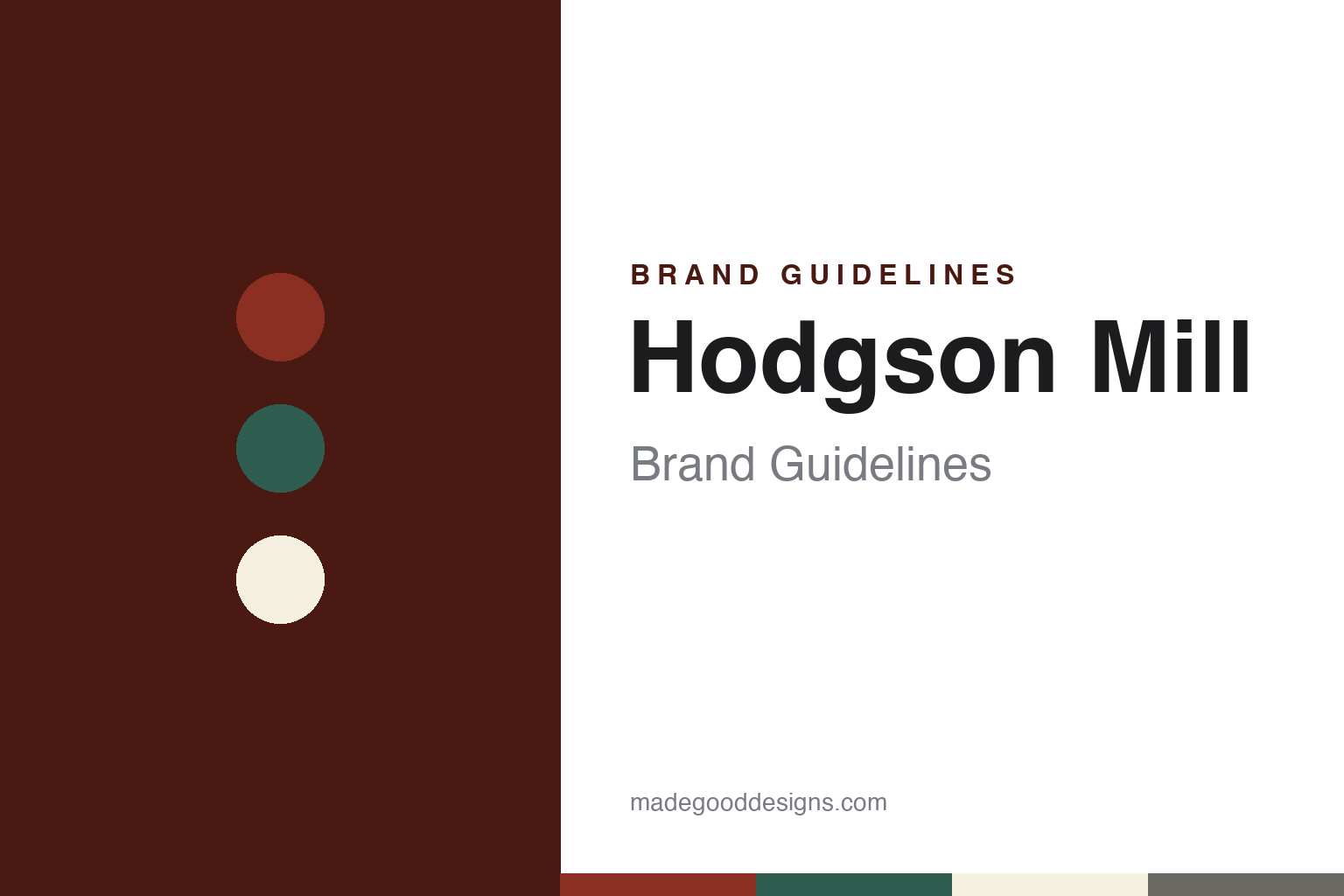
Hodgson Mill Brand Guidelines
A red water mill on an Ozark creek, a stone-ground flour and a logo that kept the building.
Aa
Two constants: a weatherboard red, creek green and flour cream palette and a sturdy slab serif register. Abstract homage — not a Hodgson Mill product or mark; no package, building image or logo is reproduced.
A mill on Bryant Creek
A spring, a creek in the Missouri Ozarks and a family of millers.
Hodgson Mill is an American brand of stone-ground flours, cornmeal, cereals and baking mixes, owned today by the New York company Hudson River Foods. The name belongs to a real building. The Hodgson-Aid Mill, also known as Hodgson Water Mill and Aid-Hodgson Mill, is a grist mill on Bryant Creek near the community of Sycamore in Ozark County, Missouri. English Wikipedia, drawing on the mill’s National Register of Historic Places nomination of 2001, describes a timber-frame mill covered with red-painted weatherboards, set beside a man-made mill pond and a limestone barrel vault where Hodgson Spring flows out at the base of a cliff.
The site was milled before the Hodgsons arrived. English Wikipedia says that in the early 1860s a settler named William Holeman built a water mill on or near the site, and that the mill was closed during the Civil War. The brand’s own timeline puts the start of the original mill site in 1837 and says a mill at the site was burned down during the war, in 1861.
The family name arrived in the 1880s. According to English Wikipedia, Alva Hodgson and his mother, Mary Elizabeth Hodgson, bought the mill in 1884 from Manuel and Elizabeth Smith, the parents of Alva’s future wife. Alva planned a new mill able to produce white or “patent” flour with roller mills and steel water turbines, and the encyclopedia dates the completion of the new building to around 1897, citing a local newspaper notice of November that year. The company tells the story differently: its timeline says that in 1882 “Master Millwright Alva Hodgson” built the water mill.
The mill was a local centre as well as a factory. English Wikipedia says the building housed a general store and the Sycamore post office, with a sawmill and a cotton gin, and that farmers came to have corn and wheat ground and to buy and sell crops. Alva’s brother George Hodgson bought a share around 1897 and became sole proprietor in 1901. Alva went on to build the nearby Dawt Mill, completed in 1909, then returned to work with his brother; he installed a dynamo to light the mill and imported buhrstones from the French Pyrenees for stone-grinding flour. George ran the mill until 1927.
Other owners and millers followed. English Wikipedia says Fred O. Foster owned the mill from 1927 to 1934, when it was bought by the businessman Charles Theodore Aid; it stayed with the Aid family until 1998, which is why it became known locally as the Hodgson-Aid or Aid-Hodgson Mill. From 1949 the miller Fred Leach leased it, sold flour and corn meal through wholesalers and welcomed visitors with picnic tables, campsites and a gift shop. From 1963 to 1969 the Harold Stott family ran it and widened the range to cornmeal, cereals and several flours.
Colour
The Harringtons, Gainesville, Siemer Milling, Effingham and Hudson River Foods.
The company that carries the name today began in 1969. English Wikipedia says Ken and Teena Harrington, antiques enthusiasts visiting the area, came across the property that year and took over the lease. They initially sold antiques and ran canoe rentals on the creek, and offered flour in their store; as demand grew they incorporated the business as Hodgson Mill, Inc. and sold its products to wholesalers and grocers. The company’s own timeline also dates the name Hodgson Mill, Inc. to 1969.
The old building could not keep up. English Wikipedia says the Harringtons installed more buhrstones and bought a site in the industrial park at nearby Gainesville, Missouri, where they built a modern production plant. Production moved there in 1976. Since then, the encyclopedia says, no large-scale production has taken place at the original mill, which has run intermittently as a tourist attraction. The mill itself followed a separate path: later owners Hank and Jean Macler stabilised its foundation, repaired flood damage and registered it on the National Register of Historic Places, which listed it in 2002, and it was sold in 2011 to the preservationists John and Gwen Deakle.
The brand moved out of Missouri under a new owner. The Ozark County Times reported on 3 January 2018 that Siemer Milling Company had bought the Hodgson Mill company in 1988, and that the new owner eventually moved production to Effingham, Illinois, leaving the Gainesville building vacant. Siemer later gave that building to a local nonprofit development committee, and the paper reported that it now housed a plastic-recycling business, Ozark Vinyl, alongside the Ozark County Food Pantry. The company’s timeline records a move to a new facility in 2006, the opening of a Hodgson Mill Mercantile shop in Effingham in 2014 and an education centre for cooking classes in 2015.
The latest change of ownership came in 2019. The Effingham Daily News reported on 4 June 2019 that Hudson River Foods, a New York health food maker, had acquired Hodgson Mill about three weeks earlier, according to a spokesperson for the buyer. The paper said production had moved to Castleton-on-Hudson, New York, that the Effingham plant was for sale and that the Mercantile had closed. Hudson River Foods has owned Hodgson Mill since 2019, and its own website, read in October 2026, lists Hodgson Mill among its brands.
Typography
Design and documentation.
The brands in this group sit on a familiar run of grocery shelves: the boxed side dish and meal helper, the bag of flour and the bag or pod of coffee. Each of these packs is bought quickly and often, and each has to say what is inside, how to use it and whose name stands behind it within a few seconds at the shelf.
A boxed mix carries its identity on a printed carton, usually with a photograph of the finished dish and short instructions on the back. A flour bag is mostly plain paper or film, so its name, colour and type of flour do much of the work. A coffee bag, can or pod carries its name alongside the roast and the grind, and the same mark may also appear on a café sign or a brewing machine.
The names behind these packs have often changed hands. Each guide therefore separates what independent, dated sources record from what the company says about itself — its founding story, its owners over time, where its products are made and how its packaging has changed — and marks plainly what rests only on the company’s own word.
Aa
A sturdy slab serif — the woodblock, general-store register of a creekside grist mill. (Specimen set in Bitter, a slab serif STAND-IN; NOT the Hodgson Mill logo.)
A building in the logo
A red mill, a spring, French buhrstones and a name that outlived three locations.
Hodgson Mill’s central visual asset is a building. The company’s timeline says Alva Hodgson built “the sturdy water mill you see in our logo”, so the mark points back to the structure on Bryant Creek rather than to an abstract symbol. English Wikipedia’s description of that structure, drawn from its National Register nomination, gives the details a designer would notice: a timber frame, red-painted weatherboards, a mill pond and a spring issuing from a limestone vault at the foot of a cliff. Those are the elements we have abstracted into the palette for this guide.
The method is part of the identity too. The company’s website presents its range as stone-ground flours, cereals and baking mixes, and the history of the mill supplies the backstory for that phrase. English Wikipedia records that Alva Hodgson imported buhrstones from the French Pyrenees for stone-grinding flour, and that the Harringtons added more buhrstones to meet demand before production left the creek in 1976.
The building’s afterlife has kept the name in public view. The mill was listed on the National Register of Historic Places in 2002, according to English Wikipedia. The company’s own story still leads with that setting, describing a small water-powered mill in the Missouri Ozarks; its timeline is built around the creek, the Civil War, the Hodgson brothers and the Harringtons rather than around the later factories.
Those later locations show how far a brand can travel from its picture. Production went from the creek to an industrial park in Gainesville in 1976, according to English Wikipedia; to Effingham, Illinois, under Siemer Milling, according to the Ozark County Times; and to Castleton-on-Hudson, New York, after the 2019 sale, according to the Effingham Daily News.
For a design guide, Hodgson Mill shows how a real building can serve as a logo and a backstory long after production has moved to other states. Compare it with Anson Mills, another American milling brand, and Gold Medal, a flour brand born in a nineteenth-century Minneapolis mill. For this guide we use weatherboard red, creek green, flour cream and millstone grey with a slab serif, an unofficial interpretation; no product or logo is reproduced.
Explore & save
Keep Hodgson Mill’s identity on hand — save it to a board in the Made Good inspiration library.
Hodgson Mill identity set
Pin the Hodgson Mill weatherboard red, creek green and flour cream palette and the sturdy slab serif register to your own board.