Jays Brand Guidelines
A Chicago chip that changed its name in a hurry and kept its blue-and-white tin.
Aa
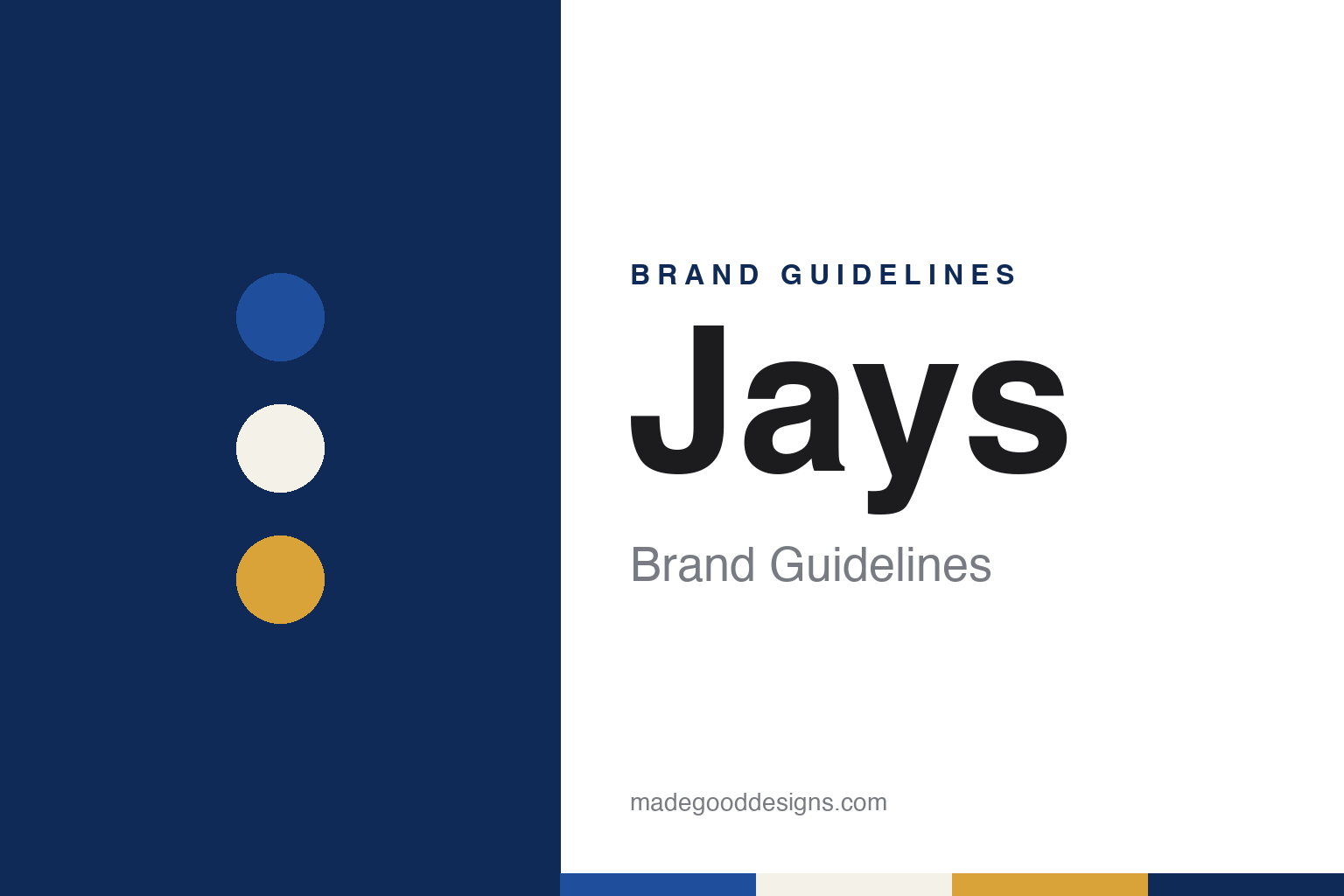
Two constants: a tin blue, tin white and fried gold palette and an upright script register. Abstract homage — not a Jays product or mark; no bag, tin or logo is reproduced.
A truck, a partner and a wife’s recipe
Pretzels from a truck in 1927, then chips under a family name.
Jays is a brand of potato chips from Chicago, sold mainly across the American Midwest and owned today by The Campbell’s Company. The name looks as if it belongs to a person, but it does not. The Made in Chicago Museum, which researches the city’s past manufacturers, pointed out in an article published in October 2018 that there never was a “Jay”, and that the Jays logo has no apostrophe. The brand was named in a hurry, to replace a family name.
That family was the Japps. English Wikipedia says Leonard Japp Sr. began selling pretzels from a truck in 1927, and that the business grew to feature a potato chip recipe made by his wife, Eugenia. The museum gives a fuller account of the same year: it says Japp and a friend, George Gavora, started their first food business in 1927, buying an old truck to sell pretzels, nuts and cigarettes, and that the firm, known as the Japp & Gavora Food Co., had grown by 1929 before the stock market crash put it back at the start.
The chips came out of a second partnership. English Wikipedia says that after the crash Japp found a new partner, George Johnson of Chicago, and began selling the chips under the brand name “Mrs. Japp’s Potato Chips”. The museum dates this more closely. It says Japp formed the Special Foods Co. with Johnson, a former Kraft salesman, in 1938; that the firm began as a distributor of many kinds of food; and that, with chips selling well, the partners bought an automatic chip-making machine and moved into a factory at 40th Street and Princeton Avenue. There, the museum says, they launched Mrs. Japp’s in 1940, fried in corn oil rather than lard.
Eugenia Japp stayed close to the brand. The museum describes her as the company’s executive vice president and credits her with putting recipes that used the chips on the backs of Jays containers, among them a potato chip tuna casserole. The family name on the bag did not last.
Colour
Pearl Harbor, Borden, a buyback, Snyder’s of Hanover and Campbell’s.
The renaming followed the attack on Pearl Harbor. English Wikipedia says that the 1941 attack, and the anti-Japanese feeling that followed in the United States, gave the name Japp’s an unwelcome sound, so the chips were rebranded Jays Potato Chips and the company became Jays Foods, Inc. The Made in Chicago Museum quotes Leonard Japp telling the Chicago Tribune in 1985 that grocers began calling at once to ask for the chips to be taken out of their stores. In the same interview, the museum says, he explained that he had wanted the name “Jax”, but a brewing company already had it, while “Jays” was available, and that for a couple of weeks the company put tags bearing the new name on plain bags.
The museum says the partners went their separate ways in 1944, when Japp and Johnson each wrote a bid to buy the other out and Japp’s bid was the higher; Special Foods ended and Jays Foods continued under the Japp family. In the mid-1950s, the museum says, Jays opened a large plant at 99th Street and Cottage Grove on Chicago’s South Side, and the factory became a regular stop for school field trips.
The family sold in the 1980s and then returned. English Wikipedia and the museum both say Jays Foods was family-owned until 1986, when it was sold to Borden, Inc., and that the Japp family bought the company back in 1994. In 2004, English Wikipedia says, Jays was bought by Willis Stein & Partners, a Chicago private-equity firm, and placed with Lincoln Snacks under a parent company called Ubiquity Brands. Jays Foods filed for Chapter 11 bankruptcy protection on 11 October 2007, according to English Wikipedia.
A new owner followed within weeks. A press release from Snyder’s of Hanover, the pretzel maker from Hanover, Pennsylvania, reprinted by the trade site PotatoPro on 7 December 2007, said Snyder’s had officially acquired Jays Foods on Tuesday, 4 December, after a bankruptcy auction in Chicago on 30 November. Snyder’s said it would continue to produce Jays Potato Chips, Krunchers! kettle chips and O-Ke-Doke popcorn. The release said the 99th Street plant had been leased from a third party and that the bulk of production had already been shifted to a plant in Jeffersonville, Indiana, by the previous management. Carl E. Lee, then president and chief executive of Snyder’s of Hanover, was quoted saying the company was pleased “to keep the Jays’ tradition alive in Chicago”.
Snyder’s itself then changed shape. English Wikipedia says Snyder’s-Lance was formed by the 2010 merger of Lance Inc. and Snyder’s of Hanover, and lists Jays among its brands. Campbell Soup Company announced on 26 March 2018 that it had completed its acquisition of Snyder’s-Lance, in a release carried by PotatoPro, and said it would combine Snyder’s-Lance with Pepperidge Farm in a U.S. snacking unit called Campbell Snacks. Campbell’s has owned Jays since that acquisition; the parent company has been known as The Campbell’s Company since November 2024, according to English Wikipedia. The old jaysfoods.com address now leads to Campbell’s Campbell Snacks page, which shows Jays and Krunchers! among its brands.
Typography
Design and documentation.
The brands in this group are American sweets and regional potato chips: boxed chocolates, jelly beans, cinnamon candies, marshmallow shapes and chips sold mainly in the cities where they began. Brands of this kind sit at very different points in the trade, from family companies that still carry a founder’s name to labels that have passed through several owners, and a single name can be sold everywhere from a corner shop to a supermarket aisle.
A candy or chip brand’s identity is usually carried less by one product than by a box, a bag, a seasonal pack and a name, because the company behind it may have changed hands, moved its production or grown well beyond the place where it started. Candy boxes and holiday packs return each year with familiar colours, while a regional chip bag often leans on the city it comes from. That makes the plain questions worth asking: who started it, who owns it now, and where it is made.
Each guide separates what independent sources record from what the company says about itself — its founding story, its owners over time, where its products are made and how its packaging has changed — and marks plainly what rests only on the company’s own word.
Aa
An upright, looping script — the friendly, hand-lettered register of a mid-century chip tin. (Specimen set in Lobster, a script STAND-IN; NOT the Jays logo.)
A tin, two slogans and a back-of-pack recipe
A blue-and-white cylinder that outlived its contents.
The Made in Chicago Museum, which holds one in its collection, says the blue-and-white Jays potato chip tin was a common sight in grocery stores and kitchen cupboards from early on, and that its design changed little from the 1940s into the 1950s and 1960s. The museum says many people kept the tins after the chips were gone and used them as waste baskets or storage bins, so plenty stayed in circulation after boxed and bagged versions replaced the one-pound tin.
The tin carried a slogan, “A Better Chip for the Better Trade”, according to the museum, which names Jays’ other main line as “Can’t Stop Eatin’ ’Em”. The museum also reproduces an early-1940s Jays advertisement painted on a building, promising chips that were “Always Fresh, Crisp & Tasty!”, and says Jays sometimes gave away collectibles in its bags. The same article credits Eugenia Japp with the recipes printed on the backs of the containers.
The name itself was a practical choice. As Leonard Japp told the Chicago Tribune in 1985, according to the museum, “Jays” was picked because it was available when “Jax” was not, and for a couple of weeks the new name went onto plain bags as tags.
Under later owners the name stayed while the products around it grew. The Snyder’s of Hanover release of December 2007 grouped Jays with Krunchers! kettle chips and O-Ke-Doke popcorn, and English Wikipedia lists ridged and flavoured Jays chips alongside those lines. Campbell’s Campbell Snacks page, where the old Jays web address now leads, places the brand next to Snyder’s of Hanover pretzels, Kettle Brand chips and Goldfish crackers.
For a design guide, Jays shows how a regional brand can survive the loss of its founding name, several changes of owner and the closure of its home plant while a short name and a familiar colour pair stay in place. Compare it with Pepperidge Farm, its fellow Campbell Snacks brand, and Lay’s, another American potato chip named after its founder. For this guide we use tin blue, tin white, fried gold and South Side navy with a script, an unofficial interpretation; no product or logo is reproduced.
Explore & save
Keep Jays’s identity on hand — save it to a board in the Made Good inspiration library.
Jays identity set
Pin the Jays tin blue, tin white and fried gold palette and the upright script register to your own board.