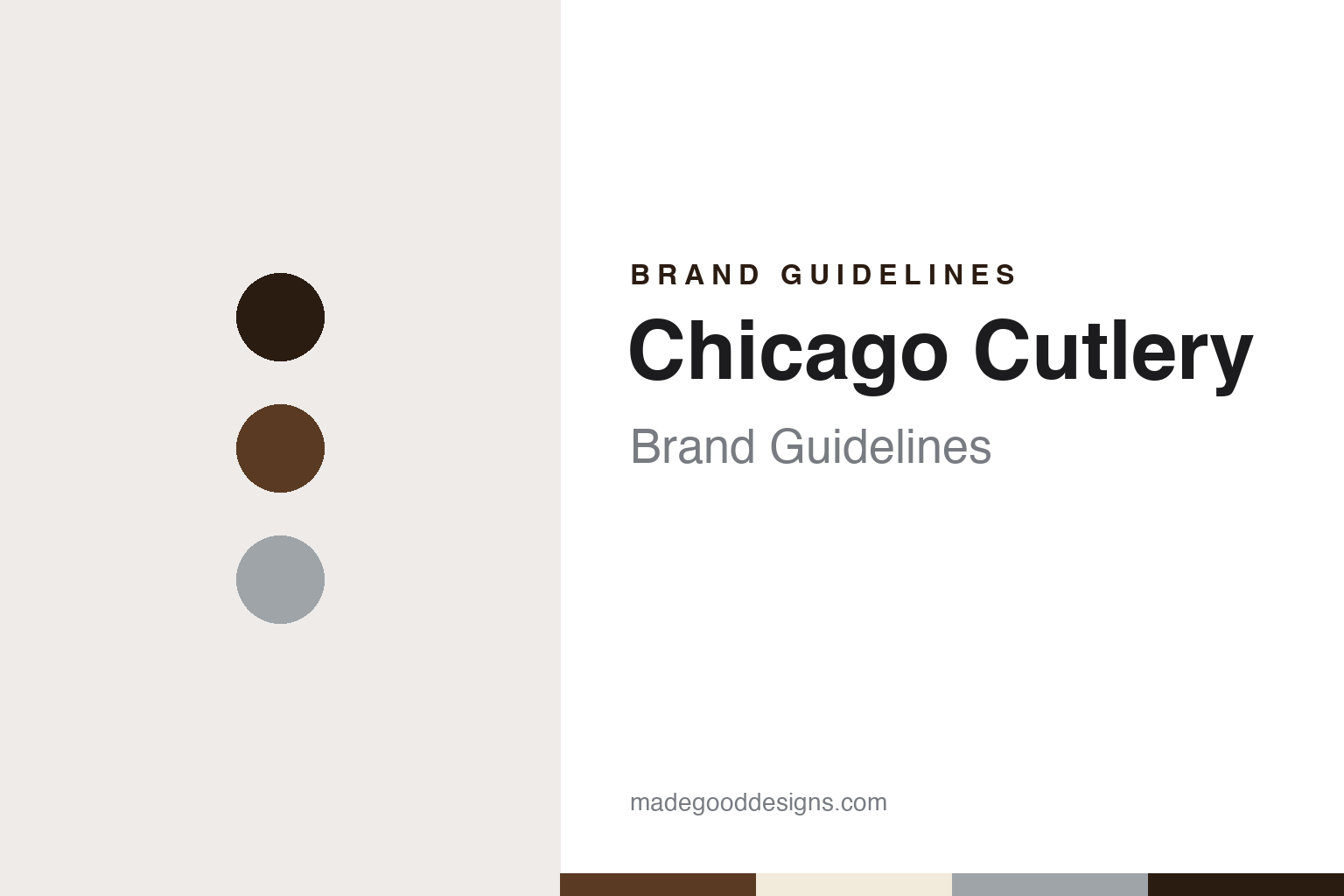
Chicago Cutlery Brand Guidelines
A trade knife name carried through a chain of owners.
Aa
Two constants: a walnut brown, steel grey and butcher paper palette and a workshop sans register. Abstract homage — not a Chicago Cutlery product or mark; no knife, block or logo is reproduced.
Trade knives
Two dated beginnings and a city name.
Chicago Cutlery’s beginnings are given with two dates. English Wikipedia’s article on Corelle Brands, the company that sells the knives today, says Chicago Cutlery was incorporated in 1930 by Alfred Paulson, and that it began in knife conditioning before making the manufacture of kitchen cutlery its main business. The entry on General Housewares Corporation in the International Directory of Company Histories, republished online by FundingUniverse, credits Ronald J. Gangelhoff with founding Chicago Cutlery in the 1960s to supply meat-packing houses with knives.
The directory entry says Gangelhoff’s company built its business on knives for meat packers and helped build a consumer market for kitchen knives in the United States, and that this was the business General Housewares later bought.
The brand reached General Housewares in 1988. The directory entry describes the purchase as an important step in General Housewares’ recovery after losses in the mid-1980s, and says Gangelhoff sold the company to General Housewares and took a seat on its board as vice chairman. In the same entry, Chicago Cutlery Inc. appears as a principal subsidiary of the group.
General Housewares itself had been founded in 1967 by Jack Muller, a former General Foods marketing executive, the directory says, and had built its business on enamel cookware before adding knives. In 1967 it bought J.R. Clark, a Minnesota maker of outdoor furniture, ladders and ironing boards; the company then turned to enamel cookware, and in 1979 it introduced the Magnalite Professional line of cast aluminium and magnesium skillets and bakeware. Its shares began trading on the New York Stock Exchange in June 1982. In June 1990, the entry says, it moved its corporate offices from Stamford, Connecticut, to Terre Haute, Indiana, into the same building as one of its enamelware factories.
Colour
General Housewares, World Kitchen and Corelle Brands.
Under General Housewares, Chicago Cutlery sat beside the brands that defined the group in the 1990s. The directory entry says the company bought OXO International, the New York maker of Good Grips kitchen tools, in October 1992, and added the Olfa Products business, distributor of Olfa cutting tools in the United States and Canada, in October 1994. In January 1996, it says, the company put its Magnalite and Wagner cast cookware lines up for sale to concentrate on four businesses: OXO, Chicago Cutlery, Granite Ware enamel-on-steel cookware and Olfa.
In 1999 General Housewares passed to the Corning Consumer Products Company, the housewares business spun off from Corning Incorporated in 1998. Corning had already sold its European, Russian, Middle Eastern and African consumer products businesses to Newell in November 1994, Wikipedia says. English Wikipedia’s Corelle Brands article, citing the company’s annual report for 2000, says it bought General Housewares and the Chicago bakeware maker Ekco that year. The business took the name World Kitchen in 2000, and Chicago Cutlery became one of its brands beside Corelle, CorningWare and Pyrex. World Kitchen filed for Chapter 11 reorganisation in 2002, and in June 2004 it completed the sale of OXO to Helen of Troy.
The owner changed names again. Wikipedia says private equity firm Cornell Capital took control of World Kitchen in April 2017, and that on 5 February 2018 the company renamed itself Corelle Brands. On 4 March 2019 it agreed to merge with the maker of the Instant Pot, and the combined company traded as Instant Brands from Downers Grove, Illinois. Instant Brands filed for Chapter 11 in June 2023; its appliance business was sold, and on 27 February 2024 the housewares business left bankruptcy under the Corelle Brands name. Wikipedia says the private equity firm Centre Lane Partners, which acquired Corelle Brands in 2024, then transferred it to Anchor Hocking, another company it owned.
Through these changes Chicago Cutlery has kept its own name. In October 2026 the chicagocutlery.com address led to a Chicago Cutlery page on the Corelle website, selling knife block sets and steak knives under collection names such as Malden and Insignia Steel.
Typography
Design and documentation.
Cookware reaches most people through a shop shelf before it reaches a stove, so a pan’s identity is carried first by its packaging. A box or sleeve usually shows the piece from above or at an angle, names the range and the collection, and gives the brand a fixed corner where the logo sits from one product to the next. Colour on the box often signals the range rather than the company, which lets one maker run several lines side by side without each one looking like the others.
Smaller printed pieces carry the name once the box is gone. Hang-tags and card wraps travel with pans sold loose on a rail, while the underside of a pan or the end of a handle may carry a stamped or cast mark that stays with the piece for as long as it is used. Those small marks are where a name is most often seen at home.
Each guide in this group sets out who started the brand, who owns it now and how its name has been presented, and separates what independent sources record from what the company says about itself.
Aa
A workshop sans — the register of a trade catalogue and a knife-block label. (Specimen set in Libre Franklin, a sans-serif STAND-IN; NOT the Chicago Cutlery logo.)
Chicago Cutlery
A place name that outlasted its owners.
The Chicago Cutlery identity rests on its name. It names a city and a product category in two words, and it has stayed on the knives through a sequence of owners: the founding company, General Housewares from 1988, the Corning Consumer Products business from 1999, World Kitchen, Corelle Brands, Instant Brands and Corelle Brands again.
The trade origin is part of the record. Wikipedia starts the story with knife conditioning, and the International Directory of Company Histories starts it with knives for meat-packing houses; kitchen cutlery for home cooks came later in both. Under General Housewares the brand shared a portfolio with OXO kitchen tools, Granite Ware enamel cookware and Olfa cutting tools, and under World Kitchen and Corelle Brands with Corelle dinnerware, CorningWare and Pyrex.
On the Corelle website in October 2026, Chicago Cutlery appeared as one of the group’s brands, with its knife block sets and steak knives sold through the same online shop as the group’s dinnerware and bakeware.
For a design guide, Chicago Cutlery shows how a plain place name, chosen for a business serving trade buyers, can hold a brand together through several decades of corporate change. Compare it with OXO, which sat in the same General Housewares and World Kitchen portfolios until 2004, and Corelle, the dinnerware name its owner adopted in 2018. For this guide we use walnut brown, steel grey and butcher paper with a sans, an unofficial interpretation; no product or logo is reproduced.
Explore & save
Keep Chicago Cutlery’s identity on hand — save it to a board in the Made Good inspiration library.
Chicago Cutlery identity set
Pin the Chicago Cutlery walnut brown, steel grey and butcher paper palette and the workshop sans register to your own board.
