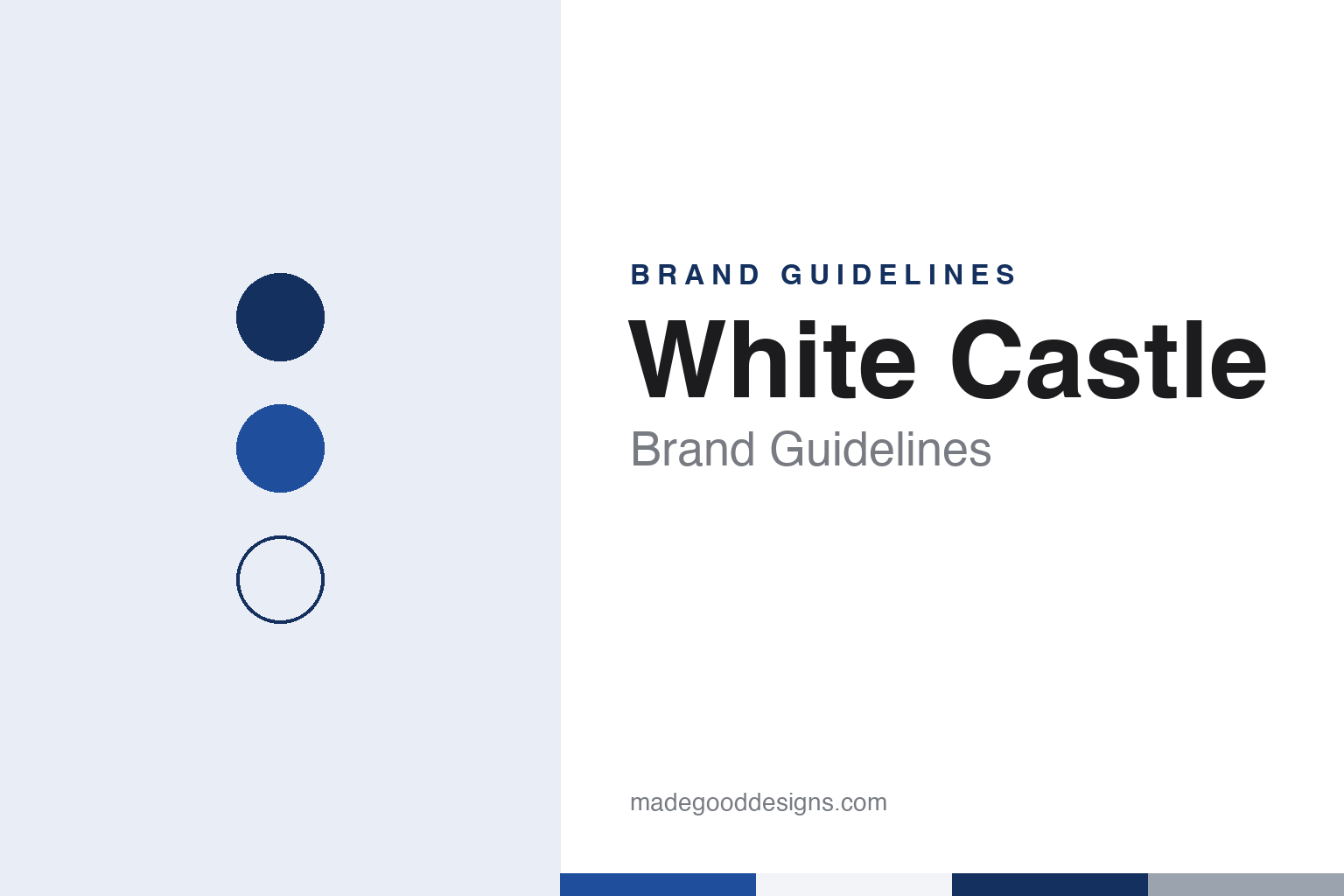
White Castle Brand Guidelines
The Wichita hamburger stand named for purity and permanence.
Aa
Two constants: a castle blue, porcelain white and steel grey palette and a carved battlement serif register. Abstract homage — not a White Castle product or mark; no building, box or logo is reproduced.
Purity and permanence
A cook, an insurance man and a name chosen for what it signified.
White Castle was founded in 1921 in Wichita, Kansas. English Wikipedia says Walter A. Anderson, a cook, had been running food stands in the city since 1916, and was planning another when he met Edgar Waldo “Billy” Ingram, an insurance and real-estate man; together they started the chain. The International Directory of Company Histories (2001) gives the same sequence in its key dates: Anderson’s hamburger stand in 1916, the first White Castle in 1921, and incorporation in 1924 as the White Castle System of Eating Houses Corporation. Wikipedia places the first restaurant at the northwest corner of First and Main in Wichita, a building that no longer stands, and dates the first move beyond the city to El Dorado, Kansas, in 1922.
The name was chosen for what it said. The company directory records that Ingram, addressing the Newcomen Society in Columbus, explained that “White” signified purity and cleanliness and “Castle” represented strength, permanence and stability. The founders’ stated aim, in the same account, was to overcome public prejudice against the hamburger by serving it in clean and sanitary surroundings, and they adopted a motto to match: serve the finest products, for the least cost, in the cleanest surroundings, with the most courteous personnel.
Wikipedia frames that choice against its time. Upton Sinclair’s The Jungle (1906) had left many Americans wary of ground beef, so the founders built small restaurants with stainless-steel interiors and dressed staff in spotless uniforms. The building and the uniform were made to carry the same message as the name.
The company also talked to itself. Wikipedia says an internal employee magazine began around November 1925, first called The Hot Hamburger and later the White Castle Official House Organ, renamed at some point The Slider Times. The Ohio History Connection holds an archive of White Castle System records from 1921 to 1991, including issues of the house organ.
Colour
Columbus, Paperlynen, Porcelain Steel and four generations of Ingrams.
White Castle built its own supply chain, including the things its staff wore and the buildings they worked in. The International Directory of Company Histories dates the Paperlynen company to 1932, formed to make the paper hats worn by White Castle workers; Wikipedia says Ingram developed a device to produce the hats and that the subsidiary went on to make other paper products. In 1933, the directory says, Anderson sold his interest in the company to Ingram, and in 1934 the company relocated to Columbus, Ohio, which remains its home.
The same year brought the Porcelain Steel Building Company. The directory says Ingram had hired L. W. Ray in 1928 to patent a movable restaurant unit — a response to landlords reluctant to lease small plots for long — modelled on Chicago’s Water Tower, with a metal frame and siding, battlements and turrets in white porcelain. The 1934 subsidiary was set up to manufacture Ray’s buildings and much of the company’s kitchen equipment. Wikipedia says the company headquarters and the Porcelain Steel Buildings division are still in Columbus.
The chain has stayed in one family. Wikipedia says Billy Ingram was followed as head of the firm by his son E. W. Ingram Jr. and his grandson E. W. “Bill” Ingram III. Nation’s Restaurant News reported on 22 December 2015 that Bill Ingram would retire at the end of that year and that his daughter, Lisa Ingram, would take over as the fourth generation of the family to lead the company. Wikipedia describes White Castle as a private company whose restaurants are company-owned, with franchising only briefly in Japan in the 1980s and in China from 2017.
Wikipedia records the first Las Vegas restaurant, on the Strip, on 27 January 2015, the first in Arizona in 2019, and a return to Florida with an Orlando restaurant that opened on 3 May 2021, timed to the company’s centenary. It also says White Castle began test-marketing frozen hamburgers through grocery stores in Denver and Indianapolis in May 1986, which carried the box and the name onto supermarket shelves far from the restaurants.
Typography
Design and documentation.
A quick-service brand is met first from the road. Before anyone reads a menu, the identity has to work on a pole sign seen from a moving car, on a roofline or a painted wall, and on the lane markings that steer a driver towards the order point. Building colours, awnings and lit lettering do much of that work, and a chain’s buildings are often designed so that one looks like the next.
The drive-thru adds its own set of surfaces: the preview board, the menu board beside the speaker post, the canopy over the window and the directional signs in between. Each has to be read quickly, often at night and in poor weather, which tends to favour short words, heavy lettering and strong contrast between type and background.
Inside the bag the identity carries on in smaller pieces — wrappers, boxes, cups, napkins and bags — printed in a limited set of colours and repeated across many outlets. Uniforms, trays and receipts follow the same palette.
Each guide that follows looks at who founded the brand, who owns it now and how its name, mark and buildings are recorded, and marks plainly what rests only on the company’s own word.
Aa
A carved battlement serif — the register of a parapet and a porcelain panel. (Specimen set in Cinzel, a serif STAND-IN; NOT the White Castle logo.)
White Castle
A name that is also a building.
The White Castle identity is unusual because the name describes the architecture. The restaurants were literally white and literally castle-like, and for decades the company made the buildings itself. Wikipedia, citing an Indiana historic-sites nomination, says Indianapolis White Castle #3, built in 1927, had an exterior of white enamel-glazed brick and an interior of enamelled steel, and that the company built in that style from 1924 to 1929. White Castle Building No. 8 in Minneapolis, built in 1936, used prefabricated white porcelain enamel on steel; Wikipedia gives it a footprint of 28 by 28 feet and says it was designed to resemble the Chicago Water Tower, with octagonal buttresses, crenellated towers and a parapet wall.
The look was widely copied. Wikipedia lists imitators that borrowed the architecture and the naming pattern, from Little Kastle in Wichita to names that swapped “Castle” or “White” for another word, and it includes Krystal among them.
The small square hamburger is part of the same system. The company directory dates the five-holed patty to 1949, and Wikipedia says the burgers are sold in boxes of 20, 30 and 100 under names such as the Crave Case. The 2004 film Harold & Kumar Go to White Castle built its plot around a trip to one of the restaurants, and Wikipedia says a full-size outlet was built in Caledon, Ontario, for the production.
Ownership is the other constant. The Ingram family has run the company since Anderson sold his share in 1933, and White Castle System, Inc. has kept its headquarters in Columbus since 1934.
For a design guide, White Castle shows how a name, a colour and a building can be designed as one idea and then manufactured in-house for decades. Compare it with Krystal, the Chattanooga chain whose founder studied White Castle in Chicago, and McDonald’s, whose arches turned a building into a sign. For this guide we use castle blue, porcelain white and steel grey with a serif, an unofficial interpretation; no product or logo is reproduced.
Explore & save
Keep White Castle’s identity on hand — save it to a board in the Made Good inspiration library.
White Castle identity set
Pin the White Castle castle blue, porcelain white and steel grey palette and the carved battlement serif register to your own board.